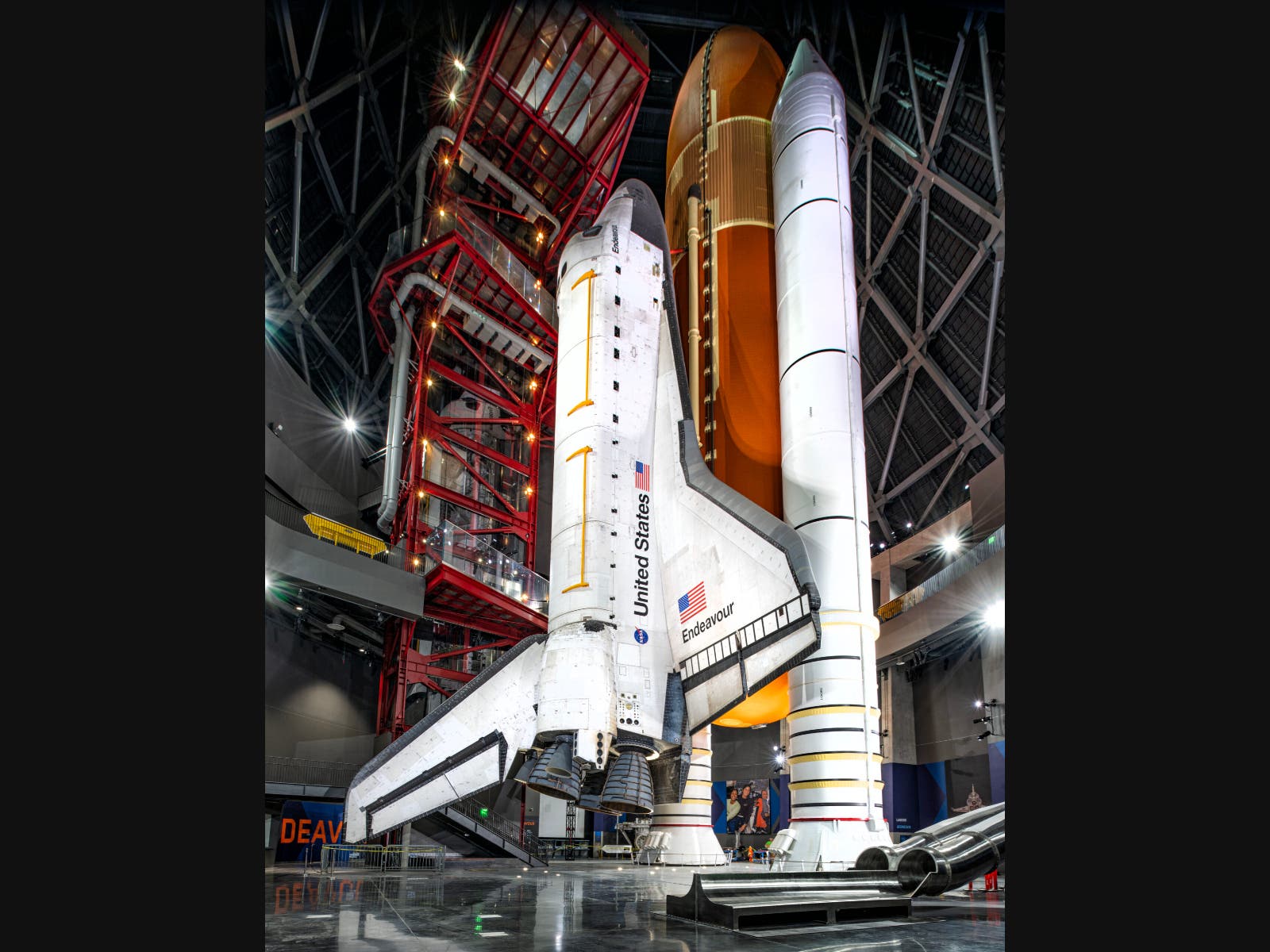
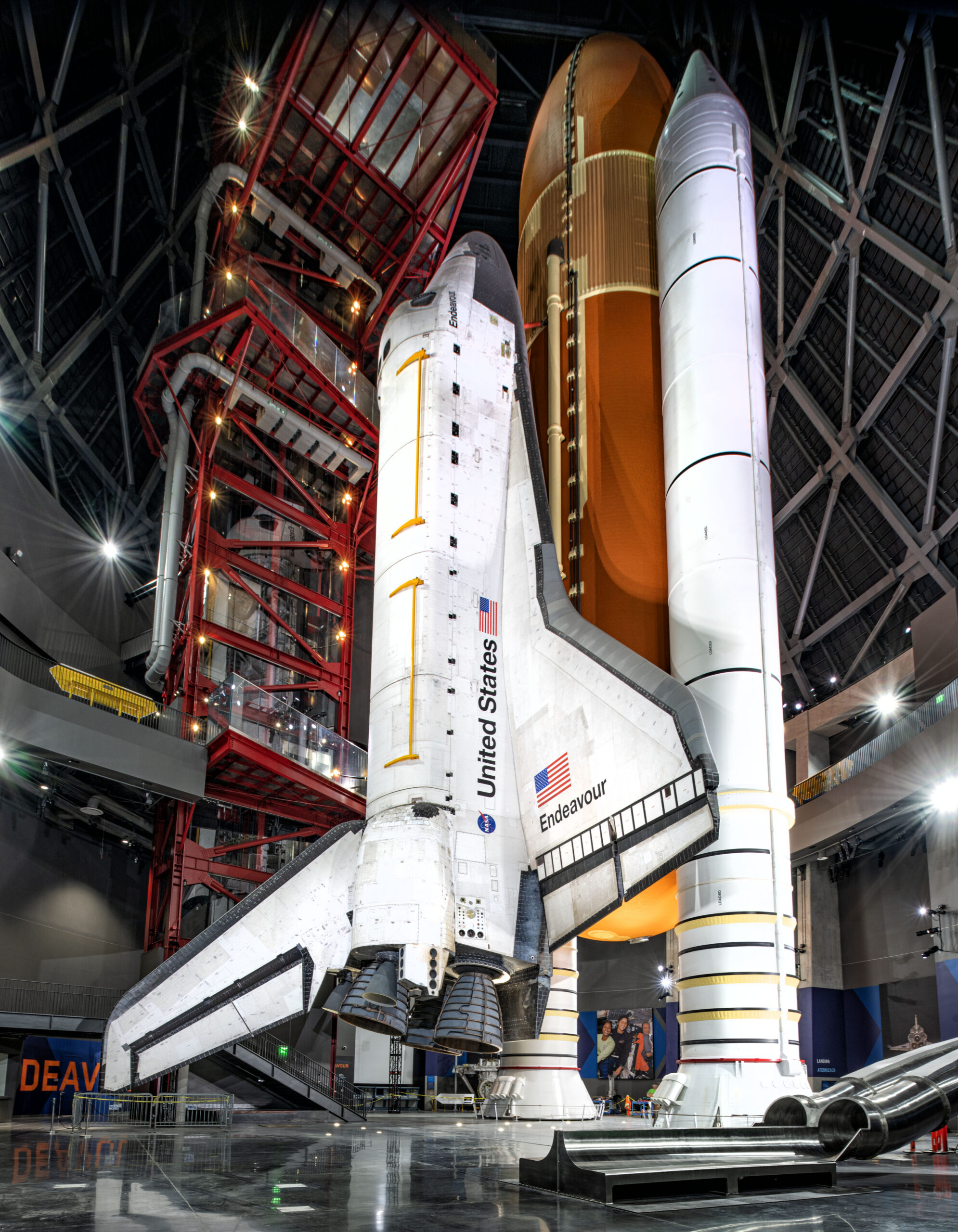
The Samuel Oschin Air and Space Center is the third major museum to open in Los Angeles this year, and with its intense focus on the science and fascination of flight, it’s strikingly different from the other two. While the Los Angeles County Museum of Art and the Lucas Museum of Narrative Art may be identified and defined by their sculptural architecture and eclectic offerings, the space center is distinguished by the singular presence of an actual space shuttle: the white, heat shield–clad Endeavour, which stands imposingly nose-up in launch position, embraced by two solid rocket boosters and attached to a massive, seemingly flight-ready orange fuel tank.
The scene is awesome: The Endeavour resides in its own enclosure, a conical, nearly 200-foot-tall gallery that soars out of the space center. The facility becomes the welcoming entry and paramount addition to the existing California Science Center in a now-cluttered Exposition Park, south of downtown Los Angeles. It’s a fitting home, commemorating the region’s long dominance in the development of the aerospace industry.
Find out what's happening in Malibufor free with the latest updates from Patch.
Once inside, the visitor’s experience is made even more dramatic, first by being ushered into an entry hall to watch a short introductory film, a sharply edited montage of pre-launch scenes of the Endeavour’s final flight: astronauts entering the poised shuttle while its booster engines are ignited, all replete with rumbling sound effects. And then, as the screen goes dark, fabricated smoke seeps into the viewing area as you’re escorted a few steps farther into the lofty central gallery to behold the space-scarred vehicle itself.
Personally, I found the experience of seeing the shuttle to be deeply moving, evocative, and even unsettling, since the Endeavour (as visitors are informed) was the successor to the ill-fated Challenger, whose disastrous end I witnessed at the Houston Command Center 40 years ago. I was there on that fateful day of January 28, 1986, as the design critic of the Los Angeles Times, writing a story on the shuttle design as a space station for extended habitation, which was one of several experiential tasks that was to be performed on the Challenger mission.
Find out what's happening in Malibufor free with the latest updates from Patch.
Invited into NASA’s amphitheater, I watched the Cape Canaveral, Florida, liftoff on two big television screens, to a chorus of cheers from the flight specialists at their work stations. About a minute into the flight, the vehicle exploded. There was an abrupt silence, then screams from the assemblage, as the capsule, in flaming pieces with tails of smoke, hurtled across the sky and into the sea, killing its seven-member crew.
The screams turned into sobs I still hear, along with the echo of the specialist I stood behind, who stared at a blank computer screen in front of him and repeated, in a cracked voice, “Do we have a downlink? Do we have a downlink?” (Tech talk for communication with the crew.) The phones started ringing, and I was abruptly escorted out of the center to the press room by a NASA employee, who was in tears, as I was.
I dutifully filed my story, “Cheers to Tears,” which ran on the front page of the next day’s Times with the banner headline “SPACE CENTER TRIUMPH TURNS TO TRAGEDY.” Emotionally drained by the scenes at NASA, I returned to Los Angeles, exhausted, feeling that design did not seem quite as important as it had before.
Jumping from rock to rock in a journalistic river, as a reporter, correspondent, and critic, one tends to put such experiences deep into memory. But the authenticity of the Oschin Space Center exhibit resonated with me.