Restaurants & Bars
On Second Sip: 5 Judgment of Paris Things We Think We Know—And Don’t Quite
A list of five "on second sip" stories about the "Judgment of Paris, the May 24, 1976 tasting whose legacy continue 50 years later.


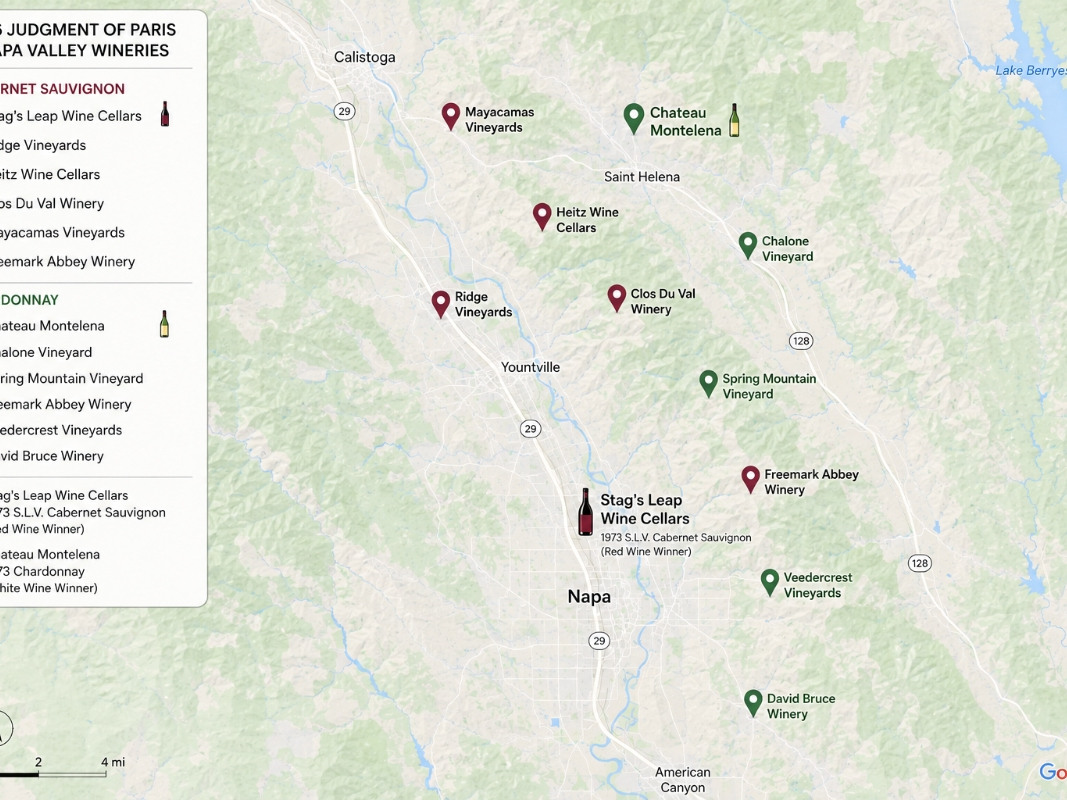
History, like good wine, is complex . The impact of May 24, 1976 tipped into history later, not during the event itself. Retellings of what came to be known as The Judgment of Paris — especially in the 2008 film "Bottle Shock" — helped cement the event's significance in popular imagination. But the film also introduced distortions for dramatic effect. Here are a list of five "on second sip" stories about that day 50 years ago. A fuller telling is, well, a longer story that you'll find here.
1. On Second Sip: “The Big Paris Showdown That Changed Everything in One Dramatic Night”
Glass-half-full story: What came to be known as the Judgment of Paris was a grand, historic duel in Paris that rewrote the wine world in a single sitting.
In the cellar, the record shows: The tasting felt more trade salon than global spectacle. It wasn’t staged as destiny. As master sommelier Andrea Robinson said in The Swirled Cup, the Judgment of Paris was important but it was a tipping point — not the whole point.
2. On Second Sip: “Napa Put Napa on the Map”
Glass-half-full story: Napa rises alone, crowned by Paris. From the vineyard ledger: The breakthrough is more geographically tangled—and Sonoma County is the missing layer that keeps getting erased.
Find out what's happening in Napa Valleyfor free with the latest updates from Patch.
The Napa Chardonnay that won in 1976 was made by Château Montelena, but, as wine consultant Karen Hannah pointed out, the grapes were from Sonoma County via the Bacigalupi Vineyard on Westside Road in Healdsburg.
So the “Napa moment” was really a North Coast moment wearing a Napa label.
Find out what's happening in Napa Valleyfor free with the latest updates from Patch.
3. On Second Sip: “The Tasting Was About Wine, Full Stop”
Glass-half-full story: A pure sensory competition.
From the global cellar door: It became an economic and cultural accelerator.
The tasting influenced:
- land value speculation
- global branding of Napa
- rise of critic scoring systems
- consolidation of stylistic preferences
So the event didn’t just rank wines—it helped define the rules of the modern wine economy.
4. On Second Sip: “The Movie Got the Story Mostly Right”
Glass-half-full story: Hollywood dramatization with minor embellishment.
From the film reel of memory: Films reshaped structure, people, and even who gets seen in the story of the Judgment of Paris.
Bottle Shock (2008), starring Alan Rickman as Steven Spurrier and Chris Pine, helped cement the Judgment of Paris in American popular imagination, but it also introduced distortions for dramatic effect. Steven Spurrier later objected strongly, saying:
“There is hardly a word that is true in the script… It’s deeply insulting. They are depicting me as an impossibly effete snob.”
He also threatened legal action over the film’s portrayal, underscoring how contested the story remained decades later.
5. The Closing Sip
The impact of May 24, 1976 continues. But California wine was being produced in Napa by the mid-19th century, when early vineyards were planted. The earliest Anglo settlers planted more vineyards and sold wine to San Francisco restaurants.
What gets lost in that cinematic reshuffling is that the transformation of California wine wasn’t driven by a single dramatic tasting or a handful of heroic figures—it was the cumulative result of French influence, immigrant labor, UC Davis science, and local vineyard supply networks that predate the spotlight and outlast the myth.
Add to that a generation of women and organizers whose roles were foundational but often under-credited in popular retelling.
So the “1976 turning point” is less a starting gun and more a late-stage reveal of a system already rebuilding itself across decades of quiet work, uneven credit, and partially erased contributors.
Get more local news delivered straight to your inbox. Sign up for free Patch newsletters and alerts.