Schools
LAUSD Allowed an Unapproved Charter Program. Families Could Pay the Price.
Without receiving authorization, CWC launched a virtual program. LAUSD didn't intervene, and students are now left without safeguards.


“Breaking the law, breaking the law”
- Judas Priest
When José Cole-Gutierrez was caught lying to his bosses on the LAUSD School Board in 2023, many assumed it would mean the end of his LAUSD career. This was especially true since, as a result of his reassigning special‑education classrooms to charter operators under false pretenses, children with special‑education needs were forced to receive services in stairwells and storage closets.
Find out what's happening in Northridge-Chatsworthfor free with the latest updates from Patch.
Instead, he was promoted.
The same LAUSD bureaucrat who strategized with the charter‑school industry to give these publicly funded private schools rooms once used for special‑education services, art education, and parent centers is now the district’s Senior Executive Director of Strategy. When voters elected pro‑public‑education candidates to replace the school‑board majority aligned with charter interests, they expected the new board to insist that problematic staffers be replaced, not elevated.
Find out what's happening in Northridge-Chatsworthfor free with the latest updates from Patch.
With the school board showing it will not force the Superintendent to hold district staff accountable for acting against the best interests of Los Angeles students, the Charter Schools Division under Cole‑Gutierrez dug in deeper. Despite promising transparency, the spreadsheet detailing how much overallocation fees charter schools still owe has not been updated since 2024. At that time, these schools owed LAUSD students at least $2,899,721 for taking more space in district facilities than they were entitled to.
At El Camino Real Charter High School, the lack of accountability has resulted in a relentless parade of scandals. After forcing out its “Executive Director” and other members of the school’s leadership team without explanation, the school is now enmeshed in yet another scandal, once again involving its athletic coaches.
Still, other charter schools are willing to test the waters to see how far adrift of the law they can go before the Charter Schools Division and its new director, Marla Willmott, take notice. The Citizens of the World nationwide chain of charter schools falls into this category.
When looking for examples of problematic operators in the charter‑school industry, many watchdogs cite Citizens of the World schools. This chain’s actions in New York were so egregious that the state’s regulators shut it down. For a school whose mission supposedly centers on building citizenship, its administration has been alleged to be difficult partners at co‑located school sites. At one campus, tensions became so heated that parents actually came to blows.
The school has now branched out into where the real charter money is: real estate. Disregarding the safety of its young students, Citizens of the World purchased a site that had previously housed a gas station and sat adjacent to a busy freeway off‑ramp. However, after sustained pushback from their own community, they were forced to abandon the project.
Owning an abandoned lot now publicly viewed as a possible toxic hazard cannot be good for the bottom line. Facing a potential hit to its balance sheet, the charter school chain has embarked on a new scheme: virtual schooling.
Staffing costs are usually the largest component of any education system’s budget, and having students largely engaged in “independent” study, reducing teachers to supervisors, allows virtual schools to employ fewer staff overseeing far more students. Not having students on campus eliminates the need for physical space, which is typically the next‑largest expense. These schools also gain access to a much larger pool of potential students, since attendance is no longer limited by proximity to a school building.
Successfully participating in an independent‑study program requires the student to have a high level of self‑discipline and an above-average ability to learn without direct instruction. Their family must also be able to provide consistent oversight to compensate for teachers who typically oversee far more students than would be found in a classroom. Since these conditions are beyond the reach of most students, it is not surprising that studies across multiple states have shown these programs produce poor academic outcomes. In California, virtual schools are consistently identified as underperforming compared to brick‑and‑mortar schools.
As a result of these failures and documented instances of massive financial fraud, California passed AB 130, which imposed a moratorium on approving these types of schools beginning in 2021. However, after lobbying from the charter school industry, this restriction was allowed to expire last summer, allowing new virtual schools to be approved in the state.
This gave Citizens of the World a path they could have taken to get approval for a virtual program. However, it does not appear that it ever applied to open a new virtual school as part of their chain. Nor have they received a material revision that would authorize them to operate a virtual program as part of their existing schools.
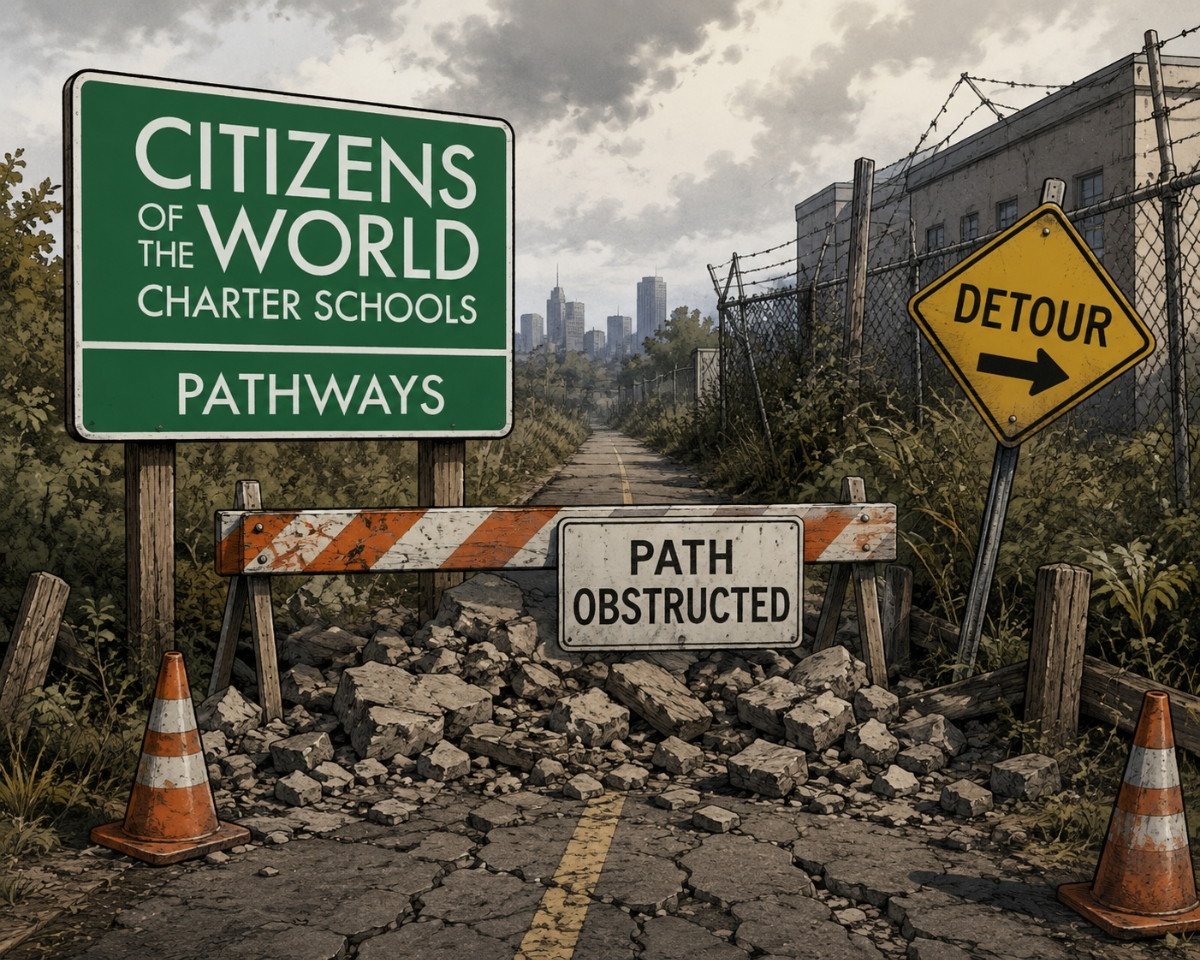
Yet, the charter school chain is advertising that they have opened enrollment for their “CWC Pathways,” a “self-study program that brings the Citizens of the World experience to families across California.”
By sidestepping the approval process, the charter chain has avoided specifying for regulators exactly how they will run the program. Therefore, there is no way of knowing exactly what safeguards will be put in place to ensure that students enrolled in “CWC Pathways” are being educated as expected when California taxpayers are paying the bill. Has the school planned for the things that can go wrong, including:
- Students who lack the maturity or ability to study independently and fall behind, something that can happen very quickly.
- Students whose special education needs are not met and, therefore, lose the ability to receive a Free Appropriate Public Education (FAPE) as required by law.
- Families who are overwhelmed by the demands of the program or whose circumstances change, resulting in their child’s academic progress falling behind.
Without any documentation being approved, the LAUSD's Charter School Division will be unable to hold the school accountable if things go sideways. The district says they put “kids first,” but it will be the children who will suffer if the program fails. They will be the latest victims of a bureaucracy that gives priority to the adults running charter schools.
The elected members of the Board of Education need to act immediately and demand that the Pathways program be shut down until it has been properly vetted. Unfortunately, given the board’s history, this is unlikely to happen.
In the end, if the board won't act, the failure won't be Citizens of the World's alone. It will also belong to a district that ignored the risks and chose not to demand better.
Carl Petersen is a former Green Party candidate for the LAUSD School Board and a longtime advocate for public education and special needs families. Now based in Washington State, he writes about politics, culture, and their intersections at TheDifrntDrmr.