Crime & Safety
Beverly Hills PD brings Hollywood sci-fi to the streets to fight crime
"The Real Time Watch Center keeps officers safe and ensures we police efficiently so we can identify the suspect much more quickly."

By Elysse James
Not long ago, when the Beverly Hills Police Department received a 911 call about a theft in progress in the city, Motor Officer Joel Givens would have turned on his lights and siren and headed quickly toward that location.
By the time he located the victim, the suspect would be gone. Givens would interview the store owners, employees, and customers to gather a description and the direction the suspect headed. But precious minutes would be lost gathering that information. The officers would do their best to find the suspect, setting up a perimeter and broadcasting a description over their radios.
Find out what's happening in Orange Countyfor free with the latest updates from Patch.
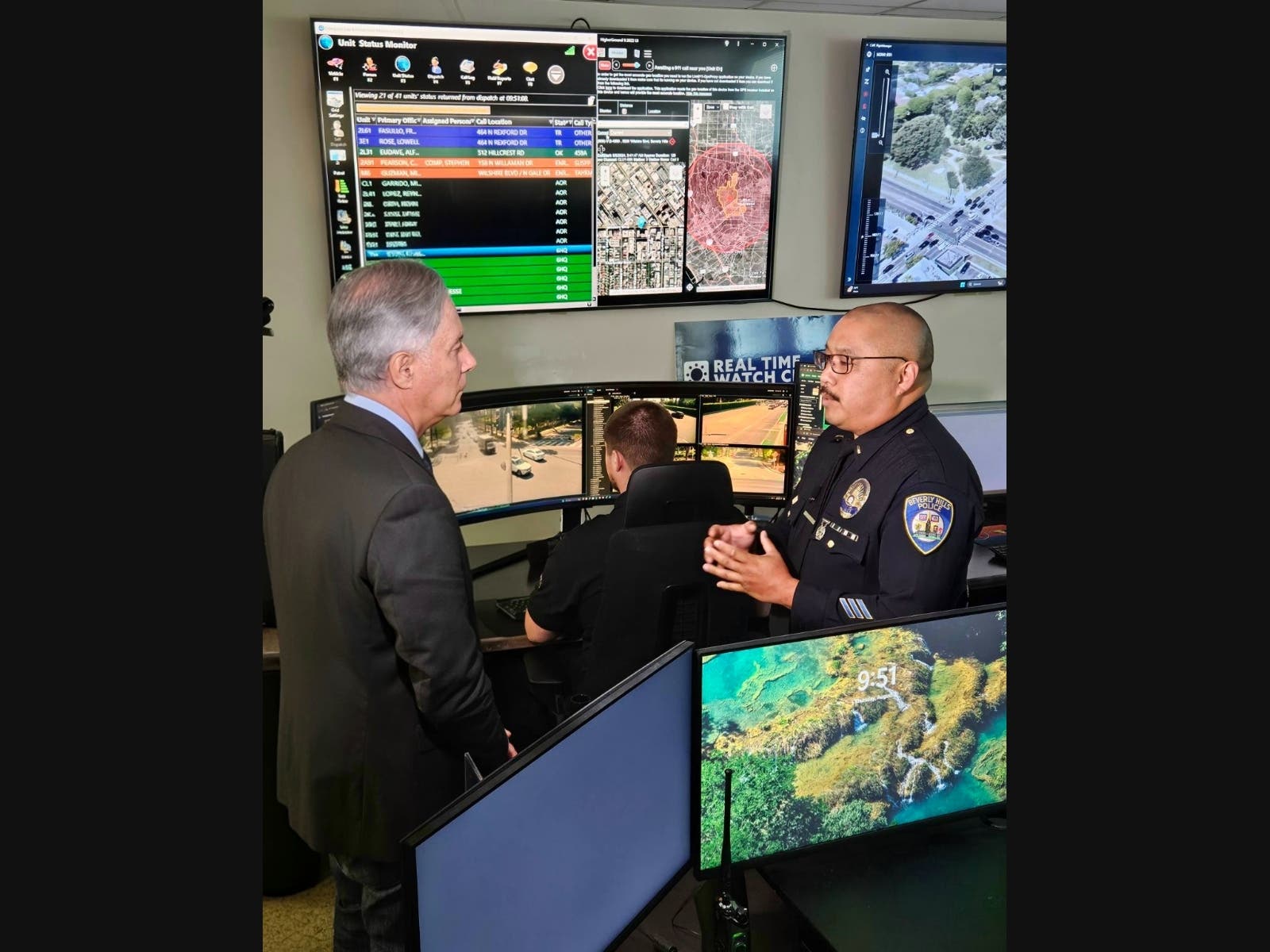
But now, thanks to new technology and mobile phone data, dispatchers can pinpoint an exact location within seconds. Without leaving the station, Virtual Police Officers can view incident footage from one of the 3,800 video cameras across the 5-square-mile city, rewind to the time of the incident, and provide officers en route with a detailed, accurate suspect description.
Then, a drone can keep eyes on the suspect until officers arrive. If the suspect flees in a vehicle, automated license plate readers on patrol cars and 116 fixed readers throughout the city help track the suspect and identify stolen vehicles. Geospacial mapping shows officers exactly where the suspect is in real time — no more guessing or relying on passersby.
Find out what's happening in Orange Countyfor free with the latest updates from Patch.
“The Real Time Watch Center keeps officers safe and ensures we police efficiently so we can identify the suspect much more quickly,” Beverly Hills Police Chief Max Subin said. “It’s a de-escalation tool… cutting edge for a small department like ours. The technology is incredible.”
All this technology combines to give Beverly Hills police an advantage in stopping crime and making arrests. From January to March 2026, burglary decreased by 50 percent, larceny/theft by 25.96 percent, and motor vehicle theft by 71.43 percent, all compared with the same period in 2025.
“It’s precision policing through technology,” said Lt. Eugene Kim, who has served with the Beverly Hills Police Department for 15 years and in law enforcement for nearly 27 years. “We redefined what response time means. Now, for us in our center, response time is my ability to see you, which could be seconds.”
On the cutting edge
Beverly Hills Police Department’s Real Time Watch Center is a sophisticated hub that integrates precision GPS tracking, citywide video feeds, integrated drone response, and digital evidence to revolutionize how police prevent, respond to, investigate, and solve crimes.
“We're a very innovative agency. We move very quickly, and at the end of the day, we have an administration and leadership that help us do all this,” said Kim, who has been at the forefront of this evolution. “That's not something you find in every agency, and that's why it's unique.”
The Real Time Watch Center has become a model for law enforcement nationwide. Kim is a former board member, former Southwest United States Director, and current member of the National Real Time Crime Center Association. He served as an Innovations Director, and is a founding member of the California Real Time Workgroup, which shares best practices and ways to use new technology across agencies.
“We are at the cutting edge,” Subin said. “Our Real Time Watch Center has revolutionized law enforcement in the country and internationally.”
“It really is an honor to be in that kind of position, with all these agencies coming to us for guidance,” Kim said. “It's quite remarkable.”
Eyes in the sky
The technology is evolving quickly. When the Drone as First Responder program started, drone pilots were stationed in the department at a desktop computer. Each time the drone flew, a person would launch it from the roof of a tall building, said Givens, who is also a drone pilot for the department.
“Now, drones take off from inside boxes, and nobody has to launch them,” Givens said. “They land on their own, charge their batteries on their own, and are far more autonomous. I can only imagine what it’ll be like in the next 15 years.”
As a motor officer, Given often handles stolen vehicles, theft, and burglaries, in addition to pulling over cars traveling at dangerous speeds.
“If somebody stole something, I say, ‘Do you know what city you are in?’,” Givens added. “Usually, a drone is overhead. And I say, ‘You picked the wrong city. This is the wrong place to do what you’re doing.’”
Not only are drones safe and available to assist officers, but they also vary in size. Smaller interior drones can be used to give officers detailed information on spaces such as the inside of a house while officers are serving a search warrant, providing a look at the layout, closed doors, dogs, and potential for hidden people. Alternatively, the drone can fly inside a vehicle, storage container, or other confined space and broadcast the video to officers before anyone puts themselves in danger.
“You’re flying under tables, looking under beds, and behind shower curtains to provide perspective and the ability to get that information out so officers and the public stay safe,” Givens said. “I think it boosts officer safety immensely.”
The people factor
Even with all the advantages of technology, human input is essential to making the tools effective.
“Technology in and of itself is cool, but if you don't have the right people to move that technology forward, if you don't have the right leaders, it's all for naught,” Kim said. “You need administrators and leadership that will build policies, and you need leadership that's not afraid to set guidelines.”
Collaboration is also important. The department’s digital forensics lab often recovers comprehensive evidence that links suspects to crimes across multiple jurisdictions.
“The same suspects who commit residential burglaries in Orange County today will be in Beverly Hills tomorrow and could be in Ventura County the next day,” Kim said. “If none of those agencies are talking to each other, those criminals are going to walk… and they will continue victimizing more people.”
The odds of a suspect being prosecuted for additional crimes in other jurisdictions are very high, he said.
“I’m always looking to find more efficient, faster, and better ways (of policing),” Kim said. “One of the greatest gifts from going to Beverly Hills PD is that resources are there.”
“We have the best patrol bureau, in my opinion, in the nation. Obviously, I’m biased,” Givens said. “If I didn’t work here and was looking at law enforcement, I would want to work at a place like this because of the quality of information that can be obtained.”