Politics & Government
Billionaires Bankroll Poison Pill Measures To Kill CA's Billionaire Tax If Voters Pass It
Rather than running a "No on Prop. 40" campaign, a well-funded PAC has endorsed ballot initiatives designed to doom the billionaire tax.



SACRAMENTO, CA — California leaders are divided on whether the state's billionaires are paying their fair share. Enter the November 3, 2026, General Election, where a bevy of tax proposals will let state voters decide.
Proposition 40 is the highly discussed billionaire tax, while Propositions 41 and 42 aim to counter the initiative. Proposition 3 also addresses taxes on the state's highest earners.
Here is a breakdown of the four measures:
Find out what's happening in Temeculafor free with the latest updates from Patch.
Propositions 40, 41, and 42
The fight over California's Prop. 40, dubbed the billionaire tax, has garnered massive attention and significant campaign dollars from both supporters and opponents. If passed, the labor union–sponsored initiative would impose a one-time state tax of up to 5% on residents with assets over $1 billion, excluding real estate and certain pensions or retirement accounts. The added tax revenues generated from Prop. 40 would be designated to help fund health care, food assistance, and education programs across the state.
Find out what's happening in Temeculafor free with the latest updates from Patch.
However, even if Prop. 40 receives a majority of votes, its implementation remains uncertain. Building a Better California, a PAC formed earlier this year to oppose Prop. 40, has backed two counter-initiatives — Propositions 41 and 42 — that contain "conflict clauses" designed to void Prop. 40.
Neither counter-measure is explicitly labeled as an anti-billionaire tax initiative:
- Proposition 41 prohibits new state taxes that exclude revenues from the state spending limit approved by voters in 1979, and requires audits for new special taxes.
- Proposition 42 prohibits new state taxes on personal property, including business interests, intellectual property, and financial assets such as retirement or investment accounts.
Both Prop. 41 and Prop. 42, however, contain provision clauses stating that conflicting voter-approved measures on the same ballot become void if Prop. 41 or Prop. 42 receives a higher vote total. Unless Prop. 40 passes with more votes than 41 or 42, it is doomed.
Google co-founder Sergey Brin has contributed millions of dollars to Building a Better California. The PAC is driven primarily by tech-sector figures and high-net-worth donors.
Political alignment on the measure remains split. According to a recent UC Berkeley poll, 80 percent of California Republicans oppose Prop. 40, while 70 percent of registered Democrats support it.
There is division among Democratic leaders. Gov. Gavin Newsom and Democratic gubernatorial candidate Xavier Becerra oppose the billionaire tax, arguing it could push California's wealthiest residents out of state and ultimately hurt revenues. Nine Democratic state lawmakers announced their opposition to Prop. 40 in an open letter to voters, writing that "while well-intentioned, this measure will blow a massive hole in our state budget in the years ahead and undermine our ability to sustain investments in the very priorities Prop 40 claims to support."
Conversely, the California Democratic Party endorsed Prop. 40, arguing that added state revenue is critical to backfill the Trump Administration's federal funding cuts to health care and food assistance programs.
If Prop. 40 passes, California could collect tens of billions of dollars from the wealth tax, though the long-term fiscal outlook remains far less certain, according to the state's Legislative Analyst's Office. If Prop. 42 passes, it would restrict future state options to raise taxes and could reduce overall revenue. The net fiscal impact of Prop. 41 remains unknown, the Legislative Analyst's Office found.
Proposition 3: Extending Progressive Income Tax Rates
Buried by the debate over Prop. 40 is another tax measure for voters. Currently, state income tax rates adjust upward for high wage-earners under a measure approved by California voters in 2012 (Proposition 30) and extended in 2016 (Proposition 55). The progressive tax brackets, which require the wealthiest residents to pay more, are set to expire in 2031. Proposition 3 would make them permanent.
Today, for example, joint filers in California earning up to $22,000 annually pay a 1% personal income tax rate, compared to 12.3% for joint filers earning over $1.5 million per year. Prop. 3 would extend the brackets permanently.
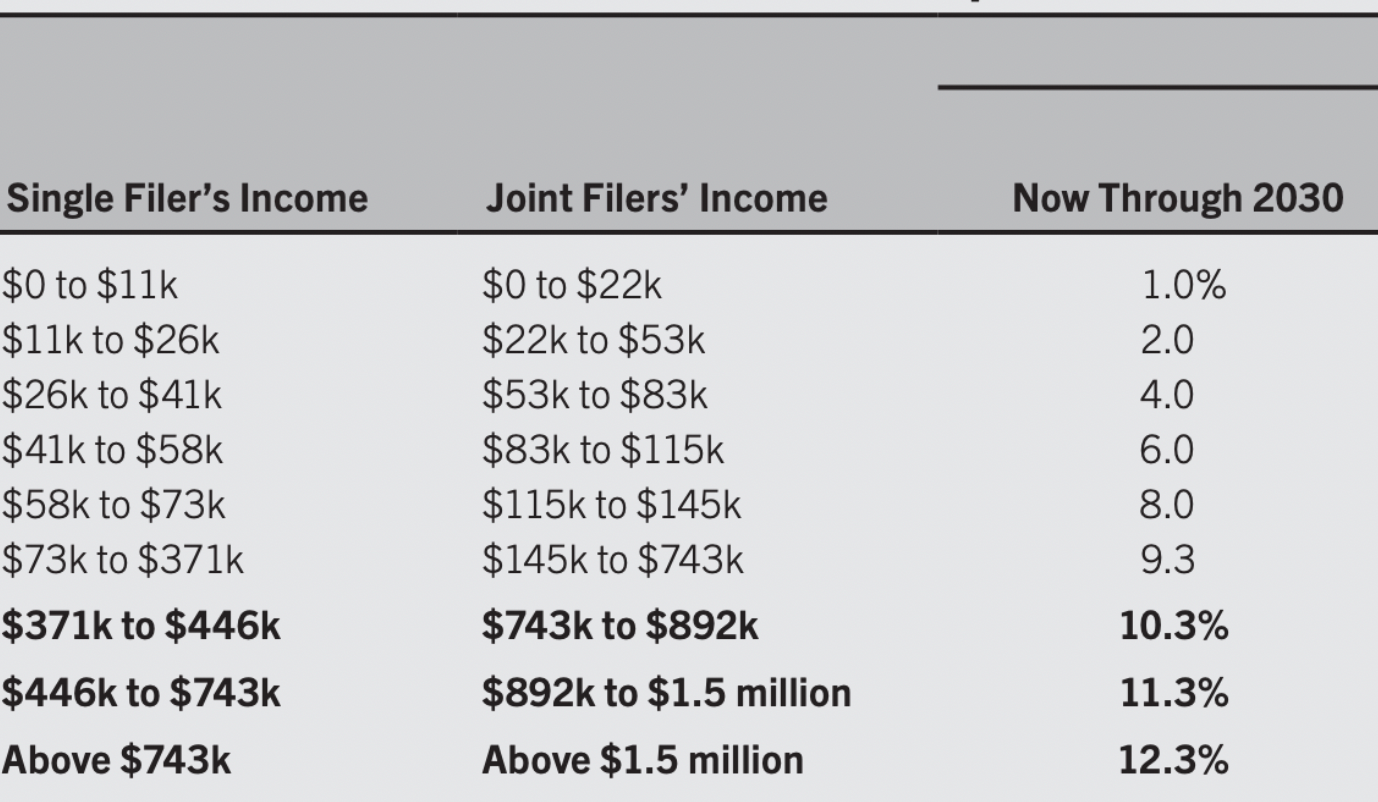
According to the Legislative Analyst's Office, passing Prop. 3 would preserve $5 billion to $15 billion in annual state income tax revenue.
California state income tax is the largest source of revenue for the state's General Fund, supplying nearly half of total state revenue. It pays for public education, health and human services programs, corrections and prisons, higher education, and the general operations of state government and local community assistance.
Proposition 3 maintains broad support among California leaders. Despite the tax implications for high earners, Building a Better California endorsed Prop. 3, stating revenues are needed "to protect funding for our schools and healthcare by maintaining the state’s progressive income tax rates, which the wealthiest 2% have paid for 15 years."
But the measure's opponents argue that Prop. 3 could spur wealthy Californians to flee for lower-tax states, taking jobs and revenue with them. While California did experience a small exodus of wealthy residents following the 2012 passage of Prop. 30, the 2016 passage of Prop. 55 didn't have the same effect.
Despite predictions of mass millionaire flight after the 2016 extension, California's share of million-dollar tax filers actually expanded from roughly 14.9% in 2010 to over 16% in subsequent years.
Election & Voter Resources
For official information regarding ballot measures, voter registration, and polling logistics, consult the following resources:
- California Secretary of State Official Voter Information Guide: Provides complete initiative texts, fiscal analyses, and official arguments.
- California Secretary of State General Election Portal: Offers key dates, registration tools, and official ballot tracking.
Get more local news delivered straight to your inbox. Sign up for free Patch newsletters and alerts.