Politics & Government
Greenwich Calls For Pause On State Zoning Mandates, Drawing Bipartisan Support From Local Officials
Greenwich officials and leaders from neighboring towns called for a pause on state zoning mandates over growing infrastructure concerns.


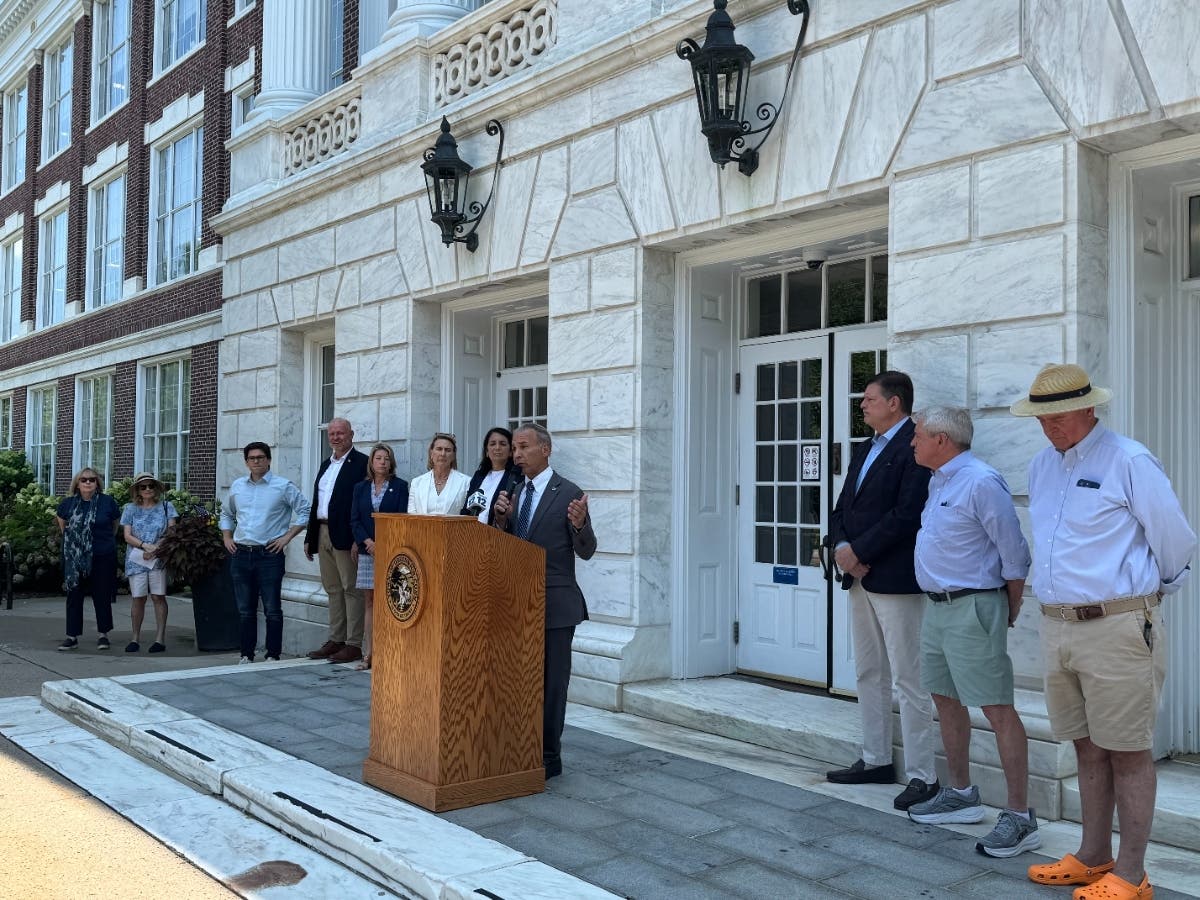
GREENWICH, CT — Greenwich First Selectman Fred Camillo is calling on the state lawmakers to implement a moratorium on zoning mandates, saying utility companies do not have the capacity to meet the growing needs of municipalities across the state.
Camillo was joined last Friday at Greenwich Town Hall by a bipartisan group of elected officials from neighboring towns, who spoke about the need for more infrastructure to support development.
According to Camillo, he has received complaints from residents in the last few weeks who, after they've expanded their homes or built bigger ones, "were told by one of the utilities that they don't have the capacity anymore, it's going to be a lot more expensive, or they can go try propane, which they obviously did not want to do in those circumstances."
Find out what's happening in Greenwichfor free with the latest updates from Patch.
Camillo said he spoke with representatives from Connecticut Natural Gas and Aquarion Water Company, "and they admitted capacity issues."
"I'm calling on the legislature, the state legislature, and Gov. [Ned] Lamont to put the brakes on the mandates," Camillo said.
Find out what's happening in Greenwichfor free with the latest updates from Patch.
"If you want to be sustainable and you want to be able to live here and see these towns grow, we're going to have to do this," Camillo added. "There's no sense passing laws, and then having people file applications and start building and then be told, 'Oh, by the way, it's not going to be for x amount, you're going to have to pay this amount, or you're going to have to do something totally different, or you can't do it.'"
Greenwich's affordable housing rate was at a little over 5 percent in December 2019, and has increased to around 6 percent, with plans to move up to 7 percent in the next couple of years towards the 10 percent mandate outlined in 8-30g.
Camillo said he feared upcoming affordable housing projects could be stalled as a result of capacity issues from utility companies.
State Rep. Hector Arzeno (D-151) said Friday that without more infrastructure, it would be "impossible" to complete new affordable housing units in the future in Greenwich.
State Rep. Tina Courpas (R-149), who represents Greenwich and Stamford, pointed to HB 8002, a sweeping housing law passed during the November 2025 special legislative session. The goal of the bill is to increase housing production —particularly affordable housing — while encouraging municipalities to plan for future growth.
"Aren't there master engineers in Hartford crunching numbers late at night to figure out exactly what our utilities can support? Is that a 5 percent, 10 percent, 20 percent increase? Doesn't all that work happen before our state passes laws?" Courpas said, criticizing the process leading up to the passing of the bill.
"I don't know, as we sit here, whether our infrastructure can support the mandate set forth in 8002. But I can tell you that our process is flawed. It was undemocratic and it lacked public input," she said.
Darien Selectman Monica McNally was at Friday's press conference on behalf of First Selectman Jon Zagrodzky and the Darien Board of Selectmen.
Darien has seen a boom in development in recent years.
"We're here because the state's well-intentioned push for more housing doesn't take into consideration all of the impact on local infrastructure that will need to be done," she said, expressing a need to look at the impact development has on transportation, roads, utilities, schools and first responders.
"Doesn't it make sense to first take a look at the necessary infrastructure before adding development, and wouldn't that make the housing that is put in place more successful, lessen the impact on the current residents, and keep their services, and reduce shortages for them?" McNally continued. "Fairfield County is heavily populated, and more development will definitely bring more people. But we should have the infrastructure to support that."
New Canaan First Selectman Dionna Carlson referred to the powerful storms that moved through the area earlier in the week, which brought massive flooding to parts of Fairfield County.
"Adding significant infrastructure, housing infrastructure, is only going to exacerbate those problems," she said.
State Rep. Steve Meskers (D-150), whose district covers the Greenwich shoreline, said he was concerned about a lack of adequate infrastructure.
"You know, if we decide to move to a larger restaurant industry on Greenwich Avenue, well, you're going to have demands on power and water.
If you decide to build larger individual houses, if you decide to build aquatic facilities, ice skating rinks, all these things have demands on our infrastructure," he said.
State Sen. Ryan Fazio (R-36), who is running for governor, called for relief "from the unfunded mandates from our state government imposing on our towns and cities."
"Across towns, across parties, we understand that these mandates layered one on top of another- 8-30g, House Bill 8002, and so much more- are putting a burden on our towns and cities that want to do the right thing and want to expand access to housing in our state," Fazio said. "And that's something I don't just hear in Southwestern Connecticut with our more well-resourced towns and cities, and our greater density; it's something I hear from the most rural and low-income towns across the state."
Other speakers Friday included state Rep. Tracy Marra (R-141) and state Rep. Tom O'Dea (R-125).
In an emailed statement to Patch on Monday, a spokesperson from Aquarion said:
"Aquarion does not have capacity issues. Rather, the issue is managing peak water demand, which is being driven by increasing irrigation usage year after year. In addition, all proposed developments must go through Aquarion’s 'will serve' review process to confirm that adequate water service can be provided."
Connecticut Natural Gas also provided a written statement to Patch on Monday.
CNG spokesperson Angela Baccaro said:
"As part of ongoing engineering reviews, CNG identified that some large new service requests in Greenwich could affect the long-term reliability of service for existing customers if additional infrastructure investments are not made. Maintaining system reliability for customers remains our highest priority. The Greenwich gas distribution system has evolved over decades and CNG has continually invested in the system, however, recent growth has occurred at a faster pace than historical trends. Utilities throughout Connecticut are facing similar challenges driven by aging infrastructure, changing customer demand patterns, and evolving energy needs.
Addressing these challenges requires thoughtful planning and continued investment in critical utility infrastructure. In collaboration with Greenwich, CNG has already begun planning system reinforcement projects and identifying the most effective infrastructure solutions to address both near-term reliability needs and the town's longer-term growth objectives."
Greenwich is planning to hold a forum with utility companies in September at Town Hall.
Get more local news delivered straight to your inbox. Sign up for free Patch newsletters and alerts.