Neighbor News
dae Launches CT’s First Quantum Computing Program for HS Students
daeZERO introduces the core concepts, tools, and applications shaping the quantum era
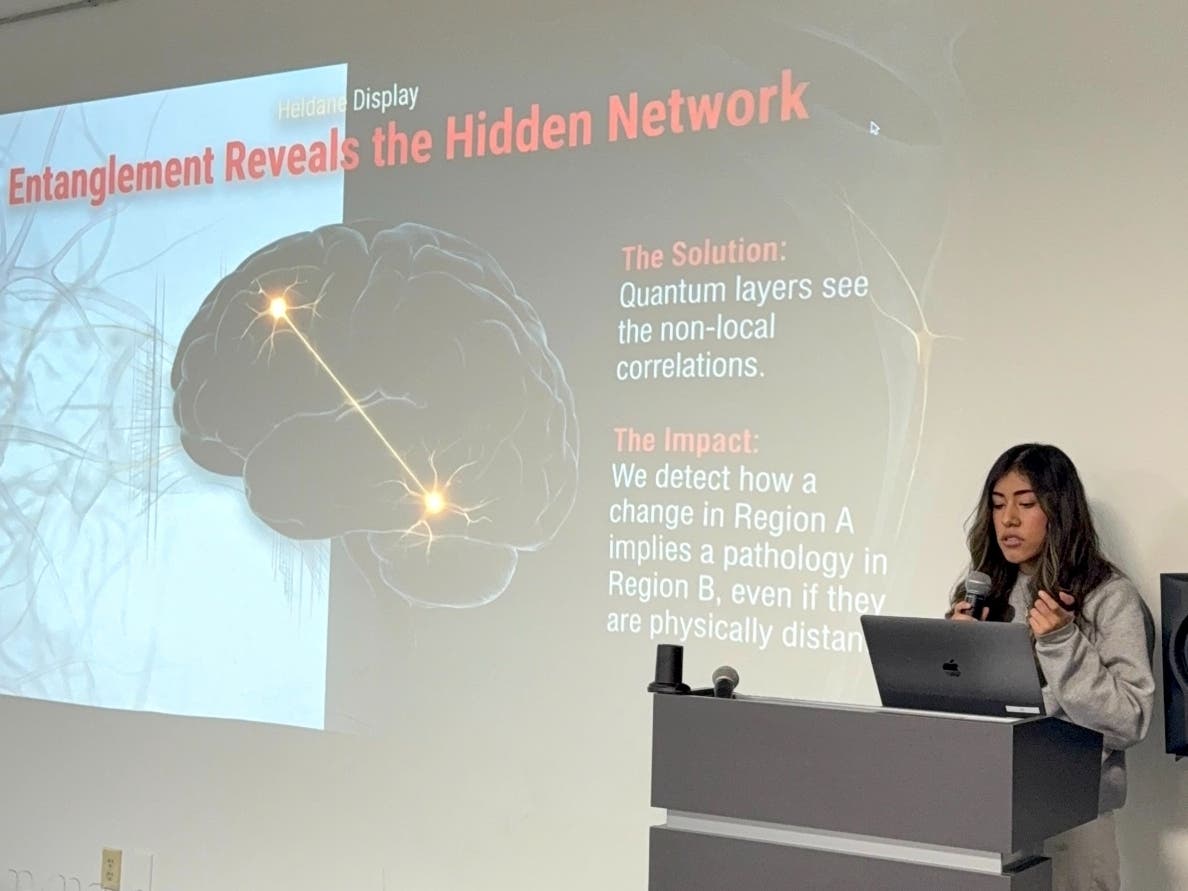


dae, a nonprofit redefining tech education through human connection and hands-on learning, recently completed the first cohort of daeZERO, Connecticut’s first quantum computing program designed specifically for high school students. One of only a few such programs nationwide, the tuition-free, immersive initiative introduces public school juniors and seniors to the core concepts, tools, and applications shaping the quantum era.
The inaugural cohort brought together students from multiple New Haven Public Schools, including Achievement First Amistad High School, Engineering & Science University Magnet School, High School in the Community, Cooperative Arts & Humanities High School, Hill Regional Career Magnet, and Sound School, with learners from Bridgeport, New Haven, Hamden, Wallingford, Milford, and Ansonia. Funded by Yale University and QuantumCT, daeZERO reflects dae’s long-term commitment to preparing students for tech and workforce shifts well before they reach higher education. A second cohort will begin on March 17.
Over four weeks, learners, many of whom had never previously engaged in any form of computer science, explored the scientific principles underlying quantum systems, including superposition, entanglement, interference, and measurement. Students designed and executed quantum circuits using IBM’s Quantum Platform and Qiskit, built their first quantum algorithms like Deutsch-Jozsa and Grover’s Search, and conducted experiments on real quantum hardware.
Find out what's happening in New Havenfor free with the latest updates from Patch.
For many daeZERO participants, the experience reshaped their understanding of how technology – and even reality itself – operates.
“Quantum mainly focuses on the fact that there’s endless possibilities,” said Anthony, a high school student in the inaugural cohort. “People always think one thing is going to happen rather than the other, but with quantum, it’s not as simple as having two options – there’s an endless amount of possibilities.”
Find out what's happening in New Havenfor free with the latest updates from Patch.
Anthony’s reflection captures one of the program’s central lessons: at the quantum level, systems are governed by probability rather than certainty. Instead of choosing between fixed outcomes, quantum states can represent many possibilities at once – a shift in thinking that challenges traditional binary logic.
“The transformations I'm seeing go far beyond what I expected,” dae senior educator Devanshi Tandel noted. “One of our students came in with coding knowledge, but he had no idea you could run quantum circuits locally with libraries like Qiskit, or that Jupyter notebooks even existed. Now he’s designing a project on mental health diagnosis using quantum concepts, and the depth of his thinking is incredible.”
Tandel also described a pivotal classroom debate about entanglement. “Half the class initially sided with Einstein: ‘How can this exist scientifically? Where's the proof?’ They were skeptical, questioning. But after we worked through quantum-level thinking – understanding that entangled systems can't be described independently – those same students shifted. Their mindset completely transformed. They went from ‘this can't be real’ to ‘this is how reality actually works at the quantum level.’”
According to Kay Detome, dae’s Director of Learning Studio, the program represents a departure from traditional tech training models.
“Historically, our programs have focused on helping students design and build products within established fields like cybersecurity, web development, game development, IoT, and AI,” Detome said. “The quantum program is different because it’s not just about building a product. It’s about reshaping how students think. Quantum computing requires learners to expand their reasoning beyond familiar computational patterns and develop comfort with probability, systems, and uncertainty as foundational elements of how technology behaves.”
Through daeZERO, students not only gain exposure to quantum theory but also begin to see how these ideas are already shaping fields such as artificial intelligence, chemistry, finance, and cybersecurity. Just as importantly, they learn to apply quantum ways of thinking – embracing complexity, probability, and multiple possibilities – to everyday problems and emerging opportunities.
“For nearly three decades, my work in human development has drawn from principles that quantum physics also explores – that people exist in states of possibility, not certainty. That transformation happens through interaction and connection, not isolated individual effort. That we must design conditions that allow potential to become real,” said a.m. bhatt, Founder & CEO of dae. “daeZERO isn't new territory for us – it's making explicit the philosophy that has shaped dae from the beginning. We don’t believe that students arrive as blank slates to be filled or fixed paths to be followed. They arrive as possibility, and our role is to create the space where that possibility takes form – where it becomes something tangible and transformative.”
Over the past five years, dae has served nearly 1,500 Connecticut students through programs that prioritize human connection and real-world application. Every graduating high school senior has gone on to college, with 85 percent majoring in STEM fields.
dae is located at 770 Chapel Street in New Haven and, in Stamford, operates from the Stamford Tech Hub at 400 Washington Boulevard for adult programs and at the Synchrony Skills Academy at 777 Longridge Road for high school programs. Those interested in learning more can call (203) 401-8768 or visit mydae.org. For the latest news and updates, follow @mydae.community on Facebook and @dae.community on Instagram.
About dae
dae is a nonprofit, multi-location learning studio, developing next-generation tech professionals who are deeply grounded in their humanity. Part community hub and part incubator, dae provides high school students and adult learners with no-cost access to explore the most in-demand uses of technology. Headquartered in New Haven with two additional locations at the Stamford Tech Hub and the Synchrony Skills Academy, the nonprofit offers programs for adults ranging from single-day digital immersions to six-month career readiness pathways, and programs for high school students that include single-day immersions and a ten-month intensive. Projects are based on the learner’s interest, the needs of the market, and the future of the tech world. For more information, visit mydae.org.