Neighbor News
What Tampa Bay Buyers and Sellers Need to Know Before Hurricane Season Affects Your Closing
Hurricane season starts on June 1st, 2026. If you're thinking of buying or selling a home this summer, read this first.

June 1st marks the official start of hurricane season, and if you are buying or selling a home anywhere in the Tampa Bay area between now and November 30th, there are some genuinely important things we want to make sure you know.
We share this not to create anxiety but because after more than 35 years of helping families buy and sell homes in Pinellas County, we have watched good people get caught off guard by situations that were completely avoidable. Our job is to make sure that never happens to you. So consider this your friendly heads-up from people who have been through more storm seasons than we can count and who genuinely care about what happens to you on your way to the closing table.
What Happens to Your Closing When a Storm Gets Named
One of the most surprising things we share with buyers, especially those who are newer to Florida, is that the moment the National Hurricane Center officially names a tropical storm, the real estate closing world changes almost instantly.
Find out what's happening in Pinellas Beachesfor free with the latest updates from Patch.
Insurance companies across Florida stop writing new policies. They stop binding coverage on existing quotes. Everything goes into a holding pattern until the threat has fully passed. This is called a binding moratorium, and it applies to homeowners insurance, windstorm coverage, and flood insurance all at once.
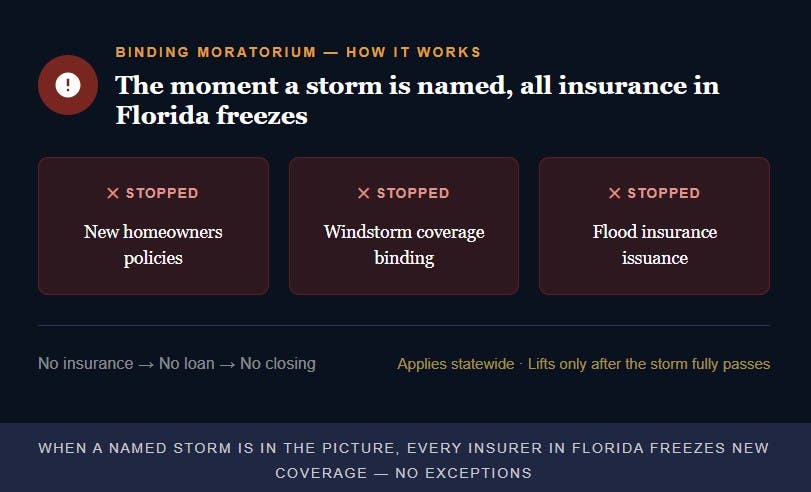
The geographic area that triggers this freeze is known in the industry as "the box," a roughly 16,000-square-mile zone that covers Florida, the Gulf of Mexico, and parts of the Atlantic. The moment a named storm enters the box, carriers suspend new business. Each insurance company makes this call independently, so there is no single universal timeline you can plan around. Some lift the moratorium a day or two after the storm passes. Others hold it for several days longer.
Find out what's happening in Pinellas Beachesfor free with the latest updates from Patch.
What this means in very practical terms is that if you are a buyer scheduled to close on a Friday and your insurance policy is not already bound before that storm gets named, you may not be closing on Friday. Your lender will not fund your loan without required insurance in place, and there is simply nothing your agent, your lender, or your title company can do to speed that process along while a named storm is in the picture.
“Buying homeowners insurance the day before a hurricane makes landfall is a little like buying car insurance at the scene of an accident. The risk is already there."
The good news is that this situation is completely preventable with a little advance planning, which we will walk you through in just a moment.
The Force Majeure Clause and Why Your Contract Protects You
Here is something we want both buyers and sellers to feel genuinely reassured about. The standard Florida real estate contract, known as the FAR/BAR As Is Residential Contract for Sale and Purchase, includes a Force Majeure clause that specifically addresses hurricanes, floods, and other acts of God. When a named storm causes a delay in your closing, this clause extends all time periods in the contract, including the closing date itself, without penalty to either party.
So if a storm develops and your closing gets pushed back, you are not in breach of contract. The seller does not get to keep your deposit. The buyer does not lose the home. Everyone simply waits until insurance can be bound and the transaction can move forward.
That said, Force Majeure is a safety net, not a strategy. It protects you when something unexpected happens, but the goal is always to get your insurance bound before anything unexpected has the chance to happen. The clients who never need to lean on that clause are the ones who handled their insurance early, and those are the stories we love to tell.
Flood Insurance Has Its Own Timeline and That Clock Starts Now
Flood insurance deserves its own conversation because it operates under rules that are completely separate from your standard homeowners policy, and the timeline catches a lot of buyers completely off guard.
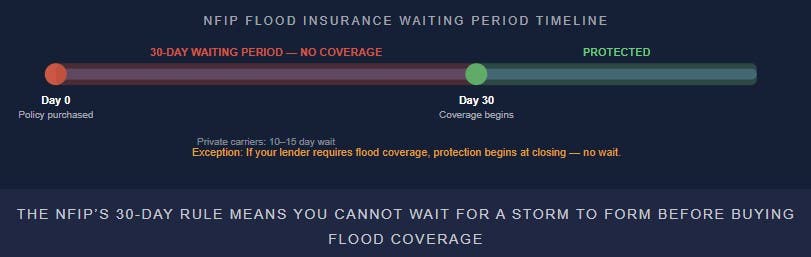
The National Flood Insurance Program, which is the federally administered program that backs the majority of residential flood policies in the country, requires a 30-day waiting period before a newly purchased policy takes effect. That means a flood policy you buy today will not provide any coverage until a full month from now, unless you are purchasing a home and your lender requires the policy as a condition of the mortgage (99% of lenders require this). If you are buying your home with a mortgage, coverage begins at closing with NO waiting period.
Some private flood insurance carriers offer shorter waiting periods, typically in the range of 10 to 15 days, which gives cash buyers a little more flexibility in certain situations. But the critical thing to understand is this: if a storm is already forming in the Gulf and you are just now thinking about flood insurance, it is already too late for that policy to protect you from that storm if you are paying cash for your home. The coverage simply will not be there.
If you are a buyer currently under contract and you have not yet addressed flood insurance, please make it a priority today. And if you are a seller, it is worth understanding that your buyer’s closing timeline could be affected if their lender requires a flood policy and that process is just getting started.
Why You May Want Flood Insurance Even If You Are Not in a Flood Zone
This is perhaps the most important conversation we have had with homeowners since Hurricanes Helene and Milton moved through Tampa Bay in the fall of 2024, and it is one we feel strongly about sharing with everyone we work with.
When those storms came through, a significant number of homeowners who were not in designated FEMA flood zones watched water enter their homes anyway. Storm drains backed up and overflowed. Retention ponds, which are designed to handle typical Florida rainfall, simply could not contain the volume of water those storms brought. Drainage systems failed. Water flowed into streets, yards, and ultimately into homes in neighborhoods that had never experienced flooding before.
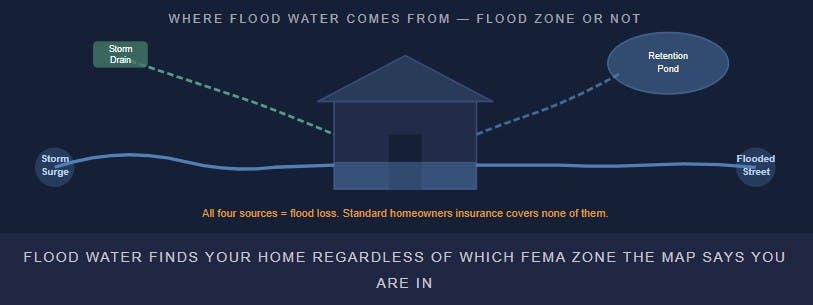
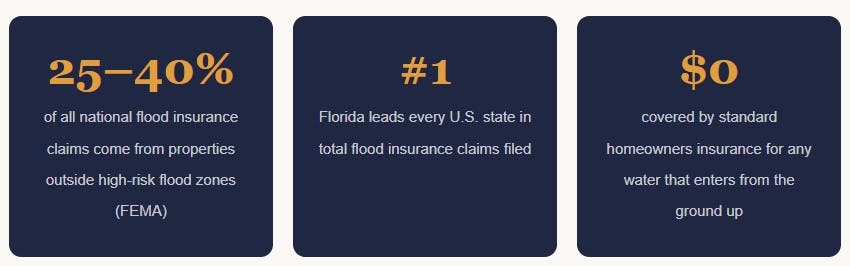
FEMA’s own data shows that somewhere between 25 and 40 percent of all flood insurance claims nationally come from properties that are not in high-risk flood zones. Florida leads every state in the country for flood insurance claims. And the flood maps themselves, while useful, are not always a current reflection of ground-level reality. Development patterns change, drainage infrastructure ages, and rainfall events are becoming more intense. More properties flood now than the maps would lead you to believe.
Our sincere recommendation to every buyer we work with, regardless of what zone the property sits in, is to get a flood policy. For homes in lower-risk zones, premiums through the National Flood Insurance Program are often quite reasonable, frequently in the range of $400 to $800 per year, though your specific property, elevation, and location will shape your actual rate. Private flood carriers are also worth exploring because they sometimes offer broader coverage at comparable or lower prices.
“The peace of mind that comes from knowing your home is covered no matter where the water originates is genuinely worth every penny."
After the Storm Passes and Why Reinspections Can Delay Your Closing
Let’s say a storm does move through the area while your transaction is in progress. The skies clear, power starts coming back on, and everyone is ready to get things moving again. It would be natural to assume the closing can simply pick up right where it left off.
Sometimes that is exactly what happens. But often there is one more step that buyers and sellers do not anticipate, and we want you to understand it so you are not caught off guard when the time comes.
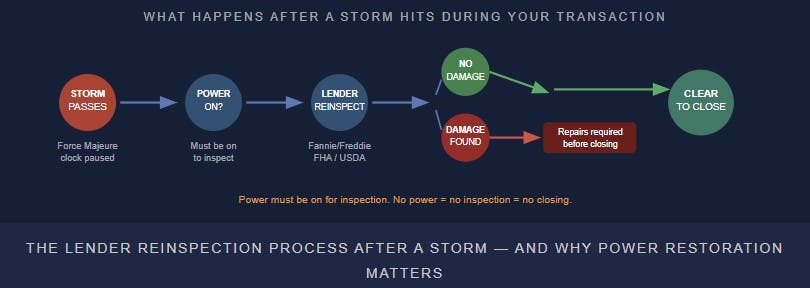
Lenders are required to verify that the property they are financing is still in essentially the same condition it was in when the loan was approved. If a hurricane or significant tropical storm has impacted the area, and especially if Pinellas County receives a FEMA disaster declaration, your lender will almost certainly require a reinspection of the property before they will release the funds to close.
The scope of that reinspection depends on your loan type and your specific lender. It might be a straightforward visual check, or it might require a full updated appraisal using Fannie Mae or Freddie Mac forms. FHA and USDA loans have their own reinspection requirements as well. The appraiser or inspector needs to confirm there is no new roof damage, no water intrusion, no structural concerns, and nothing that would materially affect the home’s condition or the lender’s confidence in the property. If damage is found, repairs must be completed and then verified before the loan can move forward.
One thing that surprises a lot of people is how much of this process depends on something as fundamental as the electricity being on. Inspectors and appraisers cannot properly evaluate a home without functioning utilities. If the storm has knocked out power to the neighborhood and TECO or Duke Energy has not yet restored service, the inspection simply cannot happen. Power restoration crews do remarkable work after major storms, but in the most severely affected areas, getting the lights back on can take days or sometimes weeks. That is time added to your closing timeline whether anyone wants it to be or not.
This is why we always encourage sellers to photograph and video every room, every exterior wall, the roof, and the HVAC system before storm season heats up. If the property comes through a storm unscathed, having that documentation makes the reinspection process faster and smoother for everyone involved. And if damage did occur, a clear before-and-after record helps establish what happened and what needs to be repaired so the transaction can move forward as efficiently as possible.
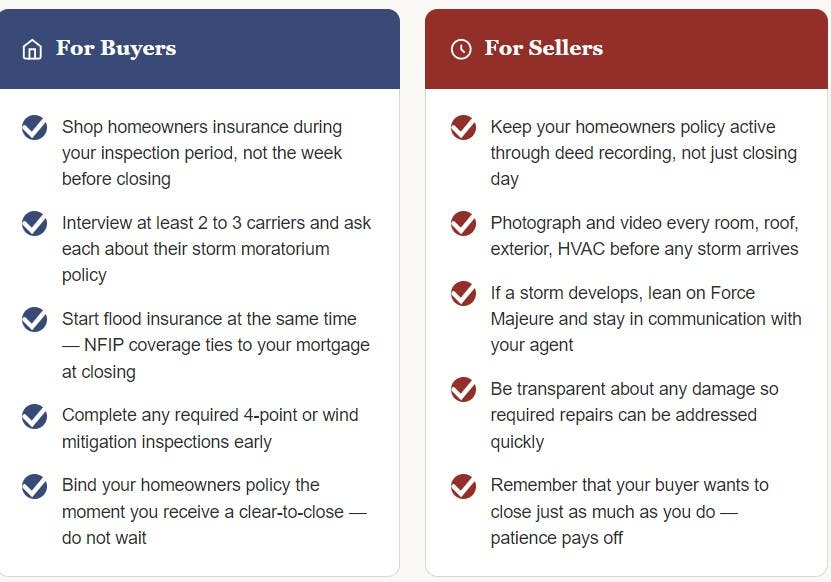
Your Game Plan for Hurricane Season Closings
We work with buyers and sellers every single day through every month of hurricane season. Here is the straightforward approach we share with all of them from June 1st forward.
A Word About the 2026 Hurricane Season Forecast
The overall outlook for 2026 is genuinely encouraging. Most of the major forecasting institutions are projecting a below-average to near-average season.
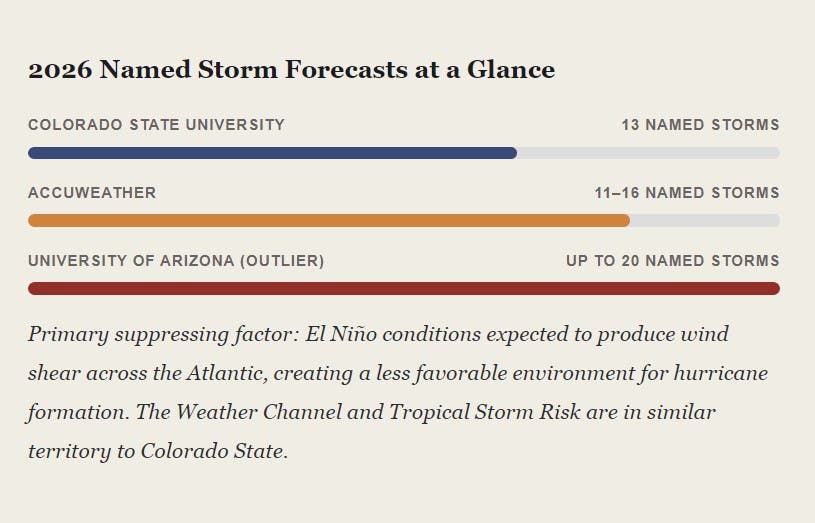
What every single forecaster agrees on, regardless of their specific numbers, is that a below-average forecast does not mean a no-risk season. It only takes one storm making landfall in the right place to make it a devastating year for the people in its path. The Tampa Bay area is consistently ranked among the most storm-surge-vulnerable metro areas in the entire country. We share it not to alarm you but because we believe informed people make better decisions, and better decisions lead to better outcomes.
Talk to the Sandy Hartmann Group
The Sandy Hartmann Group has proudly served Pinellas County buyers and sellers for more than 35 years. Statistics and regulatory information referenced in this article are sourced from the National Hurricane Center, Colorado State University Tropical Weather and Climate Research, AccuWeather, FEMA and the National Flood Insurance Program, the Florida Department of Financial Services, and Fannie Mae and Freddie Mac servicer guidelines. For questions specific to your insurance needs or legal situation, we always recommend speaking with a licensed Florida insurance agent and a qualified real estate attorney.