Neighbor News
Historic Tarpon Springs Home is Worth Saving
17 Orange Street is Eyed for Demolition by AHEPA
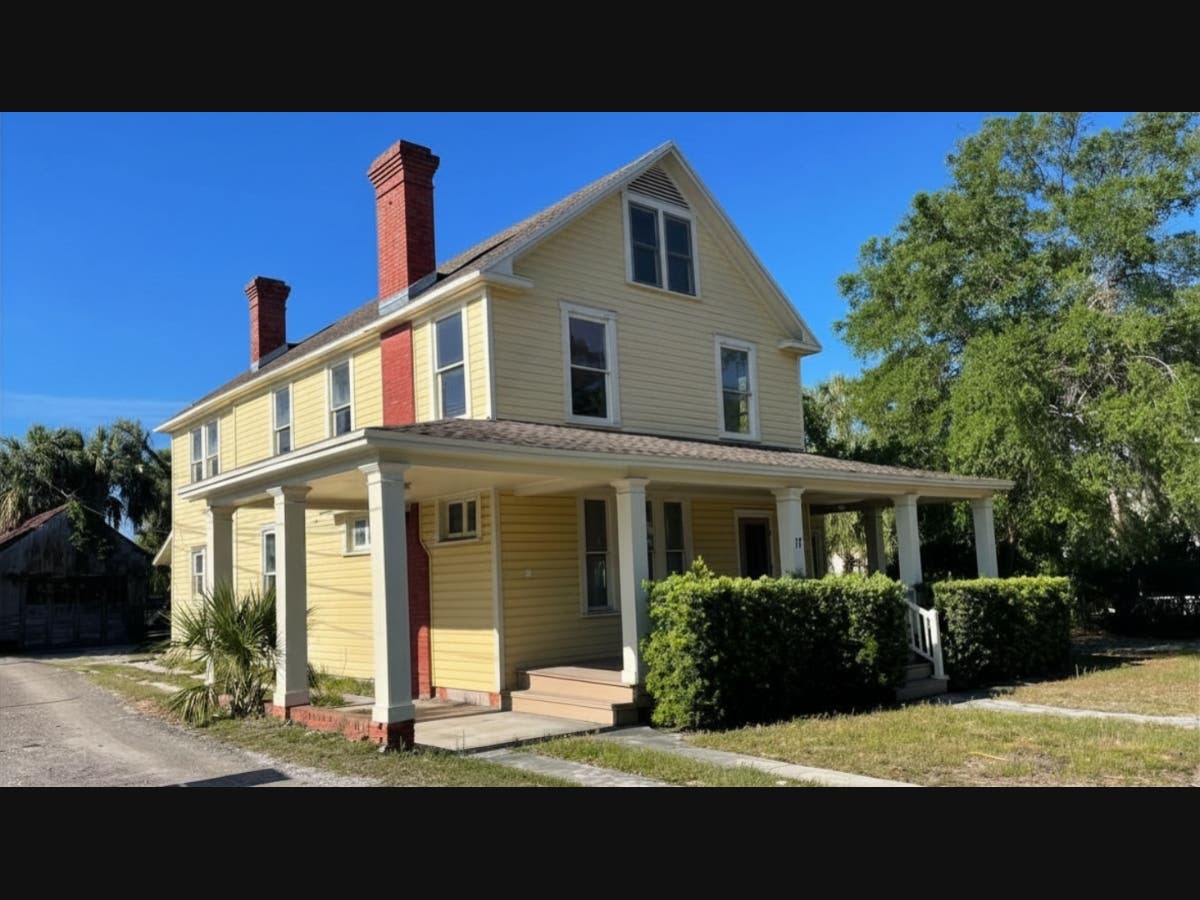
Tearing Down History Won't Build a Legacy: The Case Against Demolishing 17 W. Orange Street
By Joe Marzo-Florida Heritage Institute
There is a particular kind of civic tragedy that doesn't announce itself with fanfare. It arrives quietly, dressed in the language of progress. It comes with architects' renderings and consultants' reports and solemn assurances that what replaces the thing being destroyed will be even better, even more meaningful, than what stood before.
Find out what's happening in Tarpon Springsfor free with the latest updates from Patch.
That tragedy is now being proposed for 17 W. Orange Street in Tarpon Springs. And the community should reject it.
A House That Has Earned Its Place
The two-story frame vernacular home at 17 W. Orange Street was built in 1910, the same era that shaped the cultural identity Tarpon Springs still trades on today. For 116 years it has stood along a peaceful section of Orange Street. Its wraparound porch, triple-set windows, and twin brick chimneys complement its architectural beauty. The Florida Master Site File recognizes it as a contributing structure within the Tarpon Springs Historic District, and for good reason. It has, as city planners noted, "kept its architectural integrity" across more than a century of change.
Find out what's happening in Tarpon Springsfor free with the latest updates from Patch.
That is not nothing. That is, in fact, everything.
Historic preservation is not sentimentality. It is not an obstacle to growth. It is the act of keeping faith with a place, acknowledging that the people who built something, and the generations who lived within it, deserve to be remembered in something more durable than a museum placard.
The Argument for Demolition Doesn't Hold Up
The AHEPA Foundation, which acquired the property in May 2025 for $500,000, argues that the house is too damaged to rehabilitate. Its representative cited structural damage, insect infestation, and outdated utilities as reasons why restoration would be "inordinately expensive." A museum on the site, they argue, would better serve both AHEPA's mission and the city's goals for tourism and economic activity.
These arguments deserve scrutiny.
First, "inordinately expensive" is doing a great deal of work in that sentence. The previous owner purchased this home in 2021 for $725,000.00. Granting the AHEPA a generous $225,000 discount on this property. The home needs some work, but is no way in a state of disrepair.
Rehabilitation of historic structures is rarely cheap, but it is rarely impossible. Organizations that purchase historic properties in designated districts do so with the knowledge that preservation obligations come with the deed. The cost of doing the right thing is not, by itself, a justification for doing the wrong thing.
Second, the claim that a new museum would better serve tourism and civic pride fundamentally misunderstands what draws visitors to Tarpon Springs in the first place. People come here because this city looks and feels different from everywhere else in Florida.
They come for the sponge docks, historic downtown, our beautiful shops, and yes, the beautiful homes on our streets. Every time one of those homes disappears, the city becomes a little more like everywhere else. A modern museum building, however thoughtfully designed, does not restore what was lost. It only proves the loss was real.
Third, and perhaps most pointedly, AHEPA is an organization whose entire purpose is the preservation of Hellenic cultural heritage. The American Hellenic Educational Progressive Association was founded precisely to protect what is irreplaceable: traditions, histories, and identities that, once severed, cannot simply be rebuilt from scratch. It is difficult to reconcile that mission with an application to demolish a 116-year-old historic structure in order to build something new in its place. The contradiction should give AHEPA's own leadership pause.
The Alternative Nobody Has Seriously Pursued
The Tarpon Springs Heritage Preservation Board Chairman Phillip Mrozinski asked the right question at February's hearing: "Have you considered keeping the yellow house and somehow incorporating a new structure next to it?"
The answer, tellingly, was not "no." It was "that option remains on the table."
Which raises an obvious follow-up: why wasn't it the first option? The Orange Street property is contiguous with the existing AHEPA Center on Tarpon Avenue. Together, the parcels offer genuine space for creative design, a museum campus that incorporates the historic home as a gallery, event space, or centerpiece, with new construction extending behind or alongside it. This is not a radical idea. It is how thoughtful historic preservation has worked in cities across the country for decades.
The fact that AHEPA arrived at the Heritage Preservation Board seeking conditional demolition approval before a design had even been completed suggests that the preservation alternative was never given serious architectural or financial analysis. The board was being asked to approve the removal of an irreplaceable structure on the basis of a concept, not a plan. That is precisely backwards.
What the Board Must Do
The Heritage Preservation Board exists for moments exactly like this one. Its role is not to rubber-stamp whatever a property owner decides is most financially convenient. Its role is to hold the line, to be the institution that says, when others will not, that some things are worth protecting even when protection is difficult.
Chairman Mrozinski signaled he would be hard to convince on demolition. The board should hold that line. It should decline to issue a certificate of appropriateness for demolition and send AHEPA back with a clear directive: come back with a plan that keeps the house.
That plan may cost more. It may require more creativity. It may mean a smaller or differently configured museum than AHEPA originally envisioned. These are acceptable outcomes. A vacant lot where a century of history once stood is not.
Tarpon Springs deserves better than that. So does the house on Orange Street.
The Heritage Preservation Board is expected to take up the matter at a future meeting. Community members are encouraged to attend and make their voices heard.
To learn more about us visit FLHeritage.org