Arts & Entertainment
Brilliant new movie ‘Jimmy’ chronicles crucial parts of Stewart’s wonderful life
KJ Apa inhabits the role of the Hollywood legend as a bomber pilot in World War II and during the making of his most famous film.


By Tom Siebert
I had the high privilege of interviewing Jimmy Stewart, so I know that he preferred his formal first name James. But considering that the acting great is the most well-known Jimmy in the history of humanity, with apologies to Messrs. Cagney and Page as well as President Carter, you can’t fault the makers of this phenomenal biopic for choosing the eponymous title.
Most of my time with the Hollywood legend was devoted to discussing his stunning catalogue of important films that include Mr. Smith Goes to Washington, a must-see primer for President Trump on the politics of decency; The Philadelphia Story (1940), for which Stewart won the Academy Award for Best Actor; It’s a Wonderful Life (1946), which was a box-office bomb but became sensationally popular on television during the Christmas season; Rear Window (1954), Alfred Hitchcock’s masterful voyeuristic thriller; and Hitch’s Vertigo (1958), which has dethroned Orson Welles’ Citizen Kane (1941) as the king of all movies in recent critics’ polls.
Find out what's happening in Chicagofor free with the latest updates from Patch.
I also knew that Stewart’s “Everyman” protagonist was the hero of many films but knew nothing about his real-life heroics as a B-24 bomber pilot during World War II, the focal plot of Jimmy.
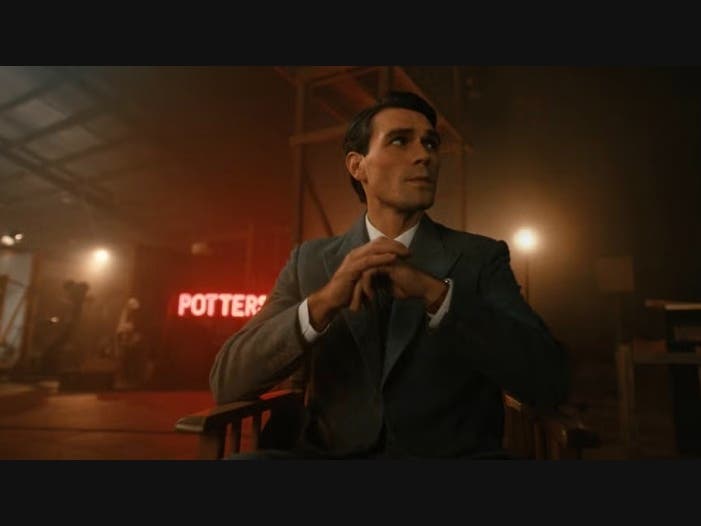
This towering movie opens with a flashback of fabled film director Frank Capra (Max Casella) pitching It's a Wonderful Life to the good-looking, lanky cinema star in 1941, five years before the picture was made, saying, “A hundred years from now, when we're dead and gone, this film will be remembered.”
Find out what's happening in Chicagofor free with the latest updates from Patch.
Stewart, then 32 and already a matinee supernova, was drafted despite his being underweight and the fact that powerful MGM studio head Louis B. Mayer (played by Jason Alexander of Seinfeld fame) could have gotten him out of it.
But the beloved actor decides to enlist in the newly founded U.S. Army Air Force, and when he goes to the recruitment center, he is met with efforts to help him avoid combat.
“America can’t afford to lose Jimmy Stewart,” a military figure tells him.
But by golly, the patriotic young man from Indiana, PA, is determined to fight for his country, even though his father (Neal McDonough) thinks his son is not up to it. The elder Stewart, Alexander, gives Jimmy a pocket-sized copy of the Book of Psalms with a note inside stating that the Bible verses “got me through some tough times.”
Then the tone of this two-hour masterpiece shifts dramatically to the time when the fate of the world hung in the balance. The Axis countries led by Germany fought the Allied countries led by the United States in an apocalyptic global conflict that would eventually cost an estimated 85 million people their lives.
Jimmy depicts the horrors of war respectfully, not graphically. Commander Stewart and his squadron of bomber pilots come under constant fire, with some of their planes being hit by shrapnel, others exploding into fire and smoke, and a few crashing into the oblivion of the ocean. Injured or dying soldiers are indiscriminately pulled from wreckage and placed on stretchers.
We also see a heartrending close-up of an American flyer with a bloodied face after his plane crashes. And in a departure from vintage World War II movies, this film shows that real men do cry out in pain or anguish when they are injured or mortally wounded in battle.
Stewart is shown caringly writing condolence letters to the families of the deceased. After one deadly dogfight, he reads aloud Psalm 91.
Between November 1943 and June 1945, Colonel James M. Stewart flew 20 high-altitude missions over Europe, some of them in Nazi-occupied territory. During those 19 months, ten of the B-24 Liberators under his command crashed, resulting in 71 airmen being killed and 29 becoming prisoners of war.
In a foreshadowing of George Bailey’s near-suicidal scene on a bridge in It’s a Wonderful Life, Stewart says in the midst of the military madness, “I’m not much of a praying man,” and then asks God to help his falling comrades.
Perhaps the most poignant scene in this lushly colored film is when Jimmy encounters an orphan boy who asks him to pray that he finds a new family, a profoundly sad moment that has been replayed over and over again in modern-day Iran, Ukraine, Israel, and Palestine. In all four places, innocent civilians have been reduced to collateral damage.
After the war is won, Jimmy returns home to Hollywood, suffering from post-traumatic stress syndrome. He is hounded by Hedda Hopper (Sarah Drew), the wildly influential Tinseltown writer whose gossip column was syndicated in thousands of newspapers––metropolitan, small-town, and weeklies.
Film mogul Mayer tells the broken actor: “I can’t sell hope right now, Jimmy, not with you.”
However, Capra and character actor Lionel Barrymore (Christopher McDonald) nurture Stewart into the starring role of It’s a Wonderful Life, into which he channels his wartime trauma and heals his psychic wounds.
Jimmy actually is two movies rolled into one, skillfully directed by Aaron Burns, the producer of several films including the Kendrick Brothers’ Overcomer (2019) and The Forge (2019).
Oh, and there is humor in this astonishing drama, and appropriately so, since Stewart was in 14 comedies, most notably Harvey (1950), in which he plays the whimsical Elwood P. Dowd whose constant companion is a giant invisible rabbit.
In Jimmy, Stewart expresses guilt about the possibility of dodging his draft letter, to which Mayer tells him to “talk to a priest.” Jimmy replies, “I’m a Presbyterian.”
Capra, a Catholic, makes the sign of the cross and recites the Trinitarian formula in Latin: “In nomine Patris et Filii et Spiritus Sancti,” adding “be at peace” to Jimmy.
And when the famed director tells Stewart that an angel is prominently featured in It’s a Wonderful Life, Jimmy asks, “Gabriel?” Capra replies, “No. Clarence!”
We also find out that Mr. Stewart had a pretty-wonderful private life. Early in the movie, “America’s Greatest Bachelor” is dating dancing queen Ginger Rogers (Jemma Donovan), to whom he clumsily proposes before marching off to war.
His romantic liaisons during wartime are all wrapped up in a fictional composite character, Lady Julia, an English noblewoman who supports various charities.
Jimmy Stewart appeared in 80 films from 1935 to 1991. Virtually every comic impressionist has tried to approximate his famous folksy twang. So it would be a Capraesque challenge to any actor to play the well-known movie giant without falling short.
However, 29-year-old New Zealander KJ Apa disappears into the title role, recreating the voice, vibe, and gangly exuberance of the acting icon, particularly when delivering a win-one-for-the-Gipper type of speech to his weary and disillusioned men.
Apa should be nominated for Best Actor, while Casella (Doogie Howser, M.D. and The Sopranos) deserves a supporting nomination for playing Capra with an Italian American energy reminiscent of Joe Pesci.
Another standout performance was turned in by former Daily Show correspondent Rob Riggle, who plays Colonel Robert Terrill. When Stewart, who had begun taking flying lessons in Los Angeles in 1935, travels to England in 1943, Terrill is convinced that he can man B-24s and becomes his mentor.
Late in the film, Jimmy meets Gloria Hatrick McLean, to whom he was married from 1949 until her death in 1994. Stewart adopted Gloria’s two young boys, and the couple later had twin daughters.
When Jimmy appeared on the Tonight Show in 1984, he joked to Johnny Carson: “Well, the two boys that Gloria had––both of them wanted sisters. So I just pulled the bow way back and let it fly.”
James Maitland Stewart died at the age of 89 surrounded by his family at his Beverly Hills home on July 2, 1997. President Bill Clinton told the country: “America lost a national treasure today. Jimmy Stewart was a great actor, a gentleman, and a patriot.”
Jimmy is an inspiring story about a humble hero who risked his fame, fortune, and very life to defend the nation in what is commonly called “The Good War.”
And here’s a final fact about Mr. Stewart: he was a Republican but his best friend was fellow screen titan Henry Fonda, a Democrat. And that gives me hope that America can overcome its latest existential threat.
.