Arts & Entertainment
Music royalty Graham Nash and Emmylou Harris regale Ravinia Festival
The two legendary artists and their bands performed hit songs and deep-cut gems to a mostly Baby Boomer audience at the heralded venue.


By Tom Siebert
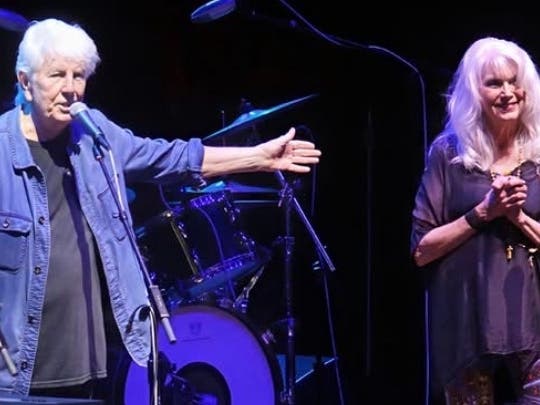
Folk-rock legend Graham Nash and country-music queen Emmylou Harris played a twilight doubleheader of storied songs Sunday night at the historic Ravinia Festival in Highland Park, 22 miles north of downtown Chicago.
The iconic duo quickly showed the audience of more than 5,200 that they were a musical match made in heaven, opening the show with an operatic version of “Bird,” a 1970 Neil Young tune from his critically acclaimed album After the Gold Rush.
Find out what's happening in Chicagofor free with the latest updates from Patch.
Then Nash, Young’s former bandmate, exited stage right to let the lady go first with her concert set.
Harris, still beautiful at 79, was regally dressed in a deep-gray blouse and multicolored bellbottoms. She was holding a ginormous acoustic guitar, her angelic face garlanded by a flowing white mane. Can you say stage presence?!
Find out what's happening in Chicagofor free with the latest updates from Patch.
Her first solo song was Gillian Welch’s “Orphan Girl,” covered by Harris on her 1996 album Wrecking Ball. The lyrics perfectly summarized Emmylou’s incandescent 50-year career, during which she has collaborated with many musical giants while standing tall on her own.
In her still-crystalline voice, she sang: “I am an orphan on God's highway/But I'll share my troubles if you go my way/I have no mother no father/No sister no brother/I am an orphan girl.”
Then the stage atmosphere shifted dramatically with Delbert McClinton’s “Two More Bottles of Wine,” a rollicking honky-tonk of a song that has been a fan favorite and staple of Harris’ concerts since 1978.
Emmylou, a 14-time Grammy winner, performed a career-spanning 17 songs at Ravinia, seamlessly weaving together the musical genres of Americana, Appalachian, bluegrass, country, gospel, and rock ‘n’ roll.
Her eclectic set also served as a stirring tribute to the many musical luminaries who were her songwriting peers and collaborators, most of them now sadly deceased.
With “Pancho and Lefty” she managed to pay homage to the ballad’s writer, Townes Van Zandt, as well as Willie Nelson and Merle Haggard, who had a number-one country hit with the song after hearing Harris’ 1977 version.
Country and Western immortal Johnny Cash was remembered by “Help Him, Jesus,” with Emmylou recreating the song that he sung on the 1980 concept LP The Legend of Jesse James.
The Alabama native also performed some of the classic songs that she herself wrote, including “Red Dirt Girl,” from the 2000 album of the same name.
It is a picturesque Americana song with acoustic instrumentation, narrated by Harris in a haunting, melancholy tone.
“There's not much hope for a red dirt girl/Somewhere out there is a great big world/That's where I'm bound/And the stars might fall on Alabama/But one of these days /I'm gonna swing my hammer down/Away from this red dirt town/I'm gonna make a joyful sound.”
As the seemingly autobiographical ballad unfolded, Emmylou’s band, fittingly called the Red Dirt Boys, showed off their exquisite musicianship.
They are Phil Madeira on keys; Will Kimbrough, guitar; Chris Donohue, bass guitar; Bryan Owings, drums; and Eamon McLoughlin, fiddle and mandolin.
After introducing the band, the divine Ms. Harris made a halting statement that may have surprised many in the almost-completely white crowd.
“One of the reasons I had a happy childhood growing up in the South was because I was born white.”
Then she and her “boys” proceeded to perform “My Name Is Emmett Till,” about the 14-year-old Black youth from Chicago who was horrifically murdered on a vacation in Mississippi, prompting the passage of the 1957 Civil Rights Act.
The first-person-singular song, which appeared on Emmylou’s 2011 album Hard Bargain, was indeed hard to listen to last night.
“They took me from my uncle's house/Mose Wright was his name/He'd later stand and without hesitation point the blame/At the ones who beat and cut me/Shot me with a gun/And threw me in the river/Like I was trash when they were done.”
Then the Country Music Hall of Famer and the backup band went on to play “From Boulder to Birmingham,” a lovely ode to country-rock pioneer Gram Parsons, who “discovered” Harris and helped launch her recording career in 1975.
Emmylou concluded her set with Neil Young's "Long May You Run" from his 1976 album with Stephen Stills.
Rumor had it that Harris was retiring after her “farewell” European tour is scheduled to conclude in September. But she put those ugly rumors to rest at Ravinia.
“I want to thank all of you who have been coming to see me all these years,” Emmylou told the cheering crowd, “so I can keep doing what I love to do.”
After a 20-minute intermission came Nash again. An age-defying 84, he began his set with the epic, peaceful-protest anthem “Chicago/We Can Change the World” from his best-selling 1971 solo album Songs for Beginners.
Seated on account of recent kneecap surgery following a fall near his home in New York City, strumming an acoustic guitar, and backed by his young three-piece band, Graham sang the opening verse in his still-sweet high tenor as the cheers of the audience slowly rose.
“Though your brother's bound and gagged/And they've chained him to a chair/Won't you please come to Chicago/Just to sing?”
The lyrics refer to the 1969-70 trial of the Chicago 8, who were charged with conspiracy to disrupt the 1968 Democratic Convention. One of the defendants, Black Panther leader Bobby Seale, was muzzled and tied to his chair because of his protestations of innocence in court.
The song also recounts Nash’s unsuccessful pleas to his then-bandmates––David Crosby, Stephen Stills, and Neil Young––to participate in the protests supporting the alleged conspiracists, who were eventually cleared of all charges.
But when Graham got to the chorus, it was clear that the song was not just a golden oldie but a renewed cry to alter the course of the planet, with its raging wars, environmental perils, widespread famine, and political corruption.
“We can change the world/Rearrange the world/It’s dying/To get better.”
I saw Nash and Crosby perform when I was a student at the University of Illinois in 1975. So I knew that Graham did not mince lyrics, like this one, which may have shocked some in the festival audience.
“Don’t ask Trump to help you/Cause he might lose the other ear/Won’t you please come to Chicago/Or else join the other side?”
More would be sung and said about history rhyming, particularly in America. But Nash’s second number, “Wasted on the Wind,” from the 1982 Crosby, Stills & Nash (CSN) album Daylight Again, focused on the years-long squabbles among the members of that fabled supergroup.
Nash reminded us of the days that we all squander, singing: “And there's so much time to make up/Everywhere you turn/Time we have wasted on the way/So much water moving/Underneath the bridge/Let the water come and carry us away.”
Next up was “Marrakesh Express,” a popular track from CSN’s self-titled, landmark first album. Some at Ravinia chimed in during Graham’s playful ditty about his 1968 Morocco vacation.
However, the concert’s vacation from current affairs was short-lived as the band launched into “Immigration Man,” a Top 40 hit off the 1972 LP David Crosby/Graham Nash. It’s about a clash that the British-born Nash had with a U.S. Customs official on the American-Canadian border in 1969.
The searing, electric-guitar-driven song foreshadowed today’s immigration nightmare, when undocumented men, women, and children are being violently arrested and detained in inhumane ICE facilities. And immigrants and protestors alike are being gunned down in U.S. cities.
In Highland Park, scene of a mass shooting itself in 2022, Nash earnestly sang these lines from“Immigration Man,” as if an urgent warning:
“So go where you will/As long as you think you can/You better watch out/Watch out for the man/Anywhere you're going.”
But perhaps the most relevant song that Nash performed at Ravinia was “Military Madness,” from Songs for Beginners. It is an autobiographical peace song for the ages, written during the Vietnam War but applicable to all the wars that the United States has fought since.
“In an upstairs room in Blackpool/By the side of a northern sea/The army had my father/And my mother was having me/Military madness was killing my country/Solitary sadness comes over me/After the school was over/And I moved to the other side/I found a different country/ But I never lost my pride/Military madness was killing the country/Solitary sadness creeps over me.”
Graham, a naturalized U.S. citizen, made another last-minute lyric change to make sure everyone knew that he was singing in the present tense.
“And after the wars are over/And the body count is finally filed/I hope that Trump discovers/What's driving the people wild/Military madness is killing your country/So much sadness/Between you and me.”
And he got much of the crowd to join in the closing chant: “No more war/No more war/No more war.”
“Just a Song Before I Go,” off of 1977’s CSN, was Crosby, Stills & Nash’s highest-charting single. And Sunday night he and his band served up a gorgeous rendition of the short ballad, which Graham wrote in 20 minutes to win a $500 bet with a “low-level drug dealer” before hopping on a plane from Honolulu to Los Angeles.
Nash was backed by Todd Caldwell on keys; Adam Minkoff on drums and bass guitar; and Zach Djanikian on guitar, mandolin, and saxophone. These musicians are also gifted singers, holding their own with Graham’s signature high harmonies.
Then came two tender-hearted hits from the 1970 Crosby, Stills, Nash & Young masterpiece Déjà Vu: “Our House,” memorializing Nash’s two years of domestic tranquility with superstar singer-songwriter Joni Mitchell; and Graham’s “Teach Your Children,” a topical counterpoint to Trump’s 10-year lesson to America’s youth that it’s okay to lie, smear, and sexually abuse.
And from that same album, Nash and his band went back to the garden with Mitchell’s “Woodstock,” where CSN played their second gig ever before more than 500,000 people in August 1969.
They went back ever farther with 1966’s “Bus Stop” by the Hollies, one of the most highly successful British Invasion bands, which Nash co-founded and performed with for six years.
Graham is a two-time inductee to the Rock and Roll Hall of Fame, as a member of the Hollies and Crosby, Stills & Nash. He has sold a combined 50 million records with those two bands, as a solo artist, and when Young recorded and toured with CSN.
Nash is also in the Songwriters Hall of Fame and he was appointed as an officer of the Order of the British Empire (OBE) for his music and charity work.
My ex hated Stephen Stills’ “Love the One You’re With,” claiming the 1971 smash single was a permission slip for infidelity. But listening to Nash perform it Sunday night, harmonizing perfectly with the younger singers, I saw the tune as an impassioned plea to cherish the ones who remain in our lives.
Many of the Baby Boomer couples in the audience sang along, looking like they had been together for a long time, and thereby seeming to agree with my sentiment of the song.
And the 81-year-old Stills, who performs only rarely, must have been honored that Nash closed the set with Stephen’s magnum opus, “Suite: Judy Blue Eyes,” with much of the crowd helping out with the “doo-doo-doo-doo-doo, doo doo, doo doo doo” coda.
It was an upbeat, happy ending from the gentleman singer/songwriter who still believes that music can be a force for positive change, notwithstanding the dreadful state of the union.
“If you love yourself, love your family, and love your friends,” Nash told the crowd, “we’ll get through these next two years of madness, together.”
Ravinia was founded in 1904 and is the longest-running music festival in North America. Located on 36 acres of parkland, it hosts summer-long concerts from June through September, with the Chicago Symphony Orchestra its seasonal resident.
Artists who have performed at the venerable venue include Louis Armstrong, The Beach Boys, Leonard Bernstein, Tony Bennett, Glen Campbell, Aaron Copeland, Bob Dylan, Duke Ellington, Ella Fitzgerald, Aretha Franklin, George Gershwin, Dizzy Gillespie, Janis Joplin, Lady Gaga, Yo-Yo Ma, John Mellencamp, Steely Dan, Stevie Nicks, Dolly Parton, Itzhak Perlman, Smokey Robinson, Diana Ross, Paul Simon, Sting, Tina Turner, John Williams, Frank Zappa & The Mothers of Invention, and Earth, Wind & Fire.
Sunday night Graham Nash and Emmylou Harris were written into Ravinia’s rich history book, after performing some of the most humanitarian music ever made, songs that will hopefully continue to echo and inspire throughout the ages.