Politics & Government
Maryland's First ‘Human Composting' Facility Is Open For Business
Facility in Elkridge turns human remains into soil, after passage of 2024 law legalizing the process.
July 2, 2026
Tucked into a nondescript warehouse development in Howard County, along winding roads lined with semi trucks, sits a facility dedicated to the dead.
Find out what's happening in Across Marylandfor free with the latest updates from Patch.
It offers a newly legal service, natural organic reduction, to mourning families — and to living customers looking to settle death arrangements before they go.
The 37,000 square foot facility, operated by Earth Funeral, is likely the first of its kind on the East Coast, and it opened in May.
Find out what's happening in Across Marylandfor free with the latest updates from Patch.
“The exterior belies what’s going on inside,” said Tom Harries, CEO at Earth Funeral, which launched in Washington, and has one facility there and another in Nevada.
Already, 25 bodies have been placed in vessels — along with mulch, wood chips and wildflowers — to undergo the process, which is nicknamed “human composting,” for its close likeness to the process. The end result, after all, is small, cylindrical cardboard canisters filled with soil-like remains.

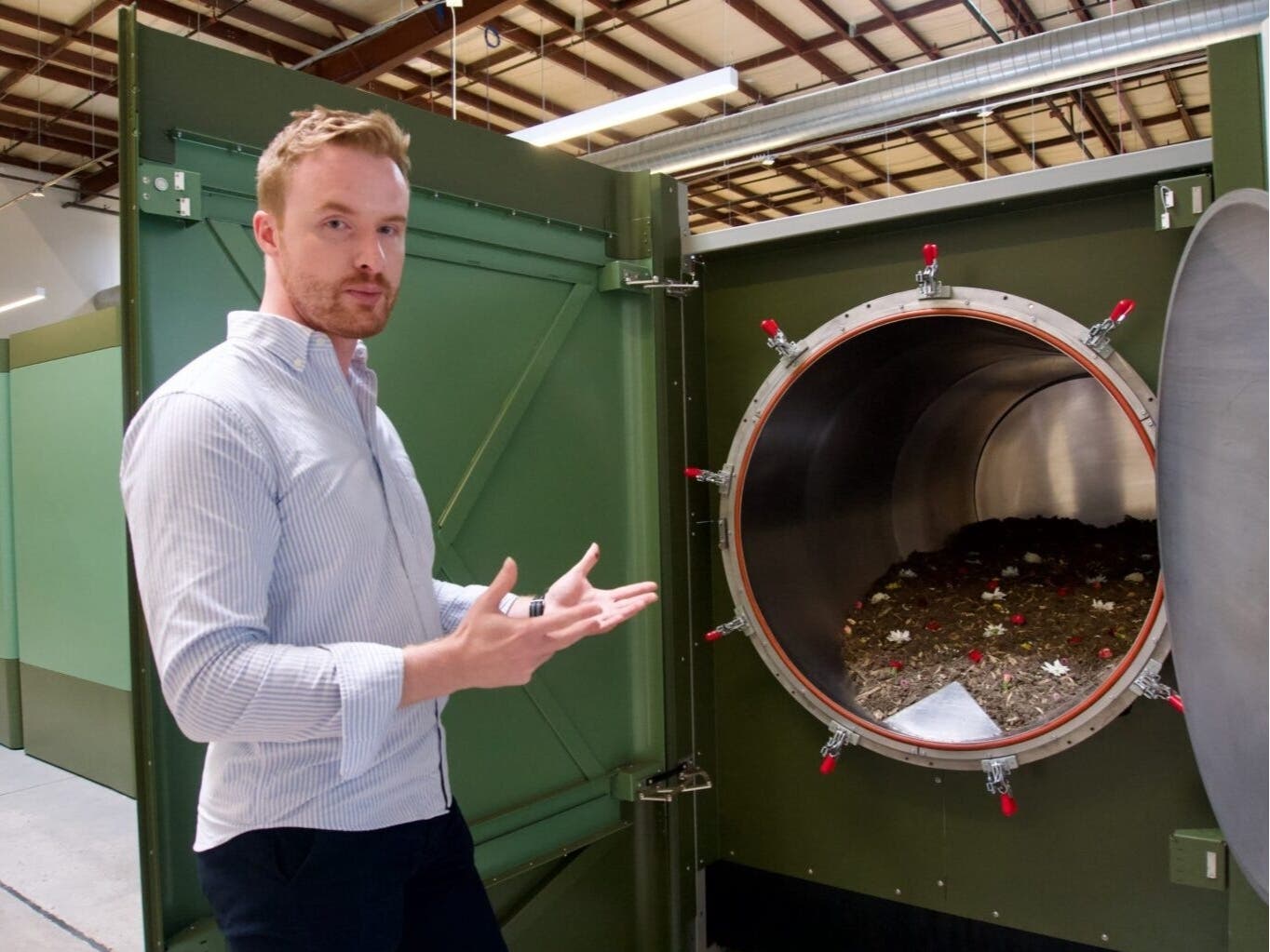
Earth Funeral CEO Tom Harries stands in the reception area of the company’s new “human composting” facility in Elkridge, Maryland, the first such facility in Maryland. (Photo by Christine Condon/ Maryland Matters)

The process is pitched as a greener alternative to cremation, which emits pollutants into the air, and traditional burial, which not only requires land, but chemicals for embalming and potentially elaborate caskets.
“This is what would happen on a forest floor, but we are accelerating it through science and technology,” Harries said. “The fundamentals behind what we do are as old as the oldest living organisms.”
To start the process, bodies are placed in biodegradable shrouds and enclosed in the Earth Funeral vessel, which maintains the optimal temperature, along with moisture and oxygen levels, to promote decomposition. The vessel, which can reach up to 150 degrees Fahrenheit, also spins very slowly, akin to a cement mixer. The process takes 30 to 45 days.
“We are balancing carbon and nitrogen. The carbon comes from natural materials, like organic mulch, wood chip, wildflower, and the nitrogen comes from the body itself,” Harries said. “You have to create a perfect ratio.”
So far, the facility, which has five full time staff members, has 30 vessels — essentially green-doored vaults lined up in neat rows on the warehouse floor. The company is hoping to reach about 50 vessels later this summer, and eventually host 126. When all is said and done, Earth Funeral will have invested $10 million into outfitting the facility, Harries said.
The company’s Earth Package costs $5,950, and can be pre-paid. For that price, Earth Funeral will transport the body from anywhere within its Maryland service area, complete the soil transformation process, and provide family members with up to five small containers of soil remains. Remains can also be donated to a conservation project.
For an additional $750, families can also schedule a 45-minute in-person visitation at the Elkridge facility for up to 10 people, during which they can say final goodbyes, and write messages on natural paper to be placed inside the composting vessel.
By comparison, as of 2023, the national median cost of a funeral with viewing and burial was $8,300. The median cost of a funeral with cremation was $6,280, according to the National Association of Funeral Directors.
‘Everything points to this’
Hal Perez and his wife Tammi Stauffer, both in their early 60s and living in Baltimore, heard about natural organic reduction through an Earth Funeral advertisement on Facebook, and also attended a webinar before signing up. Perez said he and his wife are “environmentally aware,” and enjoy spending time outdoors, so it seemed like a natural fit.
“It doesn’t have a big footprint, as far as, like, burial — you’re taking up space and land for perpetual care,” Perez said. “Cremation certainly releases a lot of byproducts, and so forth. So it was appealing.”
When the time comes, Perez said he isn’t partial about where his remains are scattered. But the couple’s decision to sign up has spawned a light-hearted running joke between his daughter and his wife.
“My wife is an avid gardener, and she’s very adamant about planting native plants and nothing else,” Perez said. “And my oldest daughter has joked with her. She says, ‘I’m gonna plant an invasive species in your soil!’”
Tom Racioppe, 65, of Baltimore, chose Earth Funeral even before the facility opened in Maryland. For him, it was based on his personal experiences. He watched his mother navigate his father’s death, trying to choose a casket, a cement vault and more.
“I could see the guilt in her. And instead of just trying to buy the cheapest thing, which would have still been expensive, they were trying to upsell her,” Racioppe said.” So, that kind of turned my head to the whole process.”
When his mother died, he had to make the same choices alongside his brothers. He realized he didn’t want his loved ones to be in the same position.
“I wanted my wife and our kids to be able to just pick up the phone, make a call and not have to worry about anything. It would all be paid for and done,” Racioppe said.
There are protections in place for pre-payers, just in case Earth Funeral is no longer operating when a person dies. Using the funds, the company purchases an insurance policy, which could be used on another death care option should Earth Funeral go out of business, said John Collins, a spokesman for Earth Funeral.
Dave Buermeyer, 85, of Reston, Virginia, said he was signed up after a webinar hosted by Earth Funeral, during which he peppered company representatives with questions — including about what would happen if the company went under.
“I asked them a whole lot of questions, because it was so new, and they answered all my questions,” Buermeyer said. “Up ’til then, I was thinking about it, but the webinar kind of turned the corner for me. It was really good.”
That a facility was opening just across the border in Maryland was also a big selling point, Buermeyer said. He signed up alongside his wife.
“That was huge, because I sensed that it was expanding, it was trending in the right direction, but it was all on the West Coast,” he said. “I didn’t really relish the idea of my remains going all the way out to the West Coast.”
Buermeyer, an Air Force veteran, said he hopes that his remains could be scattered at Arlington National Cemetery, and he could receive military honors. But he noted that would require a policy change at the cemetery.
“I think they probably will over time, once they realize this is cheaper, better, faster and less use of land,” Buermeyer said. “Everything points to this.”
Racioppe said he doesn’t consider himself the most eco-conscious. But still, the environmental benefits of the procedure resonated with him.

The exterior of Earth Funeral’s new natural organic reduction, or “human composting” facility in Elkridge Maryland, on June 30, 2026. (Photo by Christine Condon/ Maryland Matters)
Tucked into a nondescript warehouse development in Howard County, along winding roads lined with semi trucks, sits a facility dedicated to the dead.
It offers a newly legal service, natural organic reduction, to mourning families — and to living customers looking to settle death arrangements before they go.
The 37,000 square foot facility, operated by Earth Funeral, is likely the first of its kind on the East Coast, and it opened in May.
“The exterior belies what’s going on inside,” said Tom Harries, CEO at Earth Funeral, which launched in Washington, and has one facility there and another in Nevada.

Already, 25 bodies have been placed in vessels — along with mulch, wood chips and wildflowers — to undergo the process, which is nicknamed “human composting,” for its close likeness to the process. The end result, after all, is small, cylindrical cardboard canisters filled with soil-like remains.
The process is pitched as a greener alternative to cremation, which emits pollutants into the air, and traditional burial, which not only requires land, but chemicals for embalming and potentially elaborate caskets.
“This is what would happen on a forest floor, but we are accelerating it through science and technology,” Harries said. “The fundamentals behind what we do are as old as the oldest living organisms.”
To start the process, bodies are placed in biodegradable shrouds and enclosed in the Earth Funeral vessel, which maintains the optimal temperature, along with moisture and oxygen levels, to promote decomposition. The vessel, which can reach up to 150 degrees Fahrenheit, also spins very slowly, akin to a cement mixer. The process takes 30 to 45 days.
“We are balancing carbon and nitrogen. The carbon comes from natural materials, like organic mulch, wood chip, wildflower, and the nitrogen comes from the body itself,” Harries said. “You have to create a perfect ratio.”
So far, the facility, which has five full time staff members, has 30 vessels — essentially green-doored vaults lined up in neat rows on the warehouse floor. The company is hoping to reach about 50 vessels later this summer, and eventually host 126. When all is said and done, Earth Funeral will have invested $10 million into outfitting the facility, Harries said.
The company’s Earth Package costs $5,950, and can be pre-paid. For that price, Earth Funeral will transport the body from anywhere within its Maryland service area, complete the soil transformation process, and provide family members with up to five small containers of soil remains. Remains can also be donated to a conservation project.
For an additional $750, families can also schedule a 45-minute in-person visitation at the Elkridge facility for up to 10 people, during which they can say final goodbyes, and write messages on natural paper to be placed inside the composting vessel.
By comparison, as of 2023, the national median cost of a funeral with viewing and burial was $8,300. The median cost of a funeral with cremation was $6,280, according to the National Association of Funeral Directors.
‘Everything points to this’
Hal Perez and his wife Tammi Stauffer, both in their early 60s and living in Baltimore, heard about natural organic reduction through an Earth Funeral advertisement on Facebook, and also attended a webinar before signing up. Perez said he and his wife are “environmentally aware,” and enjoy spending time outdoors, so it seemed like a natural fit.
“It doesn’t have a big footprint, as far as, like, burial — you’re taking up space and land for perpetual care,” Perez said. “Cremation certainly releases a lot of byproducts, and so forth. So it was appealing.”
When the time comes, Perez said he isn’t partial about where his remains are scattered. But the couple’s decision to sign up has spawned a light-hearted running joke between his daughter and his wife.
“My wife is an avid gardener, and she’s very adamant about planting native plants and nothing else,” Perez said. “And my oldest daughter has joked with her. She says, ‘I’m gonna plant an invasive species in your soil!’”
Tom Racioppe, 65, of Baltimore, chose Earth Funeral even before the facility opened in Maryland. For him, it was based on his personal experiences. He watched his mother navigate his father’s death, trying to choose a casket, a cement vault and more.
“I could see the guilt in her. And instead of just trying to buy the cheapest thing, which would have still been expensive, they were trying to upsell her,” Racioppe said.” So, that kind of turned my head to the whole process.”
When his mother died, he had to make the same choices alongside his brothers. He realized he didn’t want his loved ones to be in the same position.
“I wanted my wife and our kids to be able to just pick up the phone, make a call and not have to worry about anything. It would all be paid for and done,” Racioppe said.
There are protections in place for pre-payers, just in case Earth Funeral is no longer operating when a person dies. Using the funds, the company purchases an insurance policy, which could be used on another death care option should Earth Funeral go out of business, said John Collins, a spokesman for Earth Funeral.
Dave Buermeyer, 85, of Reston, Virginia, said he was signed up after a webinar hosted by Earth Funeral, during which he peppered company representatives with questions — including about what would happen if the company went under.
“I asked them a whole lot of questions, because it was so new, and they answered all my questions,” Buermeyer said. “Up ’til then, I was thinking about it, but the webinar kind of turned the corner for me. It was really good.”
That a facility was opening just across the border in Maryland was also a big selling point, Buermeyer said. He signed up alongside his wife.
“That was huge, because I sensed that it was expanding, it was trending in the right direction, but it was all on the West Coast,” he said. “I didn’t really relish the idea of my remains going all the way out to the West Coast.”
Buermeyer, an Air Force veteran, said he hopes that his remains could be scattered at Arlington National Cemetery, and he could receive military honors. But he noted that would require a policy change at the cemetery.

“I think they probably will over time, once they realize this is cheaper, better, faster and less use of land,” Buermeyer said. “Everything points to this.”
Racioppe said he doesn’t consider himself the most eco-conscious. But still, the environmental benefits of the procedure resonated with him.
“I’m not really a green person, you know. I don’t drive around in an electric vehicle. But I do understand the ramifications of eventually burying everybody we’ve got on this planet — that it’s not going to work,” he said. “By sticking me into this tube and turning me into dirt, it will help the overall world.”
A ‘complex process’
The Maryland General Assembly legalized natural organic reduction in 2024, along with alkaline hydrolysis, also known as water cremation.
In 2019, Washington became the first state to legalize human composting, and it spread along the West Coast first. But it is taking hold in the Northeast, in states like New Jersey and Maine, and even in the south: Georgia legalized the process last year. Those states have legalized the process, but don’t yet have facilities up and running.
In Maryland, issuing the formal regulations for proprietors to offer human composting took about a year and a half after the bill took effect in October 2024. They got the green light on April 10. Earth Funeral, which had already taken a “gamble” by leasing the facility in Howard County, was waiting for the regulations to be finalized in order to open its doors, Harries said.
“They’re good regulations, and compared to the rest of the U.S., they are comprehensive — and that’s not a bad thing. The process was a little bit slower,” Harries said.
State officials hope that an adjustment made by the legislature earlier this year will hasten future regulatory changes, by bringing the regulations under one roof. Two different agencies had a hand in drafting the human composting rules, which state department of Labor spokesperson Dinah Winnick called “a complex process.”
Jack Mitchell, a former president of the National Funeral Directors Association, said he is reminded of the days before cremation took hold as the most popular choice for families. In 2025, the projected cremation rate was 63.4%, according to the association.
“This is similar to back in the days when cremation was only at a small percentage. We are going to have families say: ‘I want to have organic reduction. I want to have alkaline hydrolysis. Can you accommodate this?” said Mitchell, president of the Mitchell-Wiedefeld Funeral Home in Towson, as well as Dulaney Valley Memorial Gardens in Timonium.
Funeral homes may look to install new technologies on their properties to offer the green services. But many more will be looking to establish relationships with natural organic reduction providers, along with green cemeteries and water crematories, Mitchell said.
“I don’t think there are many funeral homes out there that just have empty space in their garage,” Mitchell said. “So it is important to be able to create an agreement, a relationship, with someone who can provide that.”
The rise of new technologies can feel threatening to funeral homes, Mitchell said. But funeral homes have already become more nimble as consumers have turned away from traditional viewings and burials.
“It’s not really a different challenge than what cremation, the rise in cremation, has already presented to us,” Mitchell said.
Of the three green solutions gaining popularity, Mitchell said he sees the greatest potential for green burials, which skip caskets and embalming in favor of simple shrouds and natural burial grounds. Maryland has at least one fully green cemetery, Serenity Ridge in Windsor Mill.
“Green burial just seems so natural: You just dig the hole, wrap the loved one up, place them in there — and that’s that. Whereas organic reduction and alkaline hydrolysis involve more of a process,” Mitchell said.
But Mitchell said he thinks natural organic reduction is more likely to take off than water cremation, which uses a mixture of heated water and alkaline chemicals to accelerate decomposition. The liquid remains are discharged to local wastewater treatment plants.
“You have this nutrient-rich soil, which can be used, and that makes it even greener, in a sense,” Mitchell said. “Alkaline hydrolysis, the hang-up is just what we call the ‘ick factor’ of the body, basically other than the bones, being liquefied and flushed away.”

After the natural organic reduction process, families receive their loved one’s soil-like remains in small, biodegradable packages. Earth Funeral recently opened a “human composting” facility in Elkridge, Maryland, the first in Maryland. (Photo by Christine Condon/ Maryland Matters)
Maryland Matters is part of States Newsroom, a network of news bureaus supported by grants and a coalition of donors as a 501(c)(3) public charity. Maryland Matters maintains editorial independence. Contact Editor Steve Crane for questions: scrane@marylandmatters.org. Follow Maryland Matters on Facebook and Twitter.