Politics & Government
More Maryland State Parks Likely To Require Registration, Possibly Starting This Summer
The Board of Public Works delayed consideration of the plan, asking for further research.
May 11, 2026
Beginning as soon as this summer, Maryland officials plan to expand the online reservation system that debuted last year at some of the state’s most popular parks.
Find out what's happening in Across Marylandfor free with the latest updates from Patch.
Last summer, the state began requiring park users to register in advance to visit five state parks, including Sandy Point and Newtowne Neck. Popular beaches at each of those parks had drawn miles-long lines of cars on warm sunny days, sometimes beginning as early as 3 a.m., filling parks and forcing park rangers to turn visitors away.
State park officials say the registration requirement brought a dramatic improvement and eliminated early park closures. The system processed about 67,000 reservations, and an associated call center took more than 4,000 calls, according to the Maryland Park Service, which is part of the state’s Department of Natural Resources.
Find out what's happening in Across Marylandfor free with the latest updates from Patch.
A QR code in place of a queue
Parks expected to receive registration system or new entrance technology:
Rocky Gap State Park in Flintstone
Gunpowder Falls State Park – Hammerman in Middle River
Swallow Falls State Park in Oakland
Elk Neck State Park – Turkey Point Lighthouse in North East
Rocks State Park – Wilson’s, Rock Ridge, and Hill’s Grove in Jarrettsville
Fair Hill Natural Resources Management Area lots in Elkton: Telegraph Road Parking Lot, Covered Bridge Parking Lot (Upper and Lower lots), North Appleton Parking Lot, South Appleton Parking Lot and Gallaher Road Parking Lot
Seneca Creek State Park in Gaithersburg
Gambrill State Park in Frederick
Green Ridge State Forest – Shooting Range
Savage River State Forest – Shooting Range
Elk Neck State Forest – Shooting Range
Myrtle Grove Wildlife Management Area – Shooting Range
“We really pressed this thing against the most significant challenge places to see if we could break it. And it worked. It never broke. I would say it was an unqualified success,” said Paul Peditto, assistant secretary of land resources at the department.
Now, they’re looking to implement the same system at popular areas of at least eight new parks across the state, including Gunpowder Falls, Swallow Falls, Rocky Gap and Rocks State Park, according to a list provided by Department of Natural Resources spokesperson Gregg Bortz.
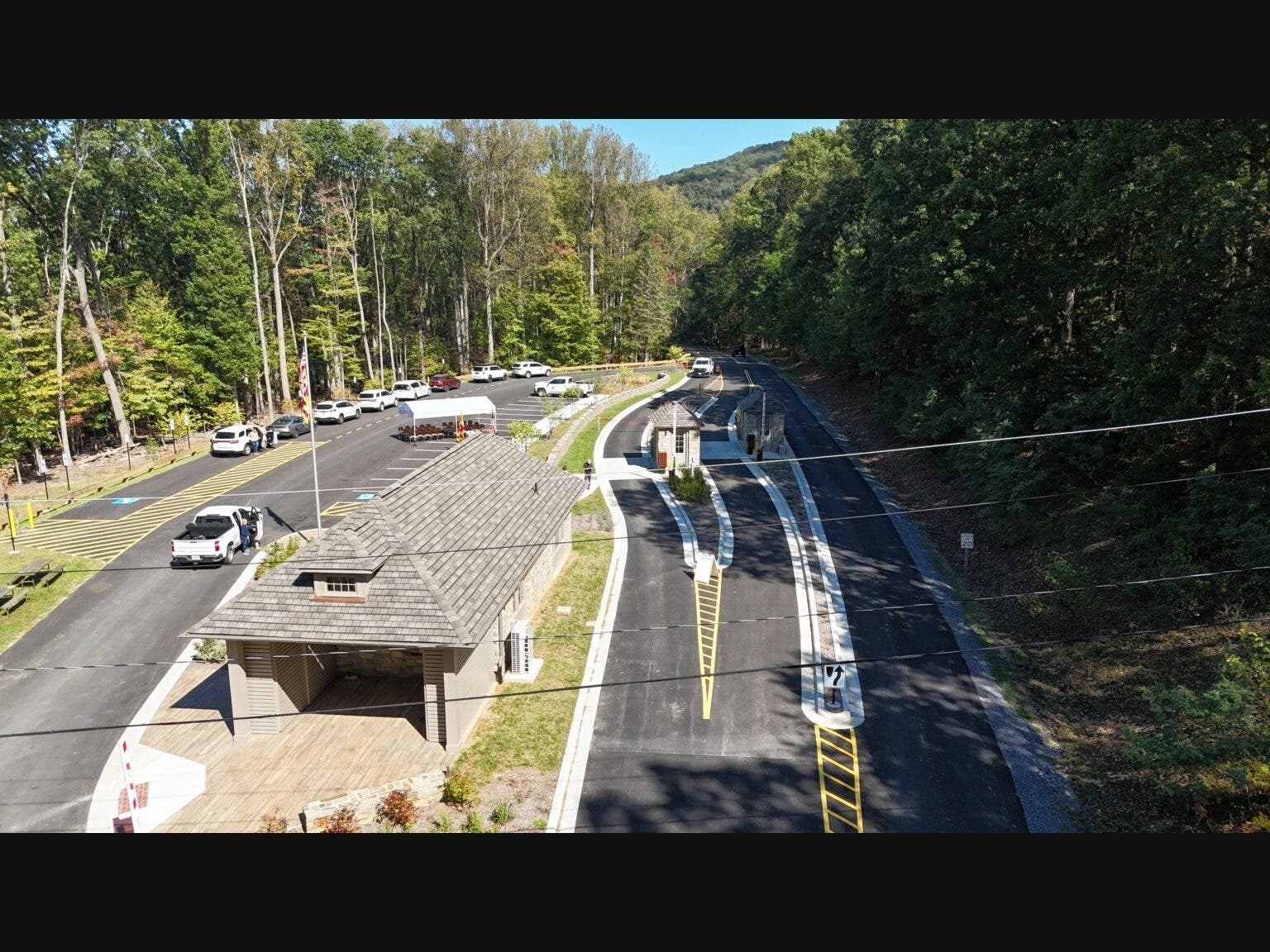
But the state is also eyeing different avenues for expansion. At some park locations with unmonitored “honor boxes,” where visitors are supposed to insert their park entry fee in cash, the department will instead post a QR code that visitors must scan on their cell phones to pay the fee before a gate will lift, allowing them to enter.
“It’s exactly the same as if we had Ranger Paul sitting there and he manually enters you into the thing, takes your cash or your credit card, and then hits the button to open the gate — but it’s all automated,” Peditto said.
The department is also looking to bring the reservation system to several shooting ranges operated by the state, Bortz said, including at Green Ridge and Savage River state forests.
The park service was hoping to start installing the system at new parks as soon as possible, so that it may reach some parks by June. But the arrangement with Kaizen Labs, the contractor installing the systems, faced a hang-up at last week’s Maryland Board of Public Works meeting, where it must be approved in order to go forward.
After pushback from the board, which includes the governor, the state treasurer and the comptroller, the department withdrew the agenda item. Agency staffers said they were asked to provide additional documentation on the agreement with Kaizen, including comparisons to other state park reservation systems nationally. The matter could be reintroduced as soon as the board’s next meeting on May 20, and department officials are optimistic that it will be.
“We’re just going back and we’re going to redo that economic assessment for the board, and continue to keep moving forward,” said Department of Natural Resources Secretary Josh Kurtz.
Under the deal, the state won’t pay Kaizen a lump sum, but rather tack on a 23% processing fee to each entry payment, which would go directly to the company. State park entry fees often range between $3 to $5 per person, so the fees could increase by more than a dollar per visitor.
It’s the same arrangement that took hold at last year’s slate of five parks. Peditto said the agency received “no pushback” on the slight fee increase in 2025.
Maryland Gov. Wes Moore, left, attends a 2025 tree planting event with his Natural Resources Secretary Josh Kurtz and Maryland first lady Dawn Moore. (Photo courtesy Maryland DNR)
“Most people figured out: ‘I would gladly pay $1.70 extra to know that I’ve got a spot in line and I’m going to get in,’” Peditto said.
‘Dishonor boxes’
Kurtz still remembers the reception he got when he stopped his car at an entrance at Greenbrier State Park last winter, hoping to drop an entry fee in the park’s collection box.
“It’s free! Keep moving!” yelled a person from a car behind Kurtz, with some obscenities mixed in, according to the secretary.
By requiring online payment at the gate, the department is hoping to change that paradigm, Kurtz said, and recoup revenue that would otherwise be lost.
“We’re in a tough budget situation. We’re not changing the fee structure. We’re just enforcing it,” he said.
Peditto said he jokingly calls the collection tins “dishonor boxes,” since they’re frequently ignored — sometimes maliciously, and sometimes not.
“Nobody carries cash with them anymore,” Peditto said. “They ask for three or five dollars and you’re like … ‘I want to pay you, but I don’t have a way of doing it.’ This solves that problem, too.”
The new procedure also has safety benefits, Peditto said.
Now, park rangers will have an online record of each park entrant, and precisely when they arrived at the entry gate, Peditto said. The system will make it easier for park rangers to realize that someone hasn’t exited the park in a timely fashion, a possible signal that they are lost or injured in the park, Peditto said.
Rangers would also immediately know more about the potentially lost visitor, making it easier for them to reach emergency contacts and more quickly ascertain where the person may be stranded.
“I’m sure there are some folks who think that that’s maybe too much Big Brother government,” Peditto said. “We look at it as a pretty darn good safety net.”
The agency is hopeful that visitors who don’t have the proper technology on hand when they arrive at the gate — or struggle to use it — will be few and far between, Peditto said. But there is still a contingency plan.
“Every location has a phone number you can call. We have a 24/7 dispatch system at DNR,” Peditto said. “We will figure out a way to get them in.”
Expanding the system
The reservation system might be a byproduct of the coronavirus pandemic, which caused a dramatic increase in Maryland state park visitation. In 2020, 21.5 million visitors came to Maryland state parks, a 45% increase over the previous record-breaking year.
After COVID, the numbers decreased slightly from the 2020 peak, but stayed considerably higher than pre-pandemic, according to the park service.
The park service plans to expand the online system as widely as possible, Peditto said. But many parks are not a natural fit, and the system likely won’t be deployed there, he said. The initial focus is on parks with traffic queues and other issues, he said.
“It would be, I don’t know, irresponsible to say we’re going to figure out a way to force everybody to come into Dan’s Mountain Wildlife Management Area on like a 5-mile-long road right through the middle of it, and try to figure out how to capture all of them.”
The park service is hopeful that the fee arrangement with Kaizen will aid in the program’s expansion, Peditto said.
“We thought that that would better incentivize the vendor to sort of grow the model with us,” Peditto said.
The vendor did not make a profit on the arrangement in 2025, he said.
“I know for sure that this was not something that they were bragging to their investors about the first year,” Peditto said.
Maryland Matters is part of States Newsroom, a network of news bureaus supported by grants and a coalition of donors as a 501(c)(3) public charity. Maryland Matters maintains editorial independence. Contact Editor Steve Crane for questions: scrane@marylandmatters.org. Follow Maryland Matters on Facebook and Twitter.