Politics & Government
Redistricting Ballot Question Faces Stiff Opposition From Voters: Poll
Campaign could lead to passage, but confusing language could cause voters to vote against or skip the question.
October 8, 2026
A proposed amendment to the Maryland Constitution that would change the way congressional districts are drawn in Maryland faces stiff voter opposition, a new poll shows.
Find out what's happening in Across Marylandfor free with the latest updates from Patch.
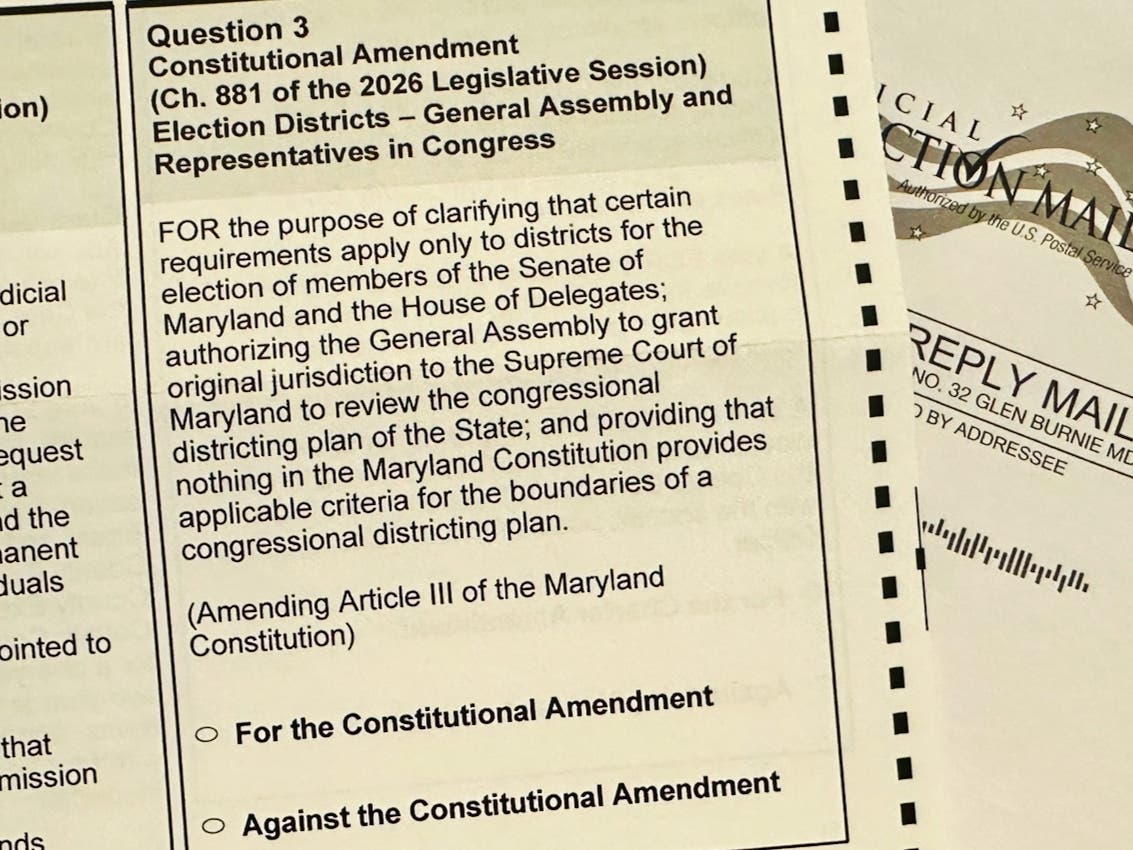
The poll, released Tuesday by the Institute of Politics at the University of Maryland Baltimore County, found 53% of those surveyed said they would vote against ballot Question 3, a proposed amendment to the Maryland Constitution that would lift many of the restrictions on how congressional districts are drawn in the state. Another 25% supported it and 19% were undecided.
Mileah Kromer, director of the poll, said she’s not convinced the ballot question won’t pass, despite the numbers. There is time for supporters to mount a full-court campaign for the question, which is backed by Gov. Wes Moore and other Democratic party leaders.
Find out what's happening in Across Marylandfor free with the latest updates from Patch.
“So I think what our numbers really show — when you look at them in comparison with the full ballot language — is that there is certainly a disconnect between when people are presented with the full ballot language, understanding what that ballot language means and what it’s asking, and the real political ramifications of it,” Kromer said.
Opposition to the question is driven by 74% of Republicans and 59% of unaffiliated voters. They were joined by 42% of Democrats.
The poll comes with four weeks left in the campaign season. Nearly 600,000 voters have already received mail-in ballots. Early voting begins Oct. 22 and ends on Oct. 29.
The survey is based on interviews with 776 Marylanders who said they were likely to vote. The survey conducted from Sept. 22 to 27 and has a margin of error of plus or minus 3.5%.
The survey released Wednesday is the second of three to be released by the university. A poll released Tuesday showed Moore with a 27 percentage point lead over Republican challenger Dan Cox in the race for governor. Part three is expected on Thursday and will examine the governor’s job approval numbers and voter sentiments on artificial intelligence and data centers.
The UMBC findings on Question 3 follow two polls released last month on the topic.
One, by Protect Maryland Votes, a group that opposes the ballot question, found just 28% support while another 4-in-10 opposed it. The poll was conducted by two pollsters — one that works for Democrats and another that works with Republicans.
A second, released days later by Question 3 supporters Fight Back Maryland found 40% support for the question. That poll was conducted by a pollster who works with Democratic candidates.
Both the Protect Maryland Votes and Fight Back Maryland surveys were based on asking voters to make a decision after hearing the question as it appears on the ballot. That question was rewritten by the Supreme Court of Maryland after a majority of judges found the original question was deficient.
The Fight Back Maryland poll found that many voters said they did not understand the ballot question.
Todd Eberly, a political science professor at St. Mary’s College of Maryland, said there are studies “that at least appear to suggest that when voters don’t understand the question, they are more likely to vote against it or leave it blank. That’s why, to me, it really does raise the question of who’s done a better job of educating people as to what this means.”
Kromer, in her poll, took a different approach from the two other polls that surveyed likely voters after presenting them with the exact, but complicated, language that will appear on ballots. The UMBC poll presented voters with a “plain language” description of the outcome of passing the question.
“I wanted to ask something with the plain language — what the meat of the political outcome was going to be, and that is that it opens up the ability for Maryland Democrats to draw congressional district lines without constraints in the Maryland Constitution,” she said.
“At the end of the day, people recognize that drawing district lines to favor one party over another, the average voter doesn’t like that concept,” Kromer said. “I think that is when you put it in plain language, that is what you’re seeing.”
Kromer also asked voters about their feelings on the political outcome of passage of the question.
A majority, 57%, said they thought drawing districts to benefit one party over another shouldn’t be done or was the wrong thing to do. Slightly more than a third of voters said it was either “sometimes necessary” or “we should do it.”
Overall, 83% of voters surveyed identified partisan redistricting as a problem facing American democracy.
“There’s not a lot of people supporting at this point,” Kromer said.
Other concerns included:
- The influence of money in politics — 88%
- Declining trust in government — 88%
- Misinformation on social media — 85%
- The feeling that ordinary people have no say — 79%
- Low voter turnout or participation — 67%
- Potential for political violence — 62%
Maryland Matters is part of States Newsroom, a network of news bureaus supported by grants and a coalition of donors as a 501(c)(3) public charity. Maryland Matters maintains editorial independence. Contact Editor Steve Crane for questions: scrane@marylandmatters.org. Follow Maryland Matters on Facebook and Twitter.