Neighbor News
How the New Beverly City Hall Impacts Our Schools
What the project's timing and priorities reveal about Beverly's long-standing underfunding of its schools.
There has been significant discussion in Beverly regarding the proposed new City Hall project, estimated at approximately $28 million.¹ Some residents see the current City Hall as outdated, inefficient, not ADA-compliant, and believe replacement is necessary and fiscally responsible. Others view the project as poorly timed, emblematic of overspending, and disconnected from residents’ concerns about taxes and core services.
As with most public debates, the truth likely lies somewhere in between.
However, focusing solely on whether a new City Hall is justified risks obscuring the more important question: how does this decision fit within Beverly’s broader fiscal priorities; particularly when it comes to funding our public schools?
Find out what's happening in Beverlyfor free with the latest updates from Patch.
The administration has argued that financing a new City Hall through long-term planned debt service is preferable to absorbing large capital costs through annual operating budgets. Several City Councilors have echoed this reasoning, emphasizing the distinction between operating budgets and capital debt, and noting that maintaining a consistent level of debt service (often cited around five percent) helps preserve borrowing capacity, avoids sharp spikes in annual operating costs, and protects classrooms from having to absorb major infrastructure expenses. This framework is intended to keep operating budgets predictable while allowing future capital needs (such as upcoming elementary roof replacements) to be addressed without diverting dollars from instruction.
From a municipal finance perspective, that logic is sound and worth understanding.
Find out what's happening in Beverlyfor free with the latest updates from Patch.
But this discussion is also inherently backward-looking. Beverly has historically underinvested in preventative maintenance and long-term capital planning. Not only in our schools, but across municipal facilities. That pattern has compounded costs over time and helps explain why the City is now confronting multiple large capital needs simultaneously. Responsibility for this reality spans many administrations; however, responsibility for setting priorities, sequencing projects, and clearly communicating tradeoffs rests with current leadership.
The concern today is not about blame; it is about priority-setting in the present moment. And priorities are ultimately revealed not by stated goals, but by the sequence and urgency of our decisions.
Beverly is facing what many have described as a structural deficit between recurring revenues and the cost of providing essential services. Our schools remain significantly underfunded relative to state norms, and the City is openly discussing additional reductions to school programs and other services. Against this backdrop, the decision by the administration to advance a major City Hall investment now raises legitimate questions about timing, tradeoffs, and leadership.
Mayor Michael Cahill has stated a goal of bringing Beverly to the Massachusetts average for per-pupil school spending during his term. That goal matters, because newly released data from the Massachusetts Department of Elementary and Secondary Education (DESE) shows that Beverly remains near the bottom statewide in in-district per-pupil expenditures.²
Despite a modest enrollment decline (which typically increases per-pupil spending) Beverly’s relative standing did not improve. Current DESE figures show that Beverly spends approximately $3,800 less per student than the statewide average.³ With roughly 4,500 students,⁴ that translates to more than $17 million per year in spending below what the average Massachusetts district invests in educating its children.
To put this into context:
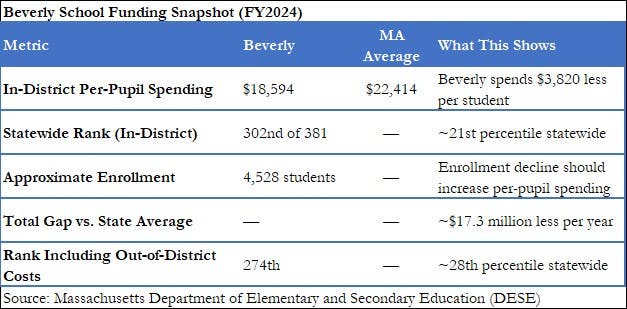
Even when out-of-district special education costs are included, Beverly remains far below the state average.⁵ While special education costs are rising statewide (and nationwide), these increases often reflect reactive, higher-cost interventions rather than proactive investments. In the long run, underfunding general education and student support services tends to drive higher special education and tuition costs, ultimately increasing financial pressure on taxpayers.
Closing this funding gap will require new revenue or difficult tradeoffs: reallocating existing city resources, responsibly using reserves, pursuing grants, or (most realistically) asking voters to approve a Proposition 2½ override.⁶ Whether the City is willing to pursue those options, and how clearly that path is articulated, is a leadership decision. To date, residents have not been presented with a clear, realistic plan from the administration for achieving the Mayor’s stated school funding goals.
Even if the City Hall project is financially defensible over the long term, the optics and timing of advancing it now were choices. Voters do not experience municipal finance through balance sheets and bond schedules; they experience it through classrooms, staffing levels, and tax bills.
The fact that many residents continue to ask basic questions about how this project fits into the City’s long-term financial plan suggests that the message (however sound its underlying logic) has not yet been communicated clearly or broadly enough.
This is where the City Council has both an opportunity and a responsibility.
As the body charged with appropriations, oversight, and long-term fiscal policy, the City Council can insist on greater transparency, clearer benchmarks, and a credible path toward adequately funding Beverly’s schools. Councilors can demand that stated commitments to education be paired with specific revenue strategies, timelines, and accountability. Not left as aspirational goals.
My message to the community is this: the City Hall project may not be a poor financial decision in isolation. Investing now and spreading costs over time can, in theory, provide long-term savings and flexibility. But that does not absolve the administration of its responsibility to lead with clarity, nor does it relieve the City of its obligation to fully fund our schools.
Ultimately, this moment will test the priorities, values, and leadership of our elected officials. I remain hopeful that the City Council will seize this opportunity to press for a clear, credible plan to address Beverly’s long-standing school funding challenges. And I remain hopeful that the Mayor will also seize this moment to lead with clarity, transparency, and urgency. Doing so will require more than sound financial logic; it will require the courage to acknowledge hard tradeoffs, to communicate honestly with residents, and to align words with action.
Beverly is a community that values its children, its schools, and its future. With courageous leadership and a shared commitment to putting students at the center of our fiscal decisions, we can invest responsibly in our infrastructure and finally make the sustained investment in education that our community expects. And deserves. I remain hopeful that our elected leaders will rise to that challenge.
Footnotes & Sources
City of Beverly capital planning and City Council materials, https://www.beverlyma.gov
DESE District Profile – Finance, https://profiles.doe.mass.edu
DESE Per-Pupil Expenditure Statistics, https://profiles.doe.mass.edu/statereport/ppx.aspx
DESE October 1 Enrollment Reports, https://www.doe.mass.edu/infoservices/reports/enroll/
DESE Special Education & Circuit Breaker Data, https://www.doe.mass.edu/finance/circuitbreaker/
Massachusetts Department of Revenue, Proposition 2½ Overview, https://www.mass.gov/service-details/proposition-2-12-and-tax-rate-process