Business & Tech
The Rise Of Yemeni Coffeehouses In Dearborn And Beyond
The mayor of Dearborn, Michigan, Abdullah Hammoud, declared the city the "Coffee Capital of America" in November 2025.

July 21, 2026
The mayor of Dearborn, Michigan, Abdullah Hammoud, declared the city the “Coffee Capital of America” in November 2025.
Find out what's happening in Across Michiganfor free with the latest updates from Patch.
Hammoud’s declaration was inspired by the recent cultural phenomenon of Yemeni coffeehouses. Yemen is where coffee was first brewed as a beverage, and these local coffeehouses reflect that rich cultural heritage.
Three businesses headquartered in Dearborn — Qahwah House, Qamaria Coffee and Haraz Coffee House — now operate between them 121 stores in 14 states, including Ohio, Illinois, Texas, Maryland, Virginia and Tennessee.
Find out what's happening in Across Michiganfor free with the latest updates from Patch.
New York Mayor Zohran Mamdani and his wife, Rama Duwaji, had their first date at a Qahwah House in Brooklyn in 2021, one of 27 offshoots of the original.
As an author and public historian, I have documented the rise of the halal food industry in Michigan and paid close attention to how Yemeni coffeehouses, founded by Middle Eastern immigrants, have become cultural institutions grown in Michigan but affecting the entire nation.
From cultural refuge to business empire
Arab American coffeehouses have a long history rooted in the diaspora.
In the early decades of the 20th century, small coffeehouses in Detroit gave immigrant men from today’s Lebanon and Syria the opportunity to catch up with fellow migrants, speak Arabic and hear news of home.
In these coffeehouses, they could learn about work and housing opportunities and enjoy dining on familiar foods, like kibbee, a spiced lamb with cracked wheat; bamiyah, an okra stew, or spinach pies prepared by other Middle Eastern immigrants. In some cases, Muslims and Christians would gather inside coffeehouses to worship or celebrate religious holidays together.
These early coffeehouses helped establish Arab community enclaves in places like Detroit and Dearborn. They were frequently male-only, smoke-filled spaces. Churches, mosques, restaurants, night clubs and civic organizations frequently grew out of the social ties forged over a cup of strong coffee.
Immigrants from Iraq, Lebanon and Yemen continued to create coffeehouses like these throughout metro Detroit in the 20th century, and they still attract recent refugees and other immigrants from Yemen, Iraq and Syria in the 21st.
Contemporary Yemeni cafes appeal to a much larger public audience. Both men and women are welcome, while smoking and hookah are not.
No alcohol is served, making these cafes halal, or permissible for Muslims, as well. The cafes provide an important third space – a kind of neutral meeting space where people can gather outside the home, work or school.
In Arab enclaves like Dearborn, these spaces allow men and women to socialize separately or together, and they take the pressure off individual households by shifting the demands of frequent hosting into public spaces.
Interestingly, in Dearborn, several coffeehouses have begun making space available in back rooms for prayer.
“We would rather our customers pray here than leave the premises for a mosque,” one proprietor explained to me. “Here, they are likely to buy a second cup of coffee once they are finished, and one for the friends who pray alongside them.”
A harvest of flavors and fellowship
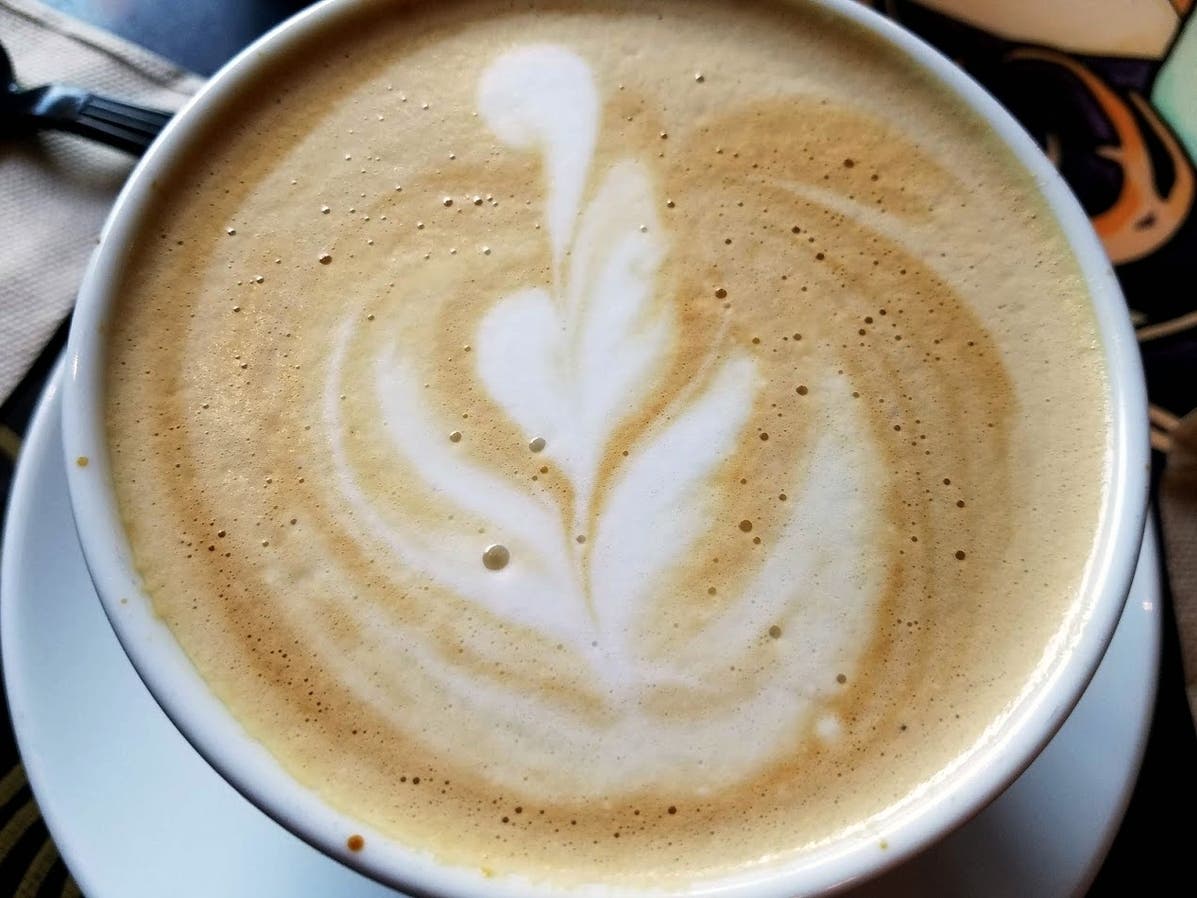
Modern Yemeni coffeehouses offer distinctive brews of coffee and tea. The drinks are seasoned with traditional infusions of cardamom, ginger, cloves, nutmeg, cinnamon or qishr, which are coffee husks. They are served in delicate finjans, or small glass cups without handles, and artful half-size demitasses as well as the more common takeout cups.
They also serve a variety of pastries, some familiar like baklava and tiramisu, and others that are unique to Yemen like sabaya, a buttery, flaky pastry smothered in honey, and khaliat al-nahl, a cheese-filled Yemeni honeycomb bread.
Some Americans are encountering Yemeni coffee for the first time in one of these new cafés, which are appreciated for their quiet atmosphere, attentive service, the quality of the beverages provided and their distinctive decor.
Qahwah House, for example, decorates its cafes with photographs of the Yemeni countryside, focusing on the regions where coffee is grown, and on the processing of coffee. They include maps of Yemen, artifacts like coffee pots that are symbols of traditional hospitality, and artifacts related to the shipping and production of coffee.
Haraz, whose first location opened in Dearborn in 2021, exhibits a more upscale decor. The coffee shop’s honeycomb motif refers to the wealth of honey varieties indigenous to Yemen and to the honeycomb shape of the khaliat al-nahl dessert. Arabic calligraphy references the values of hospitality and sociability alongside arabesque patterns in a bright gold finish that contrasts with the crisp white and earthy wood tones of the walls and furnishings.
Some of the coffeehouses in Michigan also include Yemeni diwan-style sectional couches in bright brocades and with lots of rectangular pillows that serve as armrests. More recent coffeehouses are leaning into an aesthetic that people in Michigan refer to as the “Dubai” or “luxury” style. They are more elegant in appearance but still reference Yemen in the kinds of coffee and sweets served and in the form of hospitality on display by their staff.
Visionaries behind the modern coffeehouse
Mokhtar Alkhanshali, a California-based Yemeni American whose family in Yemen has grown coffee for generations, is the entrepreneur who first reintroduced Yemeni coffee to American consumers.
As described in Dave Eggers book, “Monk of Mokha,” Alkahnshali traveled to the Yemeni countryside in 2013 to seek out the fruitiest coffee beans and to identify the most efficient ways to harvest and get them to market. He established farming cooperatives that were able to supply a steady stream of high-quality coffee for export.
In 2016, Alkahnshali launched the Port of Mokha company and made his coffee available at the high-end Blue Bottle Coffee cafes in San Francisco. In 2021, one of his single-origin coffees received a 96 on a 100-point scale from Coffee Review, an influential coffee buying guide.
Alkhanshali was not the only Yemeni American with deep family ties to coffee agriculture in the homeland. Ibrahim Alhasbani is the eighth generation of his family to farm or market coffee. He founded Qahwah House in Dearborn in 2017.
Alhasbani’s cafes focus on high-quality beans and the unique ways Yemenis prepare and consume tea and coffee, often enjoying small cups served from a communal pot with a large group of friends or family.
By sharing the story of coffee in Yemen, Alhasbani set out to share the story of Yemen.
“It’s not just a drink,” Alhasbani said recently. “It’s history. It’s culture. It’s who we are.”
Yemeni communities establish roots in the United States
Both Alkhanshali’s and Alhasbani’s businesses were started in the midst of a devastating civil war and humanitarian crisis in Yemen that started in 2014 and is ongoing. Alhasbani came to the U.S. because of the war.
Yemenis continue to face a challenging political climate. The United States has banned Yemeni immigrants and nonimmigrants from entering the country, and the temporary protected status of those already in the U.S. is under threat of suspension.
Despite these challenges, the Yemeni community in Michigan has grown significantly in recent years. Today it is the largest single Middle Eastern demographic group in Detroit and Hamtramck and a significant population in Dearborn as well.
As Yemeni coffeehouses go viral, they provide Americans with a space to savor Yemen’s history and culture. They also reflect the changing demographics of the Arab communities of Michigan along with their growing affluence and influence.
The Michigan Advance, a hard-hitting, nonprofit news site, covers politics and policy across the state of Michigan through in-depth stories, blog posts, and social media updates, as well as top-notch progressive commentary. The Advance is part of States Newsroom, a national 501(c)(3) nonprofit supported by grants and a coalition of donors and readers.