Politics & Government
Social Security Shortfall Could Cost MI $12.1B In Benefits, Report Says
More than 2 million Michiganders would be affected if the retirement trust fund is depleted in 2032, an analysis found.


Social Security retirement benefits could be cut by about 22 percent in six years if Congress doesn’t act, and Michigan would be among the hardest-hit states.
The retirement trust fund is projected to run out in the fourth quarter of 2032, according to the 2026 Social Security Trustees Report. At that point, continuing income would cover 78 percent of scheduled benefits.
The warning comes as retirees prepare for a 3.6 percent cost-of-living increase in January, which the Social Security Administration announced Oct. 14.
Find out what's happening in Across Michiganfor free with the latest updates from Patch.
The Committee for a Responsible Federal Budget, a nonpartisan fiscal policy group, estimated how a cut would play out in each state. The average Michigan retiree would lose $523 a month, which would be the ninth highest among all states. The analysis was released in June, before the latest Trustees Report, and is based on a 24 percent cut.
The cuts would directly affect 2,009,446 Michiganders, or 19.8 percent of the state’s population. In total, Michigan residents would lose $12.1 billion in benefits, the analysis found. That is the 9th-highest total among states and equal to 1.6 percent of the state’s economy.
Find out what's happening in Across Michiganfor free with the latest updates from Patch.
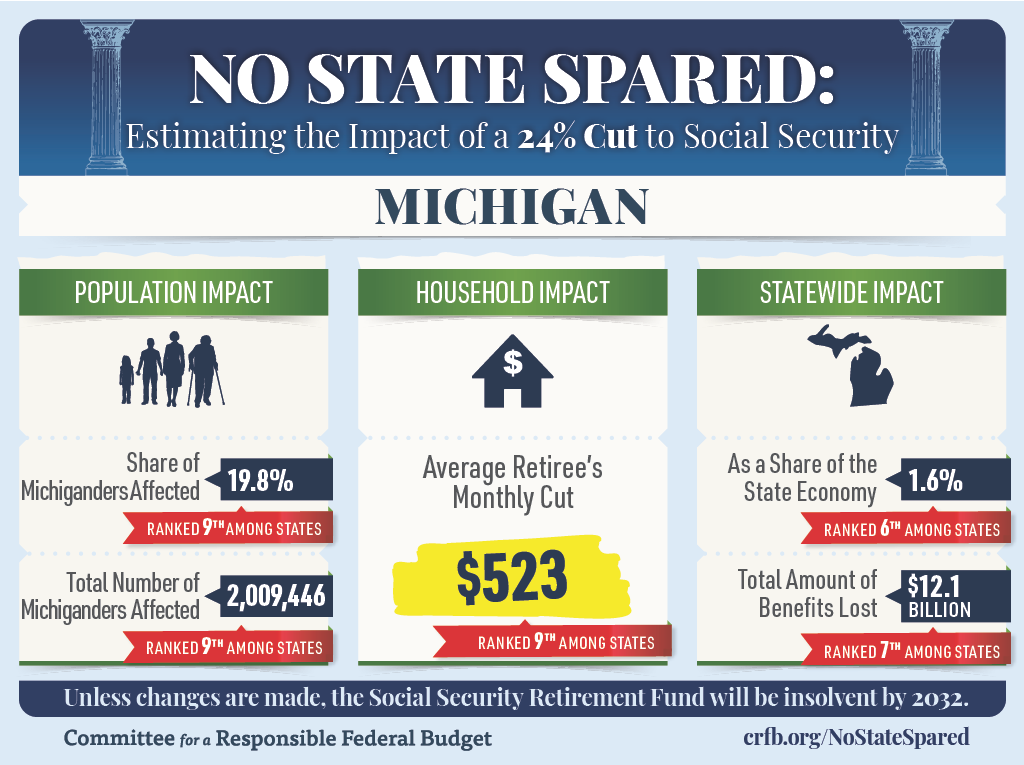
These are the states facing the largest average monthly cuts, according to the analysis:
- Connecticut: $556
- New Jersey: $554
- New Hampshire: $553
- Delaware: $549
- Maryland: $541
In neighboring states, Ohio retirees would lose an average of $487 a month and Wisconsin retirees $513.
Nationwide, the average monthly cut would be $500, and cuts would top $500 in 29 states, the group said.
Why Michigan Would Be Hit Harder
Monthly benefits vary based on a person’s lifetime earnings and the age when they first claim them, according to the Peter G. Peterson Foundation, a nonpartisan fiscal policy group. Because the committee applied the same 24 percent cut in every state, retirees in states with higher average benefits, like Michigan, would lose more in dollars.
When The Cuts Could Happen
By law, once the trust fund is depleted, the program cannot pay out more in benefits than it takes in. This means cuts would take effect automatically unless lawmakers step in.
The committee’s estimates are based on a 24 percent cut. The group noted that the Trustees now estimate a cut of about 22 percent, rising to 38 percent by 2100, while the Congressional Budget Office estimates an average cut of 28% from 2032 to 2036.
The committee urged lawmakers to act quickly to prevent “deep, abrupt benefit cuts that would affect all beneficiaries, regardless of age or need.”
What It Would Mean For Retirees
According to the Senior Citizens League, 73 percent of retirees depend on Social Security for more than half their income, and nearly 4 in 10 say it is their only income.
Running out of reserves would not shut down Social Security or stop monthly payments, according to ElderLawAnswers, a legal resource site for older adults. Instead, payments would drop to what incoming revenue can cover.
Lawmakers have several options to close or shrink the gap, including raising revenue, adjusting benefits or combining the trust funds, according to the American Academy of Actuaries. Merging the retirement and disability funds would push the depletion date to 2034, according to the Trustees Report, but it would not fix the program’s long-term shortfall.
Get more local news delivered straight to your inbox. Sign up for free Patch newsletters and alerts.