Politics & Government
Think An Income Tax Is Crazy? AFP Roundtable Warns 'Crazy' Happens In Concord Every Day
The message throughout the evening at the Goffstown brewery was that absurd-sounding policies have a way of becoming law.

It starts with laws against ferret hunting and nighttime seaweed collection, and it ends with passing a state income tax.
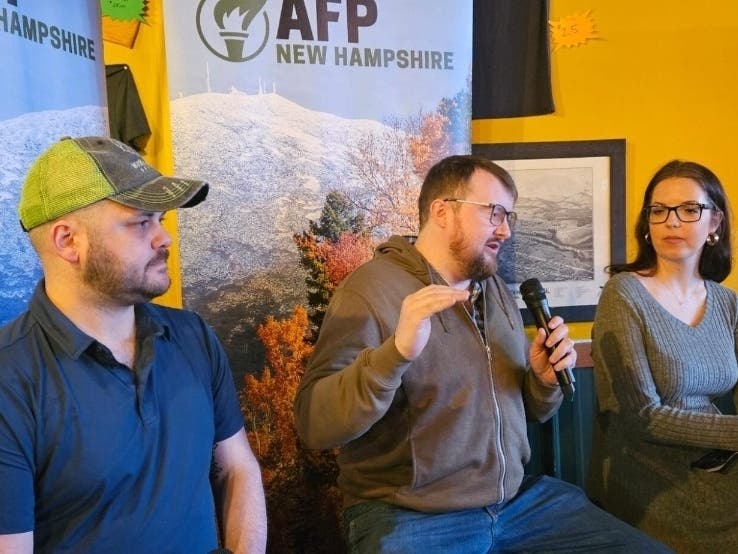
That was the message at an Americans for Prosperity New Hampshire roundtable at Mountain Base Brewery, highlighting crazy Granite State legislation — some merely proposed, others passed into law.
Find out what's happening in Bedfordfor free with the latest updates from Patch.
If a state can pass mandates on the size of the holes in restaurant sugar shakers (they cannot exceed three-eighths of an inch) today, why not a broad-based state income tax tomorrow?
Host AFP Deputy State Director Sarah Scott began the event by asking participants to name the craziest bill they’ve seen during the current session.
Find out what's happening in Bedfordfor free with the latest updates from Patch.
“My favorite bill was an act relative to the prohibition of games in which the goal of the contest is to capture a greased pig — God forbid!” said Rep. Ross Berry (R-Weare).
“I thought this was America,” Berry joked.
Rep. Joe Alexander (R-Goffstown) nominated a bill by left-wing Democratic Rep. Wendy Thomas (D-Merrimack) that would have prohibited the sale of condoms and personal lubricants containing intentionally added PFAS compounds.
“I don’t think anybody wearing a condom is really concerned about PFAS content,” Alexander said. “But apparently Rep. Thomas is.”
The message throughout the evening at the Goffstown brewery was that absurd-sounding policies have a way of becoming law, and that New Hampshire’s long-standing resistance to an income tax is not as ironclad as Republicans may assume.
“Growing up in New Hampshire, we’ve always been really proud of not having an income tax,” Scott said. “Every year, when anybody suggests implementing that, the resounding response from everybody in the state is always absolutely not. So when you hear a proposal for an income tax, first you kind of look around; did somebody really suggest that here?”
“Somebody did,” Berry promptly noted, “and they held a press conference on the State House steps,” a reference to former Democratic Executive Councilor Andru Volinsky.
Volinsky is leading the fight for what he calls the “Cut Our Property Taxes” initiative. His plan would impose a 3 percent income tax to raise $1 billion a year to help pay for state education funding, shifting the burden from property taxes.
Volinsky’s plan has been rejected by Republican Gov. Kelly Ayotte and her likely Democratic opponent, former Executive Councilor Cinde Warmington. Legislative leaders on both sides of the aisle have also declared the idea DOA.
But strange things can happen in Concord, Berry noted, pointing out that a proposed constitutional amendment to permanently ban a state income tax has failed in the legislature, with some Democrats arguing they oppose an income tax but don’t want to foreclose the option entirely.
“If you don’t think it’s off the table with these guys, it’s 100 percent on the table,” Berry said.
Alexander agreed, arguing that while Republicans dismiss the Volinsky plan as a joke, many Democrats aren’t laughing.
“Democrats (in the House) are divided. Half of them don’t want an income tax. Half of them are very, very clear that they do want an income tax. Which is it?” Alexander asked.
“We are very consistent on our side, and their leaders stand on the pedestal and say, ‘We don’t want an income tax, either.’ But the rank-and-file Democrats want it.”
Alexander also warned that the Democrats’ message of lower property taxes has appeal. New Hampshire has among the highest property taxes in America, and he said he’s heard from local business owners who are intrigued by the idea of a tax shift.
“But when have you ever seen a tax go down?” Alexander said. “The reason they’re trying to message it that way is because that’s how they think it’ll get through.”
Scott pointed to Washington state, which recently enacted a new income tax targeting high earners, as another example of how such taxes tend to expand once established.
“They always say it’s only going to target the rich — millionaires and billionaires,” she said. “That’s always how it starts. And then of course you start expanding it.”
The panel also discussed what they described as more consequential policy battles. Alexander highlighted the repeal of mandatory vehicle inspections as one of the most meaningful affordability wins of the session.
“As somebody who is moderate to lower income — I was a bartender by trade — the fact that you have to get your vehicle inspected and they might say your brakes are bad or your tire tread isn’t good enough, that extra $1,000 really matters to people,” he said. “The fact that we said we’re not doing that anymore is really important.”
Berry raised the proposed battery recycling fee, which he and Scott criticized for including a provision barring retailers from disclosing the fee to consumers.
“If you have to hide the cost, you’re not the good guy,” Berry said.
This story was originally published by the NH Journal, an online news publication dedicated to providing fair, unbiased reporting on, and analysis of, political news of interest to New Hampshire. For more stories from the NH Journal, visit NHJournal.com.