Politics & Government
Can A Former Television Actor And NH Pols Bridge The Partisan Divide? The NH Forum Seeks To Find Out
Andrew Shue, formerly of the 1990s hit TV series "Melrose Place," and a Dartmouth Grad, was in Concord to unveil The NH Forum on Tuesday.


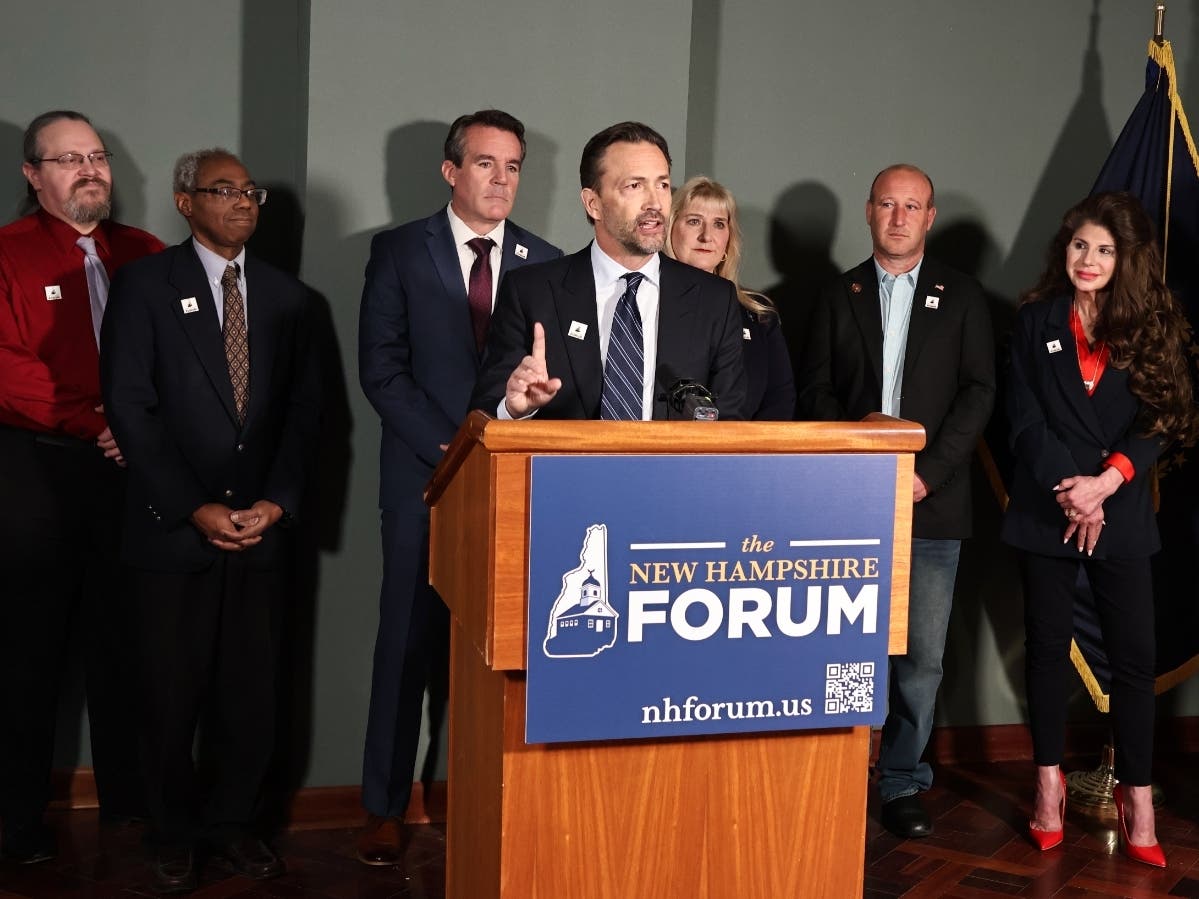


CONCORD, NH — Former and current elected legislators are hoping, with a new website and some help from a former television star, to bridge the state’s partisan divide and bring about change, focusing on political issues that unite people rather than divide them.
On Tuesday, leaders from both political parties, and Andrew Shue, a Dartmouth College grad who has founded several civic organizations, and is probably best known for playing soccer and the role of heartthrob Billy on “Melrose Place,” introduced The New Hampshire Forum to the public. Collectively, the organization, which is being led by Republican Kevin Smith, the former town manager of Londonderry and former candidate for U.S. Senate and Governor, and former State Senate President Donna Soucy, a Democrat from Manchester, hopes to bring Granite Staters together around issues with commonsense, easy, and implementing solutions, while also, later, delving into the more complicated public policy that divides everyone.
Smith joked when it was first pitched to him, he was going to shy away from it, wanting nothing to do with politics these days. But after hearing more and knowing Soucy would be involved, someone he respected and admired on the other side, he agreed to co-lead the effort. He likened their process to Noah’s Ark, ensuring both parties were represented.
Find out what's happening in Concordfor free with the latest updates from Patch.
Soucy said she was “thrilled” when she learned Smith had agreed to participate. She said organizers wanted the site to be a safe place for residents to speak their minds and interact with each other. Both agreed there was a need to cut through the noise and factions.
To learn more about the New Hampshire Forum, visit this link.
Find out what's happening in Concordfor free with the latest updates from Patch.
State Sen. Denise Riccardi, R-Bedford, who is part of the legislative advisors, said she was very excited about the group’s prospects, adding that, in six years in the Senate, she strove to work in a bipartisan manner on legislation.
“This is exactly how I operate,” she said. “It’s about not being right as politicians but being true public servants… doing what’s right for the people. We are going to make life better for all Granite Staters.”
Shue, who also founded The People in 2018, a similar effort, and DoSomething decades before that in the early 1990s, an international nonprofit exhorting young people that community involvement was fun and important, joked about snow in early April, reminding him of his Dartmouth days. But, he turned serious, too, and said the nation was at an “all hands on deck moment” and there was no one coming to save the nation. The only people who were going to be able to do that were ourselves, he said. Shue said the state of the nation has been motivating him for the last seven years to create this effort.
“I think all of us feel that we are not right,” Shue said, “that America is not right. I think all of us feel for our kids and our grandkids.”
Seven years ago, Shue and others crisscrossed the state discussing important issues of the day, which led to the New Hampshire Forum website. The org also has sites in Nevada and South Carolina, two early presidential primary states.
Shue said, in attendance, were elected officials from both parties, including partisans who know the state and nation are dysfunctional and something different had to be attempted. It was not a recent phenomenon either, he said, adding, “This has been going on for decades… we have left all of the big issues that affect all of us sitting, waiting, getting worse by the day, for too long.” Shue compared the effort to Henry Wadsworth Longfellow’s “Paul Revere’s Ride,” which was written to inspire unity in the early 1860s before the start of the Civil War.
“In that moment, people knew a free society was at stake,” he said. “It’s no different than today.”
Shue pointed to the current political polarization, income inequality at levels similar to before the Great Depression, fiscal irresponsibility, political violence similar to that seen in the 1960s, and “the fear everybody has with impending transformation of AI” and what it will do to younger generations, work, and other issues.
“This is our wakeup call,” Shue said, adding the United States had to decide whether it was defined as a “blood and soil nation” or “a creedal nation.”
The Forum, he said, would bring everyone to the table: From billionaires to bartenders, Democrats and Republicans, Free Staters and the frustrated. Shue said about 5,000 people had already signed up to the website, added their voices to the process, and offered changes they wanted to see to the state of New Hampshire. From there, the org hopes to organize participants around commonality. After that, they will tackle the more complicated problems to see if solutions can be found.
If the Forum can achieve political balance, attain “real scale,” and move good legislation through the process of the House, Senate, and be signed by the governor, “we will tell a story to the nation, just like Longfellow was trying to tell… we all love America, and we will answer the call.”
State Rep. Dan Veilleux, D-Amherst, and state Rep. Mike Bordes, R-Laconia, who is also that city’s mayor, were part of the legislative advisors. Bordes said his dual role required him to bring people together and work with both sites.
“More people agree than disagree,” he said. “Seventy percent of America is right here. And that is what we need to focus on.”
State Sen. Tara Reardon, D-Concord, was also involved in the effort, agreeing with Bordes that there was more commonality than division and the key was to take advantage of it. She said New Hampshire was a place of “unmatched civic engagement” and real progress could be made by working together.
“New Hampshire doesn’t need shouting,” she said. “We need a way to be heard and counted together.”
Both Soucy and Smith chimed in, too, about how exhausted the public was by the polarization and the lack of compromise seen on the state level, even though the same people can find it at Town Meeting and other bodies.
During the question-and-answer period, Shue was asked what made this effort different than others. He said the technology would allow anyone and everyone to participate, whether they voted or not. At the same time, they are striving to find political balance. There will also be transparency, starting with online engagement, in-person and group functions, and then an event in the fall to co-create legislation. Shue pointed to the housing issue, which is multifaceted and already worked on, but maybe could have been tweaked to move public policy forward. He said “amending constitutions” was not possible, but there needed to be a way for a free society “to self-correct and to heal” and “solve big problems.”
Shue was also asked about the significance of having three Forum sites in the early 2028 primary states. He called them “patriotic states.” But if the org is successful with legislation and its efforts in 2027, the presidential candidates will see the way forward.
Shue was asked where the group’s financing was coming from. He said he was paying for some of it, but also donations. Shue said most of the donors were “mostly centrist, to be honest.” The org was also fundraising in New Hampshire and seeking politically balanced philanthropic financing. Shue said there could be no agenda for the Forum process or funding other than the people’s agenda.
In a follow-up, Shue said about $1 million was being spent in each state for the efforts.
When asked about what was being overlooked with the elected officials and how they cannot get to the 70 or 80 percent of issues everyone agrees on, since they see a lot of fighting at the Statehouse. Soucy said the election process made it difficult to work in a bipartisan manner. She hoped, though, by working together organically, officials could show voters that it was possible not to lose core values while getting things done, and that they would prove it in 2027, after the midterms.
Shue was asked how there could be no agenda in an organization attempting to self-correct, a possibility that could be perceived as a political agenda. Any civil society had to have a way or process for adapting or evolving to new situations, he said. Some people, Shue said, might think things are OK. But he would bet there were more who thought things were not working.
Smith said he did not think the org would solve “third-rail issues,” but there would be issues where there was “broad consensus,” like affordability, as one, but they tend to get polarizing during the election cycle.
When asked if anything would be used before the midterms to influence campaigns, Shue said no. Granite Staters, he said, needed to construct the process within the Forum, and that would take time.
When asked if there would be packages of legislation in 2027 or individual, minor changes to the bills proposed, Smith said, “It’s too early to say… It’s all going to be organic… the only agenda is to get as many Granite Staters involved as possible and find these areas where both parties can work together, to find broad consensus.”
Soucy said there could be one issue or three. It is unknown, but it would be “bottom up.”
Shue added, while working directly with the legislators, in hopes of avoiding entanglement with special interests.
Do you have a news tip? Email it to tony.schinella@patch.com. View videos on Tony Schinella's YouTube or Rumble channels. Patch in New Hampshire is now in 217 communities — and expanding every day. Also, follow Patch on Google Discover.
Get more local news delivered straight to your inbox. Sign up for free Patch newsletters and alerts.