Politics & Government
Start A Conversation? Volinsky's Income Tax Plan For New Hampshire Starts A Firestorm
Both Democrats and Republicans denounced Andru Volinsky's proposal to institute an income tax and raise the SWEPT tax for schools.

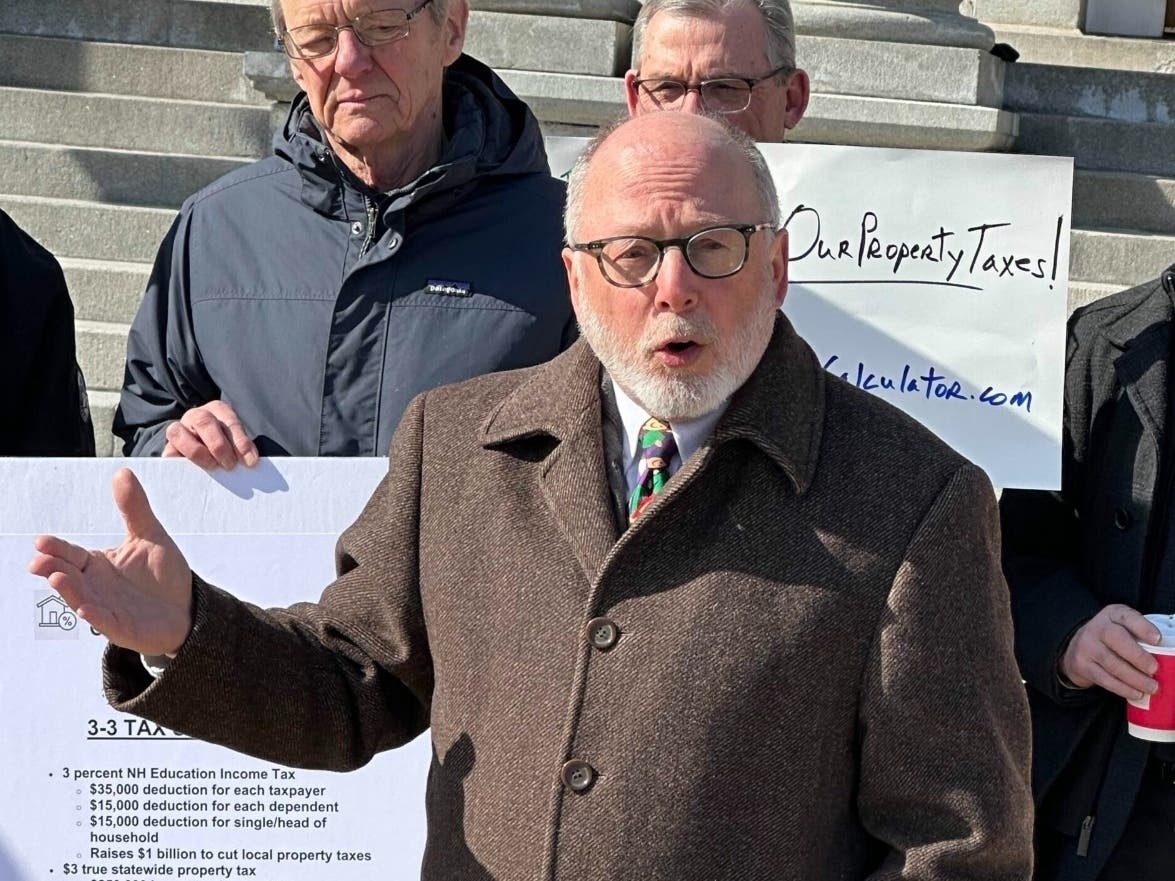
Andru Volinsky and fellow supporters of a state income tax to fund education spending said at a Tuesday press conference that their goal was to “start a conversation” about the best way to pay for public schools. And it worked.
Granite State politicians had plenty to say in response to the proposal — all of it bad.
Find out what's happening in Concordfor free with the latest updates from Patch.
“No income tax. No sales tax. No raising taxes on working families.”
“When Volinsky ran for governor on an income tax five years ago, he lost the Democratic primary. If he wants to try again, that’s his choice.”
Find out what's happening in Concordfor free with the latest updates from Patch.
“Granite Staters do not want an income tax. Period.”
And that was the response from Democrats.
(In order: Cinde Warmington, House Democratic Leader Rep. Alexis Simpson and Deputy House Democratic Leader Rep. Laura Telerski.)
“New Hampshire House Democrats will not support an income tax. House Democrats are fighting every day for our Fair Chance Agenda, and an income tax has not and will not be considered,” Simpson added.
 Supporters of using an income tax to fund state education spending hold a presser at the N.H. state house on March 3, 2026.
Volinsky, Rep. Thomas Oppel (D-Canaan), and former Democratic candidate for governor Mark Fernald pleaded with the press and public to focus on the policy proposal, not the politics. They argue voters are looking for relief from the state’s high property taxes, and shifting part of the burden to an income tax is a reasonable proposal.
“This is a plan to get the conversation started,” Oppel said. “We want to have a policy discussion, and we want the media to be part of that discussion. If the media immediately jumps to, ‘Well, politically, this won’t work,’ you’ve done a disservice.”
But before the Tuesday presser was even over, the plan was already taking political fire.
“New Hampshire Democrats are once again making clear that their top focus is instituting a sales and income tax and making New Hampshire more like Massachusetts,” said Ayotte campaign spokesman John Corbett. “As Gov. Ayotte has warned, we are never more than one election away from becoming Massachusetts, and there is no reason to believe that Opioid Lobbyist Cinde Warmington would have the courage to stop her party from passing sales, income, death, interest and dividends taxes, paint taxes, or whatever else they might cook up, if she were in the Corner Office.”
House Majority Leader Jason Osborne released a statement on behalf of his caucus.
“Let me be perfectly clear: The ‘3-3 Plan’ is a billion-dollar income tax. The House Republicans’ answer to an income tax has not changed. Our answer is still HELL NO.”
Telerski responded: “Rep. Osborne and I don’t agree on much, but we agree on this.”
The “3-3 Plan” refers to a 3 percent income tax and a $3 statewide property tax, each of which would raise a projected $1 billion, supporters said, to offset current property tax revenue.
There would be exemptions on the income tax: a $35,000 exemption per taxpayer, a $15,000 exemption per dependent, and $15,000 for a single person or head of household.
“So if you have income in a four-member family of $100,000 a year, you pay zero in the New Hampshire education income tax,” Volinsky said. And since the median household income is $99,000, “the 3 percent (tax) doesn’t kick in until most people have more income than the median.”
However, the average income for a single-person household is about $46,000, meaning they would pay the income tax. The average salary for a full-time worker in the Granite State is about $92,000.
The $3.00 statewide school tax proposal comes with a $250,000 homestead exemption for Granite Staters on their primary residences. “A homeowner with a $500,000 house pays $750 a year — far less than most are paying now,” according to the plan.
“Renters receive an equivalent credit, recognizing they pay property taxes indirectly through rent.”
Passing an income tax would end the “New Hampshire Advantage,” shorthand for the state having no broad-based sales or income taxes. It’s a powerful marketing tool for businesses and would-be residents, particularly in high-tax New England.
Rochester Mayor Chuck Grassie has a different take.
“When people talk about the ‘New Hampshire Advantage,’ I always say the New Hampshire Advantage wasn’t our taxes, because the people at the bottom get screwed,” Grassie said at the presser. “Our New Hampshire Advantage is quality schools in a good environment, and I’m not seeing that coming out of this State House.”
But Sarah Scott with Americans for Prosperity–New Hampshire says the “Advantage” is very real.
“We have seen this play before in states like Connecticut with higher taxes, broken promises, and working families paying the price,” Scott said.
“The state’s low-tax environment and pro-growth policies have led to a booming economy that should not be tampered with. AFP-NH urges the Legislature to reject this proposal and protect New Hampshire’s economic freedom so we don’t follow the failed path of higher-tax states.”
With Warmington having already announced she will not support a tax increase, will Volinsky enter the race to make his case for the “3-3 Plan?”
“I am not running for governor,” he told NHJournal.
Asked if he’s disappointed that an income tax is “off the table” for his party and its candidates, Volinsky replied: “Some people think it’s off the table.”
XFacebookLinkedInCopy LinkEmailShare
This story was originally published by the NH Journal, an online news publication dedicated to providing fair, unbiased reporting on, and analysis of, political news of interest to New Hampshire. For more stories from the NH Journal, visit NHJournal.com.