Politics & Government
An Open Letter to Governor Sherrill: Pending Data Center Applications Need State Protections Now
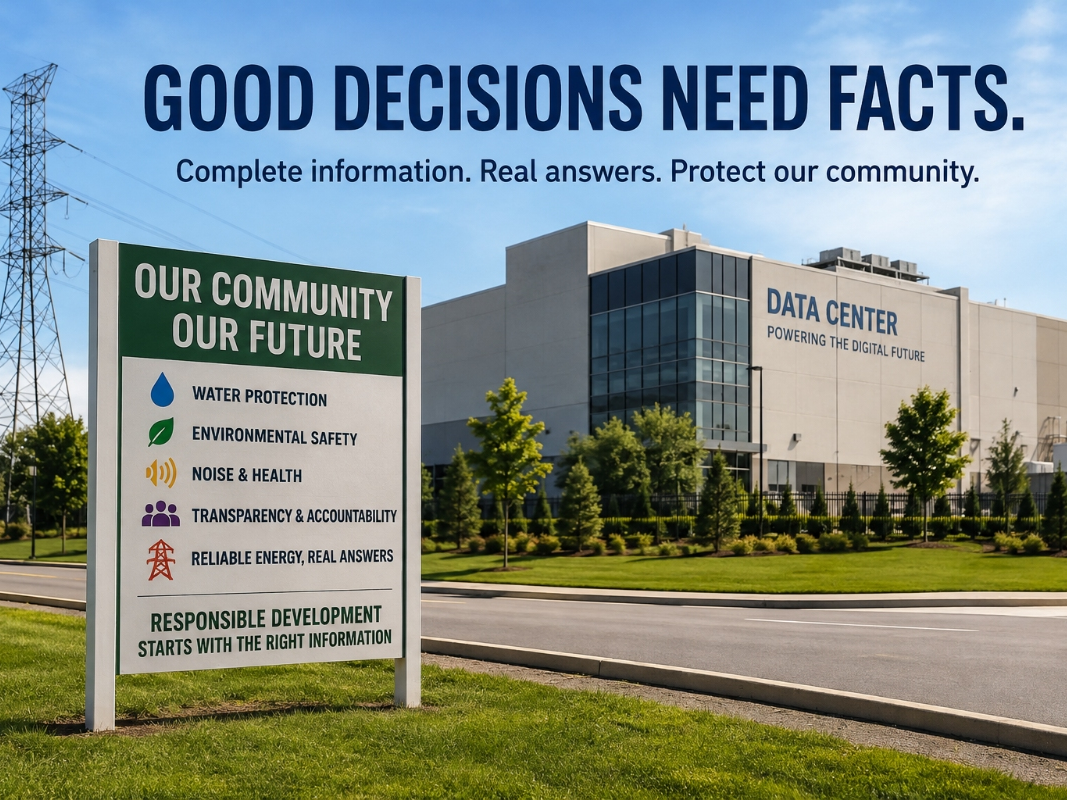
Pending data center applications need full disclosure before local boards act.
Dear Governor Sherrill:
Your administration has correctly recognized that large data centers can affect energy demand, water use, pollution and host communities. Your statewide plan calls for fair-share energy rules, greater transparency, stronger community-benefit standards and state resources to help municipalities negotiate from a position of strength. The problem is that local applications are advancing faster than those protections.
Large developers arrive with attorneys, engineers, consultants and promises of investment and tax revenue. Local officials face intense pressure to welcome economic development. Meanwhile, ordinary residents—often a small, self-funded volunteer group—must raise money, hire land-use counsel, locate technical experts and review thousands of pages simply to obtain information that should have been required before an application advanced.
Find out what's happening in Holmdel-Hazletfor free with the latest updates from Patch.
Holmdel is a case in point. A data center was included as a permitted use in the Bell Works redevelopment framework adopted in 2012—before the current generative-AI-driven surge in large-load facilities. The present proposal is for a 108,000-square-foot data center with a 40-megawatt utility load.
Residents have been told that the application was deemed complete. Yet Holmdel’s checklist requires a detailed narrative addressing the project’s use and operations. The public filing does not identify the ultimate operator or tenant, explain the facility’s specific operating model or end use, or disclose its expected average operating load. It also does not establish the final cooling and water design, completed-facility noise impacts, generator-backup capacity and diesel storage, or final electrical-service configuration.
Find out what's happening in Holmdel-Hazletfor free with the latest updates from Patch.
The developer publicly says existing electrical capacity is sufficient, reliability will not be affected, no new poles are needed and any infrastructure work will involve only replacing existing wires. JCP&L’s filed letter does not confirm those claims. It says complete electrical-load information is still required, the exact service method remains subject to engineering review, and a substation, system upgrades or additional equipment may be necessary.
These are not ordinary setback or parking questions. They involve regional grid planning, ratepayer protection, air emissions, backup fuel and contaminated-site remediation. The filing also predicts increased groundwater recharge at a property where PFAS and other groundwater contamination are documented.
It is fair to ask how an application of this magnitude could be deemed complete while core information about its operator, use, average electrical demand, cooling, backup power, fuel storage and utility infrastructure remains unresolved. Administrative completeness should not be confused with having enough information to understand a project’s consequences.
This exposes a serious weakness in current local land-use laws. They are too weak and outdated to ensure that the broader consequences of today’s large-load data centers are independently established before projects advance through municipal review. Projects of this scale need clear minimum-disclosure standards before local hearings begin—not after residents are forced to uncover the missing information themselves.
The proposed Responsible Data Center Development and Resource Protection Act (S4402) recognizes this gap by requiring a state-approved resource-impact statement before a municipality grants preliminary approval for a large-load data center. That proposal is important, but communities facing hearings now cannot wait for legislation to catch up.
S4402 should include a transitional provision requiring every large-load data-center application still pending and not yet granted preliminary approval to comply with its resource-impact and minimum-disclosure standards, because excluding projects already in the municipal pipeline would deny the communities facing the most immediate risks the very protections the legislation is designed to provide.
I urge you to please establish interim minimum-disclosure standards for large-load projects; provide municipalities and residents with independent technical assistance from the Board of Public Utilities, Department of Environmental Protection and State Planning Commission; and support a transitional provision in S4402 requiring every pending application that has not yet received preliminary approval to comply with the bill’s resource-impact and disclosure requirements, so communities facing the most immediate decisions are not excluded from its protections.
No volunteer resident group should have to build and finance its own miniature regulatory agency simply to learn what a project will do.
Local laws should not permit a large data center to move faster than the information needed to understand its impact.
Truly,
Prakash Santhana
Former Holmdel Deputy Mayor