Health & Fitness
'They Will Come To You': Lone Star Ticks Spread West In Suffolk
Suffolk officials say tick-borne diseases are rising as Lone Star ticks expand farther west across the county.


BAY SHORE, NY — Ticks remain a growing public health concern across Suffolk County and officials said Tuesday that increased surveillance efforts are underway as the movement of the Lone Star ticks continues to head towards western Suffolk County.
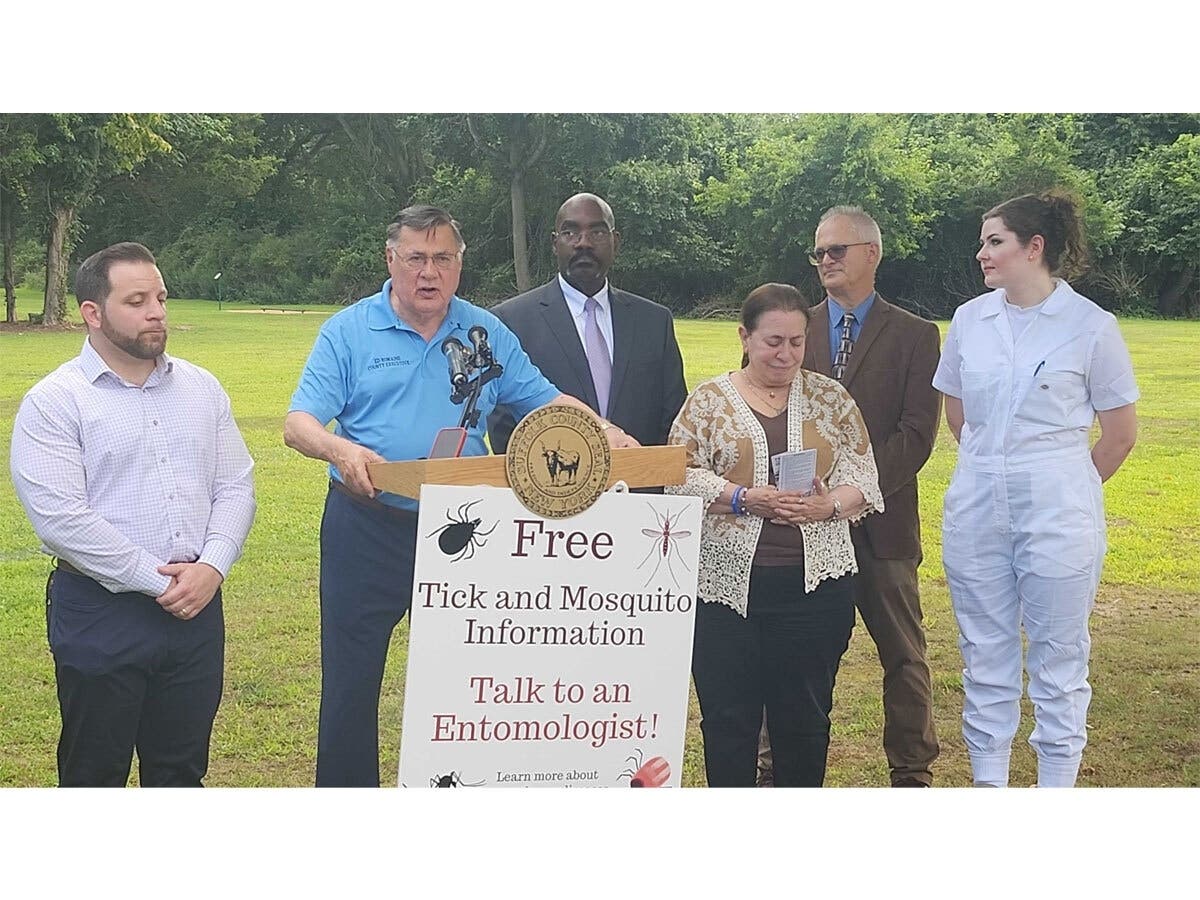
County Executive Ed Romaine, county health officials and Legislator Richard Renna gathered at Gardiner County Park in Bay Shore to discuss tick-borne diseases, prevention and the county's efforts to monitor tick populations.
Romaine said public education remains one of the county's strongest tools and urged residents to wear protective clothing, check themselves after spending time outdoors and quickly remove ticks that attach to the skin.
Find out what's happening in Bay Shorefor free with the latest updates from Patch.
“Tick-borne diseases are on the rise,” Romaine said. “Do we have a fixed way of fighting it? No, we don't. The best defense against a tick is an observant person."
Dr. Scott Campbell, a medical entomologist and the Chief of the Arthropod-Borne Disease Laboratory at the Suffolk County Department of Health Services, said that ticks can remain active throughout the year whenever temperatures rise above 40 degrees, challenging the perception that tick precautions are only necessary during the warmer months.
Find out what's happening in Bay Shorefor free with the latest updates from Patch.
Campbell said adult black-legged ticks can continue “questing” during warm periods in winter and can transmit the pathogen that causes Lyme disease.
“Any day during the winter, typically, you would also want to do a tick check,” Campbell said.
Romaine said tick numbers and conditions appeared to be “a little worse” in 2026, but Campbell cautioned that final 2026 human case numbers were not yet available because cases are still being investigated.
“There's approximately 3,000 cases of Lyme disease in Suffolk County every year,” Campbell said. “It fluctuates because the tick populations fluctuate, and the infection rates in the ticks fluctuate slightly because it's dependent on weather and hosts.”
The warning follows data highlighted earlier this summer showing the scale of the problem in Suffolk.
In July, Patch reported that Suffolk County recorded 3,152 Lyme disease cases in 2024 — the most of any county in New York, according to data released by U.S. Sen. Chuck Schumer's office. Schumer, appearing with Romaine and health officials at West Hills County Park in Huntington, called for $273.5 million in federal funding for tick-borne disease research, surveillance, testing and treatment.
.jpg)
The movement of deer populations farther west is a factor increasing people's exposure to ticks, Campbell said.
One species receiving particular attention is the Lone Star tick, which officials said has continued moving into western Suffolk County.
Unlike some ticks that wait on vegetation until a host brushes against them, Lone Star ticks can actively move toward a potential host.
“They will come to you,” Romaine said. "They jump on you, they'll try to suck the blood out of you, and then after two or three days, they drop off, and it's itching. You think it's a reaction and all of a sudden it turns into a bullseye."
.jpg)
Lone Star ticks are among the species capable of transmitting illnesses and are also associated with alpha-gal syndrome, an allergic condition linked to certain tick bites.
Officials urged residents not to ignore symptoms following a tick bite, particularly a rash, headaches, aches or other signs of illness, and encouraged people to seek medical attention.
“You cannot have enough protection against this,” Romaine said. “Please, I would urge everyone, be vigilant.”
Romaine said tick sprays and treatments of Suffolk County Parks are conducted in some circumstances depending on where ticks are being found. He said he favors natural treatments rather than chemical products, while acknowledging they may not be as effective.
Renna, who represents the 14th Legislative District, said tick checks have become routine for his family after spending time outdoors.
“As somebody with little children, I was telling the doctor before, when we go out, we come home. We're doing tick checks, head to toe,” Renna said.
County entomologist Molly Thompson demonstrated how Suffolk officials search for ticks in the field.
Thompson dragged a large white cloth across grass and vegetation at Gardiner County Park, a surveillance technique designed to mimic an animal or person moving through an area.
“We do surveillance,” Thompson said. “I go to the parks all over the county and I do this, and then I would collect the ticks and we collaborate with the State Department of Health, and we send them off for testing.”
Ticks engage in a behavior known as “questing,” Thompson explained, positioning themselves on grass or leaves and waiting to attach to a passing host.
“They sit on the edge of blades of grass, leaves, and they'll grab on,” Thompson said of the ticks.
Romaine said the county's message comes down to awareness and prevention as residents continue enjoying Suffolk's parks, yards and other outdoor areas.
“We are going to do all we can to fight the tick,” Romaine said. “I need everyone to check themselves. It's as simple as that.”
Get more local news delivered straight to your inbox. Sign up for free Patch newsletters and alerts.