Politics & Government
Back of the Ballot, Block by Block
Every charter question passed in all 72 CB6 election districts, and CB6 has backed every housing and transit question in a dozen years.


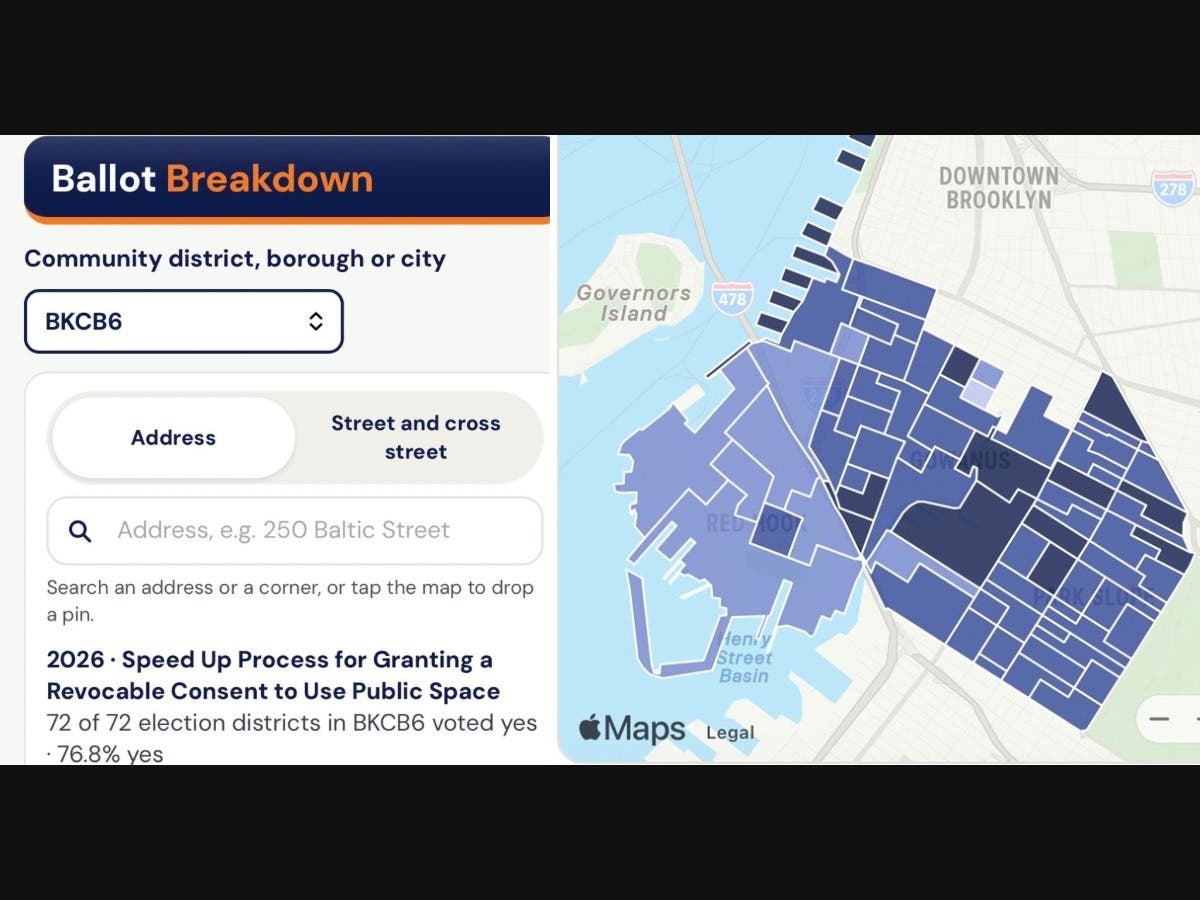
In a prior newsletter, I made the point that the most competitive election in the Brownstone Belt wasn't even the election, but the 5 charter changes on the back of the ballot. They are also the most useful to break down. A candidate wins or loses. A ballot question tells you what a neighborhood wants, block by block.
Here, all five passed in every CB6 election district with votes counted, 72 of them, with 75 to 82 percent voting yes. And Brooklyn as we know it was born from a ballot measure, which I'll get to below.
So I went back. I've pulled together CB6's voting record on the back of the ballot questions, both city- and state-initiated, that we have records for. I'm working back through every question since the vote that put Brooklyn in the city, and I'm still compiling.
Find out what's happening in Brooklynfor free with the latest updates from Patch.
Over the last ten elections, spanning a dozen years, CB6 has had 42 questions on its ballots. We voted yes on every one supporting housing, transportation, and faster review. So did Brooklyn and the city as a whole, but not by as much: CB6 ran 4 to 13 points ahead of both on each.
That is not a district that votes yes on everything. It is a trend of voters showing discretion, and it is especially true here. Two years ago CB6 voted no on all five city questions, and the city passed four of them anyway. And even on the least contentious matter, last year's digital city map, we showed up: 89 percent yes, the highest of any community district in the city.
Find out what's happening in Brooklynfor free with the latest updates from Patch.
You can see it election district by election district, on the site or a download away.
The vote that made the city
The ballot that got the ball rolling toward New York City becoming the 5 boroughs we know it as today came in 1894. Eight places voted on whether to become one city, and Brooklyn, then a city of its own, said yes by 277 votes out of nearly 130,000. The "City of Greater New York" was the ceremonial name used during the consolidation of the City of New York with the City of Brooklyn, western Queens County, and Staten Island (Richmond), which took effect on January 1, 1898.
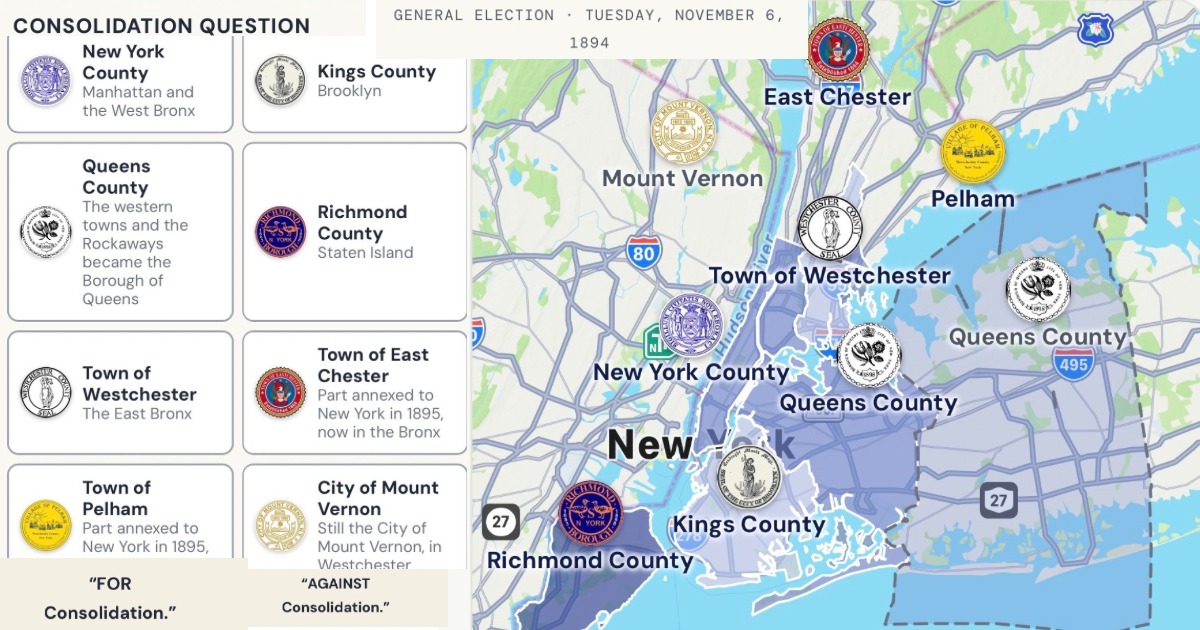
Now you can cast that ballot yourself. Pick your county, pick your slip, "For Consolidation" or "Against Consolidation," the way voters did then, and your vote is added to the running count on the page.
Then see if you would have drawn the city differently: Build Your Own City lets you add Mount Vernon or Nassau, take Staten Island out, and see what that city would look like today.
Either way, the one borough that sometimes talks about leaving is Staten Island. It has even put the question on the ballot, in 1990 and again in 1993, but it hasn't gotten too far past that. It did, however, get them a permanently free ferry.
For the record, I like the 5 boroughs, and I never agreed with the folks who longed for Brooklyn to remain a city and call consolidation "the mistake of '98." However, I'm still hoping someone takes up the mantle of the Norman Mailer and Jimmy Breslin campaign to make the city its own state.
Adapted from the Brooklyn Community Board 6 newsletter of November 11, 2026. Read the full issue at bkcb6.app/newsletter.