Crime & Safety
NYPD Units Failed Nearly Half Of Stop-And-Frisks: Report
91 percent of people stopped by the specialized units were Black or Hispanic, according to the monitor.


NEW YORK CITY— The NYPD’s specialized enforcement units continued to conduct unconstitutional stops, frisks and searches at significantly higher rates than other officers in 2025, according to a report by the department’s independent monitor.
The report, filed Monday by Independent Monitor Mylan Denerstein, examined the Neighborhood Safety Teams, Public Safety Teams and Community Response Teams, which conduct proactive enforcement in high-crime neighborhoods and frequently initiate encounters without responding to a 911 call.
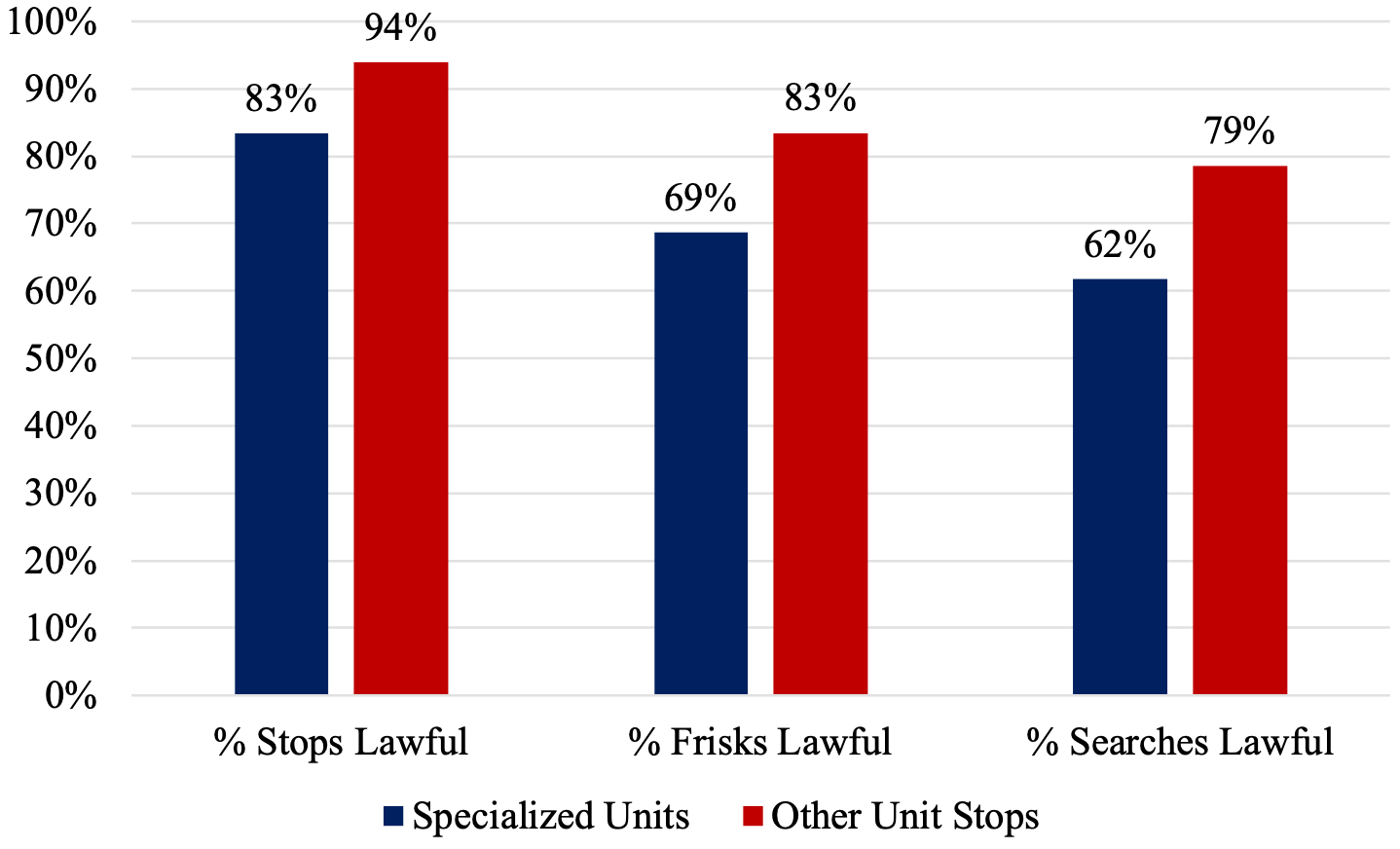
Across 603 stops reviewed by the monitor, officers in the specialized units met constitutional requirements in 83.4 percent of stops, 68.6 percent of frisks and 61.7 percent of searches.
Find out what's happening in New York Cityfor free with the latest updates from Patch.
Officers in other NYPD units, including routine patrol, had substantially higher compliance rates: 94 percent for stops, 83 percent for frisks and 79 percent for searches.
Specialized NYPD Units Had Lower Fourth Amendment Compliance Rates Than Other Units
Who Was Stopped?
The racial breakdown of the monitor’s 603-stop sample was:
Find out what's happening in New York Cityfor free with the latest updates from Patch.
- Black: 401 people, or 66.5 percent
- Hispanic: 150, or 24.9 percent
- White: 28, or 4.6 percent
- Asian: 13, or 2.2 percent
- Middle Eastern: 11, or 1.8 percent
Overall, 91 percent of those stopped were Black or Hispanic.
The monitor found that 532 of the 603 people stopped, 88 percent, were Black or Hispanic men.
The report also included concerns recorded by the Office of the Community Liaison.
Participants described encounters near NYCHA developments involving officers in unmarked vehicles or nonstandard uniforms.
Some reported being asked for identification or subjected to frisks without an explanation of why officers were stopping them or whether they could leave.
Younger participants, generally ages 16 to 22, described being stopped while walking home from school, gathering near residential buildings or spending time in public spaces.
In 2013, a federal judge ruled the NYPD’s stop-and-frisk practices were unconstitutional, finding that the department had unlawfully targeted Black and Hispanic New Yorkers.
The ruling led to a federal monitor being appointed to oversee the department’s compliance with the Fourth and 14th Amendments, and the NYPD remains under court supervision today.
What Happened With CRT Auditing?
The monitor found that the NYPD went about three years without properly checking stops made by its citywide Community Response Team.
The problem started in March 2023.
Before September 2025, some CRT teams were included in the NYPD’s regular audits, but the centralized citywide CRT was not.
When all of the teams were combined into the centralized CRT in September 2025, none of their stops were being audited.
The NYPD discovered the mistake in March 2026 after talking with the monitor and began auditing CRT stops again.
The monitor also asked the NYPD to go back and review CRT stops from the past.
For its 2025 report, the monitor independently chose 100 CRT stop reports that the NYPD had not previously reviewed.
The lapse matters because CRT officers make a large number of self-initiated stops, which the monitor found are especially likely to raise concerns about whether officers had enough legal justification to stop or search someone.
What Did The Monitor Find In Officers’ Reports?
The monitor identified recurring language in stop reports that raised questions about how officers described the circumstances supporting stops and searches.
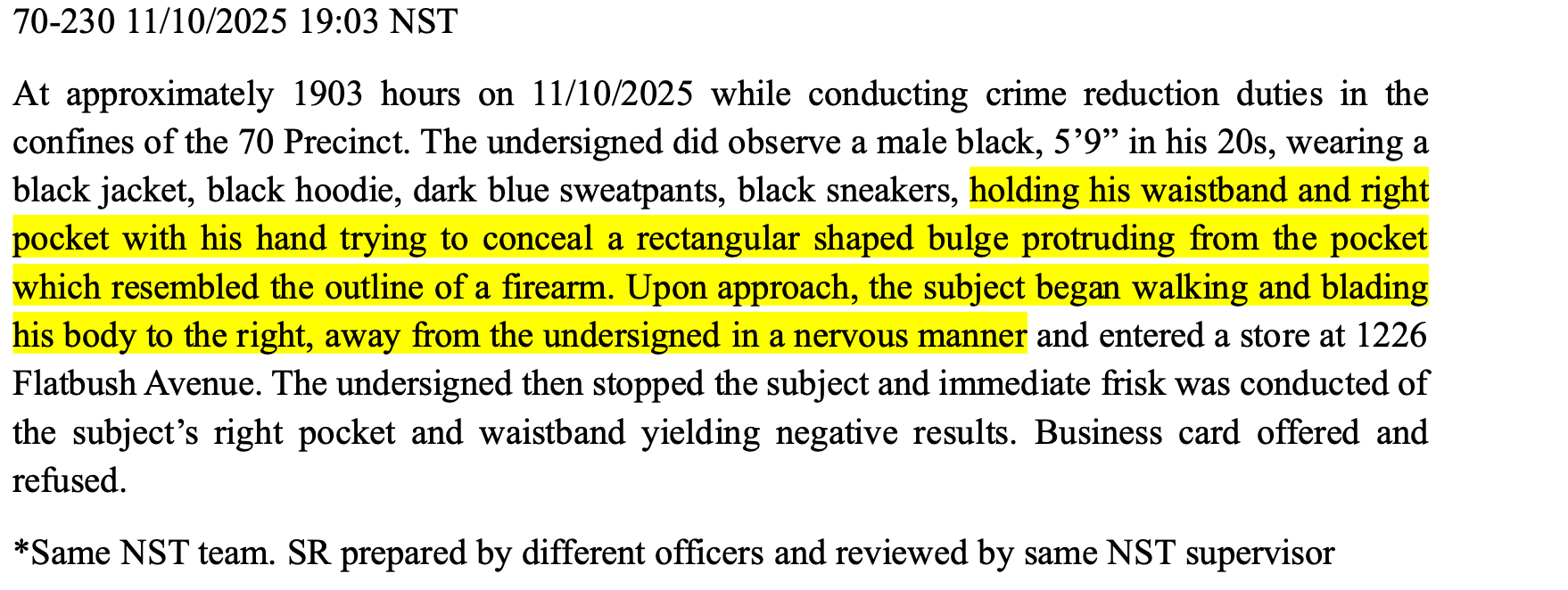
Reports frequently referred to an “L-shaped object resembling a weapon,” a “rectangular bulge” or a “straight-edged object” that officers said resembled part of a gun.
The monitor compared those written descriptions with body-camera footage.
It generally accepted the reports unless the video clearly contradicted them, but noted that repeated language in apparently different encounters raised questions about the credibility of the narratives.
One November NST report described a Black man in his 20s carrying a heavy bag with a rectangular bulge that appeared to resemble a firearm.
The report said he walked away faster, appeared nervous and avoided eye contact before officers stopped and frisked him.
Four days later, another NST report described a Black man in his 20s who allegedly concealed a rectangular bulge in his waistband or pocket.
The report again cited nervous behavior and avoidance before an officer stopped and frisked him.
The monitor identified the reports as involving the same NST team, with different officers preparing the reports and the same supervisor reviewing them.
Similar patterns appeared in reports from the same PST team, according to the report.
The monitor also cited descriptions of behavior such as looking at officers, walking faster, avoiding eye contact, holding clothing or moving closer to a wall as factors officers interpreted as evidence of possible criminal activity.
The report said some of those descriptions did not adequately establish the reasonable suspicion required for a constitutional stop, frisk or search.
What Did The Specialized Units Do?
By the summer of 2025, the NYPD’s specialized units were expected to conduct at least 85 percent of their stops, frisks and searches lawfully, according to the court-appointed monitor.
By the end of the year, the units needed to get at least 90 percent right.
The units cleared the third-quarter target for stops, with 89.7 percent of stops deemed lawful.
They fell short on frisks, at 76.3 percent, and searches, at 69.4 percent.
The fourth quarter brought a decline across all three categories.
Only 82.7 percent of stops, 66.3 percent of frisks and 56.8 percent of searches met constitutional requirements.
No specialized unit reached the 90 percent target in any category during the fourth quarter.
For the full year, the combined rates were 83.4 percent for stops, 68.6 percent for frisks and 61.7 percent for searches.
The monitor did not set a benchmark for the full year. But using the 85 percent benchmark from the third quarter, only CRT stops met that standard, with 86.9 percent of stops considered lawful.
The 2025 results showed little overall improvement from 2024.
Specialized-unit stops were lawful 85 percent of the time in 2024, compared with 83 percent in 2025.
Frisk compliance rose from 62.9 percent to 68.6 percent, while search compliance slipped from 62.8 percent to 61.7 percent.
Why Were Self-Initiated Stops A Particular Concern?
The largest compliance problems appeared when officers initiated stops based on their own observations.
For self-initiated encounters, specialized-unit officers made lawful stops in 80 percent of cases, lawful frisks in 64 percent and lawful searches in 55 percent.
NYPD Specialized Units Fell Short on Lawful Stops, Frisks and Searches in 2025
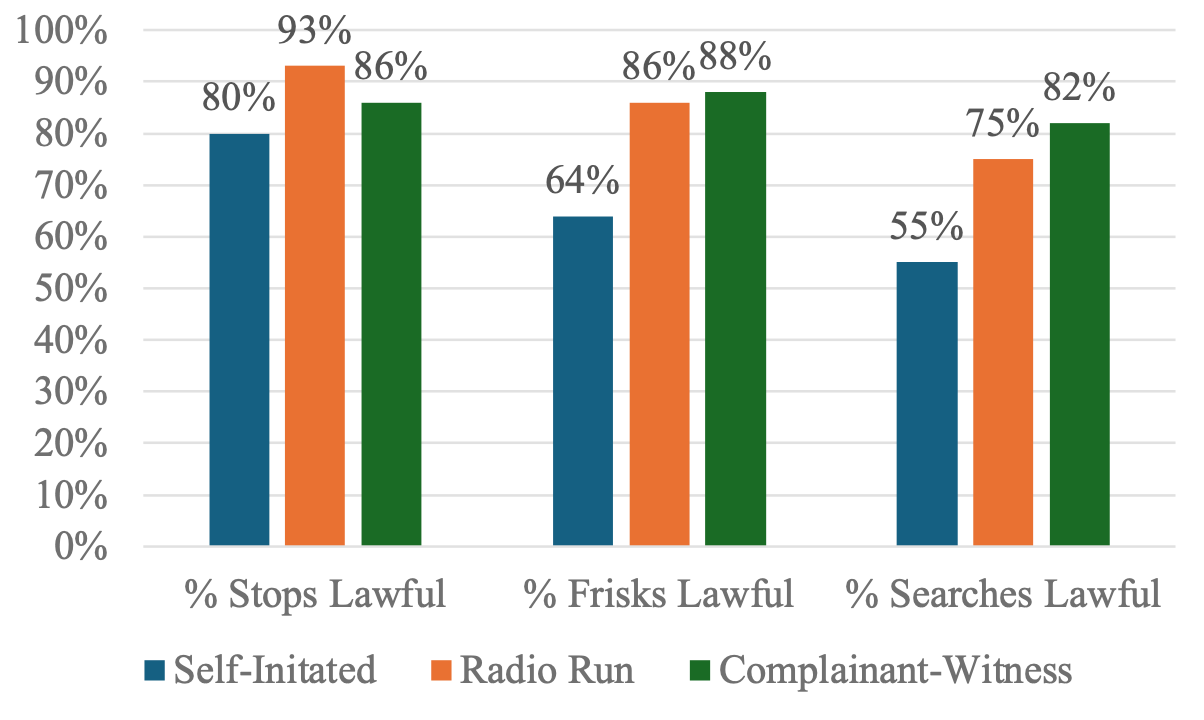
By comparison, stops initiated in response to radio calls were lawful 93 percent of the time, with 86 percent of frisks and 88 percent of searches meeting constitutional requirements.
Stops involving a complainant or witness had lawful rates of 86 percent for stops, 75 percent for frisks and 82 percent for searches.
The specialized units were created specifically for proactive enforcement rather than primarily responding to calls for service.
Neighborhood Safety Teams, created in 2022, focused on removing illegal guns from high-crime areas.
Public Safety Teams had a similar enforcement mission before the NYPD disbanded them Nov. 7, 2025. Some PST officers moved into NSTs.
Community Response Teams began as quality-of-life enforcement units, but evolved toward proactive street enforcement, according to the report.
What Happens Next?
Denerstein set a new benchmark for 2026: The specialized units must achieve at least 90 percent lawful compliance for stops, frisks and searches by the third quarter and maintain that level through the fourth quarter.
The target applies as the NYPD continues operating its Neighborhood Safety Teams and Community Response Teams following the elimination of the Public Safety Teams.
The monitor's conclusion was direct: “The NYPD has the ability to do better.”
Get more local news delivered straight to your inbox. Sign up for free Patch newsletters and alerts.