Health & Fitness
Why Some NYC Neighborhoods Feel Hotter Than Others
A Patch analysis found major differences in tree coverage across the City.


NEW YORK, NY— On a summer afternoon in New York City, the difference between a shaded sidewalk and a sun-baked street can feel like more than a few degrees.
In neighborhoods with fewer trees, pavement, buildings and asphalt absorb heat throughout the day and release it slowly, creating hotter conditions for residents long after the sun goes down.
That difference is not just perception.
Find out what's happening in New York Cityfor free with the latest updates from Patch.
A recent report from the Nature Conservancy found that neighborhoods with fewer trees can feel hotter, while tree-lined areas benefit from cooler temperatures and reduced sun exposure.
In New York City, trees can lower surrounding temperatures and reduce ultraviolet radiation exposure by about 25 percent.
Find out what's happening in New York Cityfor free with the latest updates from Patch.
Trees act as natural infrastructure: helping lower temperatures, absorb stormwater and improve air quality.
A Patch analysis of 262 neighborhoods shows that tree cover varies dramatically across New York City, ranging from just 1 percent in some neighborhoods to nearly 80 percent in others.
Tree canopy coverage varies widely across New York City, affecting how much cooling, shade and other environmental benefits residents experience, according to Tami Lin-Moges, director of the Cities Program for New York State at the Nature Conservancy.
The organization's 2026 Growing Greener report found that trees in New York City are estimated to lower air temperature by an average of 0.13 degrees and reduce exposure to ultraviolet radiation by an average of 25.1 percent.
“Climate change effects are impacting people and neighborhoods really differently across New York City,” Lin-Moges said. “A lot of that is driven by how each of the different neighborhoods are designed and set up.”
The City has identified certain neighborhoods as high heat vulnerable areas, where residents face greater risks from heat-related illness and death. These communities often overlap with areas that have less tree canopy and fewer cooling resources.
Why Do Trees Make A Difference During Heat Waves?
Trees act as natural cooling systems.
Tree canopy refers to the area covered by the leaves and branches of trees when viewed from above.
Larger, older trees provide more canopy and can block more sunlight from reaching streets, sidewalks and buildings.
But trees also cool neighborhoods through a process called evapotranspiration.
Trees absorb water through their roots and release moisture through their leaves, which lowers surrounding air temperatures, Lin-Moges said.
New York experienced multiple examples of these climate pressures when extreme heat, severe storms, and wildfire smoke affected the city within the same period.
“These are all consequences of climate change,” Lin-Moges said.
How Much Tree Cover Does Your NYC Neighborhood Have? Explore the Interactive Map
Editor's Note: If the embedded map is not visible, readers can access the interactive map here.
Source: New York City Land Cover (2021) data from The Nature Conservancy, developed under contract by the University of Vermont Spatial Analysis Laboratory. Tree canopy percentages were analyzed using Neighborhood Tabulation Areas.
The average neighborhood has about 23 percent tree canopy, with coverage shaped by factors such as parks and industrial land uses like airports and transportation facilities.
Queens contains the neighborhood with the highest tree canopy percentage in the dataset.
Forest Park reaches 79 percent canopy coverage, making it one of the city’s strongest examples of how large natural areas can transform the urban environment.
In Brooklyn, neighborhoods surrounding major parks and cemeteries ranked among the highest.
Lincoln Terrace Park and Prospect Park each reached 58 percent canopy coverage, while several cemeteries also appeared in the top five.
Manhattan’s highest-canopy neighborhoods are concentrated around its major parks, including Inwood Hill Park, Highbridge Park, and Central Park.
After removing large parks and natural areas, the pattern shifts from open-space dominance to neighborhood design.
Queens no longer leads because of large parkland, but several lower-density residential communities remain among the City’s highest-canopy neighborhoods.
Highest Tree Canopy Neighborhoods After Removing Major Parks and Natural Areas
| Borough | Neighborhood | Tree Coverage |
|---|---|---|
| Man. | Stuyvesant Town–Peter Cooper Village | 36% |
| Man. | Morningside Heights | 36% |
| Qns. | Jamaica Estates–Holliswood | 35% |
| Qns. | Oakland Gardens–Hollis Hills | 34% |
| Qns. | Douglaston–Little Neck | 33% |
| Man. | Upper West Side–Manhattan Valley | 32% |
| Man. | Washington Heights North | 32% |
| Bklyn. | Clinton Hill | 30% |
| Bklyn. | Fort Greene | 29% |
| Bklyn. | Bedford-Stuyvesant East | 27% |
Why Do Some Neighborhoods Have Fewer Trees?
The lowest-canopy neighborhoods remain concentrated in areas shaped by dense commercial and industrial development.
Midtown–Times Square has only 3 percent canopy coverage, while Midtown South, Flatiron and Union Square has 6 percent.
Many industrial neighborhoods were built along waterfronts, rail lines, and major transportation corridors because those locations allowed factories and warehouses to move goods efficiently.
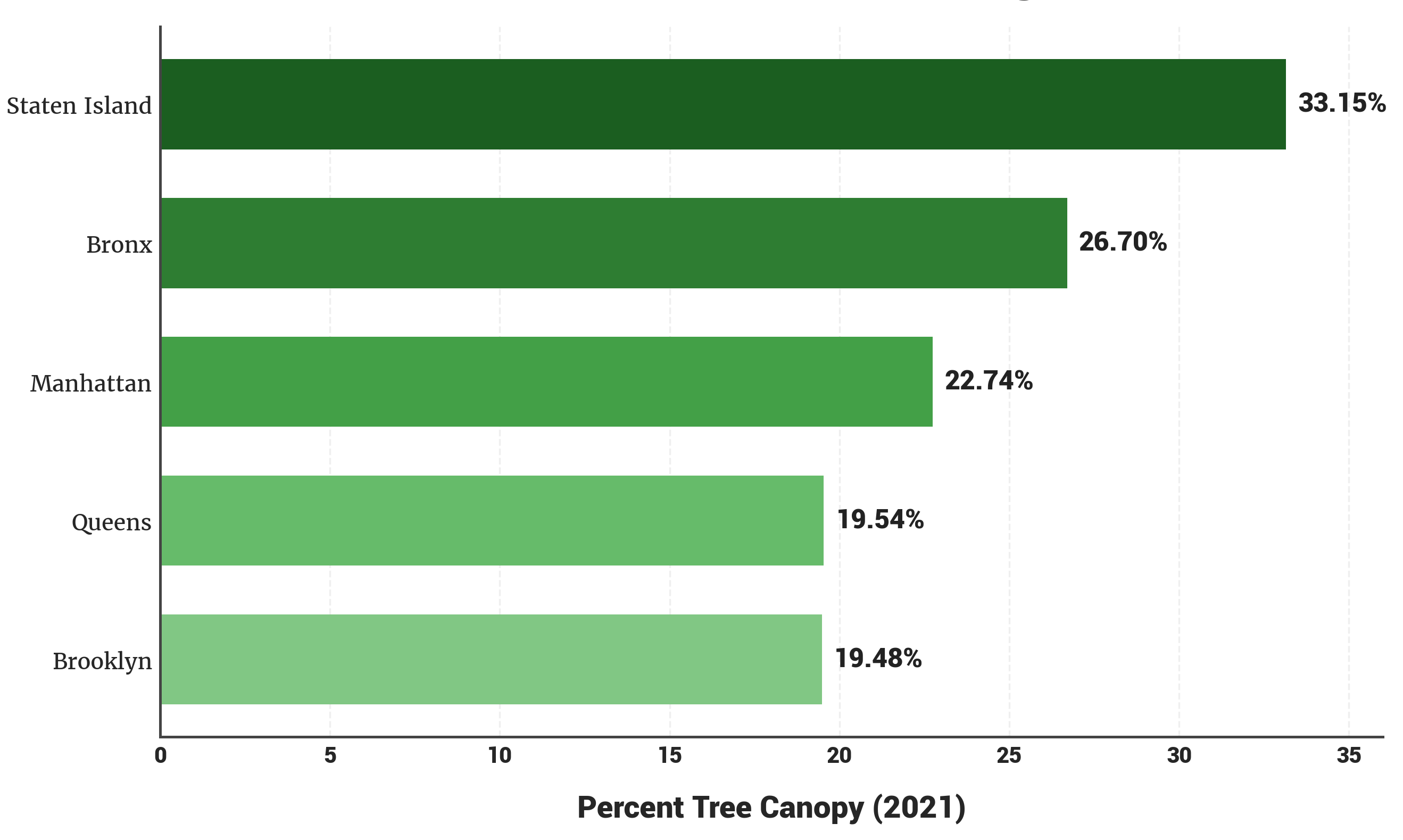
Tree Canopy Percentage By Borough
Over time, these areas accumulated highways, freight infrastructure and large paved surfaces that left fewer opportunities for trees and green space.
Other neighborhoods experienced decades of dense residential and commercial development, where limited land availability and high demand for housing left little room for additional vegetation.
Lin-Moges said these patterns often overlap with communities that face greater heat risks because residents may have fewer resources to adapt.
“Oftentimes in those neighborhoods, there are people who cannot afford indoor air conditioning or the energy use associated with it,” she said.
Trees, Lin-Moges said, should be viewed as more than environmental features.
“They should be viewed as critical public health infrastructure around the City,” she said.
What Will It Take For NYC To Reach Its Tree Canopy Goal?
New York City has set a goal of reaching 30 percent tree canopy cover by 2040 through its first Urban Forest Plan, a citywide strategy focused on planting, protecting and maintaining trees.
But reaching that goal will depend on more than planting new trees.
“Trees take time to grow,” Lin-Moges said. “Maintaining and taking care of the existing trees so that they can reach maturity and continue to grow that is really critical.”
The Mayor’s Office of Climate & Environmental Justice will lead citywide coordination of the plan, tracking progress, supporting research, and working with agencies, community groups, advocates, and private landowners.
NYC Parks currently manages about 24,500 acres of tree canopy, representing more than half of the city’s total canopy.
To meet future goals, the agency will assess the staffing, equipment and resources needed to maintain additional trees as canopy expands.
The plan also calls for agencies with tree-covered properties, including NYCHA campuses, public schools, and other public facilities, to designate staff responsible for coordinating tree care efforts.
The plan also proposes improving how the City manages its urban forest resources. This includes creating standardized contracts for tree maintenance across agencies, expanding forest monitoring, and improving coordination between departments.
Reaching the City’s canopy goal will also depend on long-term funding.
Lin-Moges said the Urban Forest Plan provides a roadmap for expanding tree cover, but additional investment will be needed to maintain existing trees and increase planting efforts.
“Without adding additional workforce to help maintain the existing trees, without added or accelerating the number of trees that are being planted across the City, as well as additional community engagement events, it will be difficult to stay on track to meet the goal of 30 percent canopy cover by 2040,” Lin-Moges said.
The NYC Green Fund supports community investment by providing grants to organizations that care for parks, open spaces and neighborhood environmental projects.
Its Grassroots Grants Program supports smaller community organizations that provide local stewardship and programming, while the Treetops Grants Program funds larger organizations working on park maintenance, environmental action, and urban tree care.
These investments address one of the challenges identified by urban forestry experts: planting new trees is only one part of expanding canopy coverage.
To learn more about the NYC Green Fund visit its website.
Get more local news delivered straight to your inbox. Sign up for free Patch newsletters and alerts.