Politics & Government
Newtown Sewer Authority Grants DeLuca a 1-Year "Due Diligence" Extension Regarding Purchase of Land
Extending due diligence relates to the plan submission process and regulatory clocks rather than serving as a timetable for a final sale.

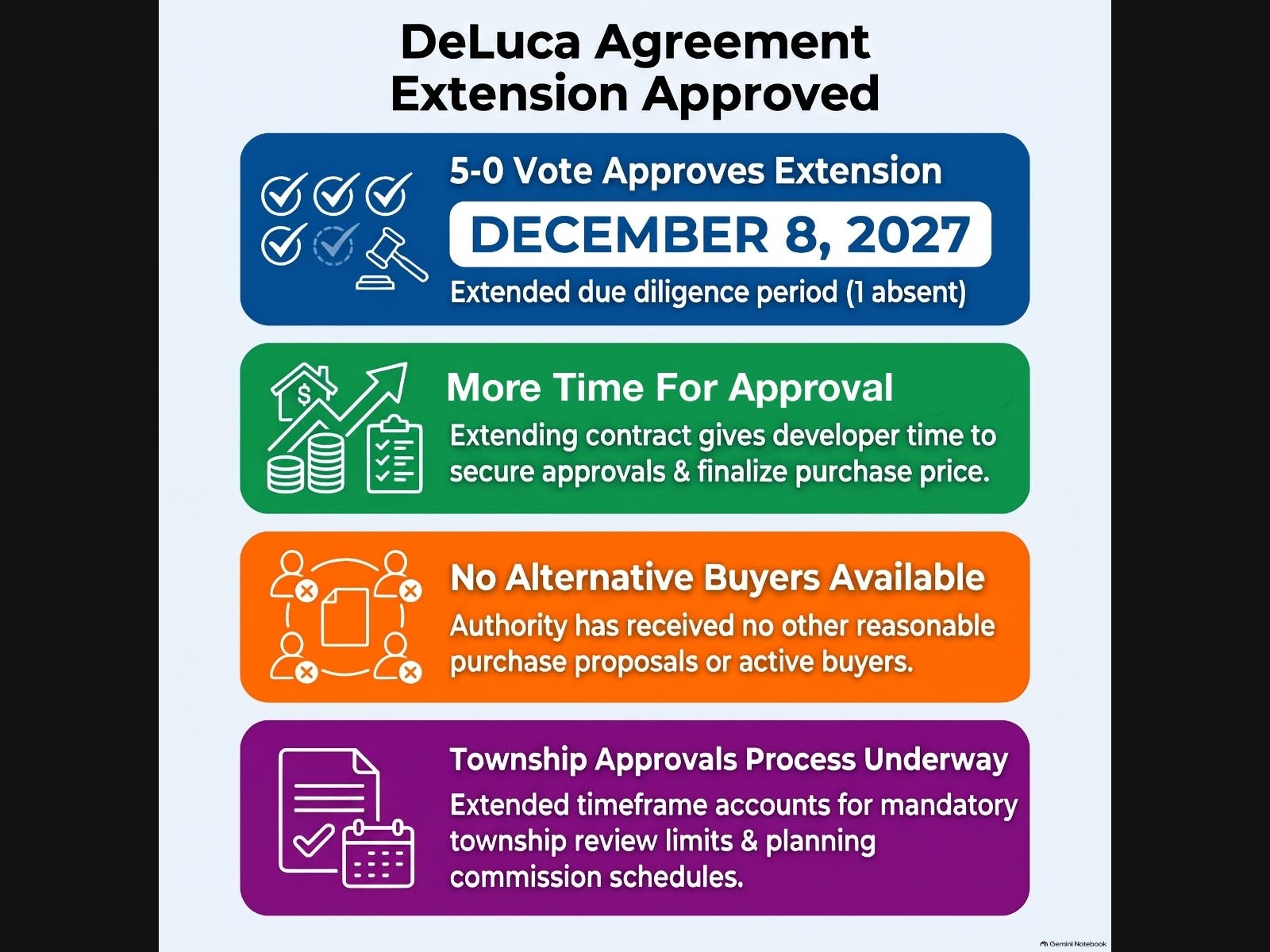
The Newtown Sewer Authority voted unanimously, 5-0, with one member absent, to extend DeLuca Newtown LLC's due diligence period until December 8, 2027. The developer is pursuing a proposal for 42 single-family homes on Authority-owned land along Lower Silver Lake Road. The extension keeps the existing sales agreement alive but does not guarantee township approval or a completed sale.
Introduction: The Slow Grind of Local Government
Municipal land development often moves at an excruciatingly sluggish pace. Between technical staff reviews, advisory board hearings, and potential legal disputes, municipal real estate transactions frequently stretch far beyond original schedules. What looks like a straightforward property sale on paper can easily evolve into a multi-year administrative marathon.
A clear snapshot of this administrative reality emerged during the Newtown, Bucks County, Joint Municipal Authority (NBCJMA), also known as the Sewer Authority, meeting on November 11, 2026.
Find out what's happening in Newtownfor free with the latest updates from Patch.
Convening immediately after an executive session held specifically to discuss a "litigating matter," the board voted unanimously to approve a third addendum to its agreement of sale with DeLuca Newtown LLC.
The decision extends the developer's due diligence period to December 8, 2027, giving DeLuca additional time to navigate the township's land development process.
Find out what's happening in Newtownfor free with the latest updates from Patch.
For background, read What You Need to Know About the #NewtownPA Sewer Authority Land Sale Agreement .
When There Is No "Plan B," You Hang On
The primary motivation behind the Sewer Authority's decision to grant a full one-year extension comes down to a lack of viable market alternatives.
Board leadership emphasized that the Authority currently has no competing buyers waiting in the wings. Even prospective entities that initially expressed interest failed to submit reasonable purchase proposals.
This market environment puts the public entity in a defensive negotiating posture. Keeping the existing contract with DeLuca active represents the board's strongest available path toward bringing the negotiated purchase proceeds back into Authority coffers to benefit local ratepayers and support utility operating funds.
Solicitor Jessica VanderKam highlighted that the extension allows the developer to appear before township bodies and press its case while attempting to preserve the agreed-upon purchase price.
"It's in our best interest to keep this particular contract live and give the developer DeLuca LLC additional time to do their due diligence and see what they can work out with the township."— Chairman Jerry Schenkman
"Due Diligence" Starts a Statutory Clock, Not a Guarantee
During public comment, resident John Mack engaged in a detailed discussion with Chairman Jerry Schenkman regarding the legal mechanics of due diligence.
Mack cautioned that extending due diligence does not establish a firm timetable for a final closing, nor does it guarantee an ultimate agreement with township supervisors.
DeLuca originally had a 75-day due diligence period, with a deadline around October 15, 2026, subject to extension. During this period, the buyer and its representatives may investigate the property, including survey and title matters, and assess whether the land is suitable for the proposed use.
DeLuca may also submit plans to the township to evaluate the likelihood of approval. Meanwhile, the Sewer Authority agrees to keep the property off the market during the contractual due diligence period.
Chairman Schenkman clarified that while due diligence does not guarantee a closing date, formally filing a land development application triggers statutory timelines under municipal law.
| Development Stage | What It Means |
|---|---|
| Due Diligence | Developer investigates property suitability and evaluates potential development options. |
| Formal Application | Triggers statutory review and decision-making timelines under municipal law. |
| Planning Commission Review | Plans undergo technical and advisory review, potentially including revisions. |
| Board of Supervisors | Township governing body considers the proposal under applicable land-use requirements. |
| Property Closing | Not guaranteed by the due diligence extension; depends on contractual and other requirements. |
Understanding the difference between contractual due diligence and statutory land development review helps explain why municipal developers often seek substantial extensions.
The Ghost of Past Precedents: Wawa and KRE
To explain why a one-year extension is reasonable, board officials referenced historical land-use disputes in Newtown Township.
DeLuca's current proposal calls for constructing 42 single-family homes, a lower-density development than some past proposals that resulted in lengthy legal disputes.
November 24, 2026: The meeting discussion referenced this Board of Supervisors meeting as a possible opportunity for DeLuca's plan to be discussed. However, officials also indicated that a formal presentation was not expected to be ready by that date.
Two past local development controversies illustrate the potential for lengthy delays:
The Wawa Project
A commercial approval process that dragged on for approximately five years. During the discussion, John Mack noted that formal lawsuits filed against the township were a major reason for the delays.
The KRE Development
A high-density proposal involving 245 apartments that triggered more than a year of court litigation before leading into municipal condemnation proceedings.
Against this backdrop, Sewer Authority officials view a one-year contract extension as a relatively modest accommodation compared with the years that can be consumed by litigation.
Cool Receptions and Political Uncertainties
Despite securing the extension from the Sewer Authority, DeLuca faces significant political and procedural hurdles at the township level.
Although DeLuca's revised application for 42 single-family homes was accepted — but NOT approved — by the township without initial administrative delay, Chairman Schenkman observed that the developer was "not received with open arms" during preliminary meetings with township professional staff.
Officials indicated that the project was not expected to have sufficient traction for a formal presentation at the November 24 Board of Supervisors meeting.
The plan has yet to go before the Planning Commission or be scheduled for a formal public hearing before township supervisors, according to the meeting account.
Adding another layer of uncertainty is local politics. The discussion noted that a supervisor seat will be contested in the November 2027 municipal election, potentially changing the political composition of the Board of Supervisors before DeLuca's final proposal officially comes before the Newtown Board of Supervisors.
What Happens Next?
The following summarizes the key dates and outstanding issues:
| Date / Status | Milestone |
|---|---|
| November 11, 2026 | Sewer Authority approves third agreement addendum, 5-0. |
| November 24, 2026 | Possible BOS discussion referenced, but formal presentation not expected to be ready. |
| Pending | Planning Commission and formal township review of the development proposal. |
| November 2027 | Municipal election involving one supervisor seat, as referenced in the discussion. |
| December 8, 2027 | Extended contractual due diligence deadline. |
Conclusion: The Price of Patience in Municipal Deals
The Sewer Authority's 5-0 vote to extend DeLuca Newtown LLC's due diligence period to December 8, 2027, reflects a pragmatic real estate calculation.
Lacking alternative buyers, public officials chose to grant the developer more time to navigate township reviews, resolve technical plan requirements, and attempt to deliver the negotiated sale proceeds to the Authority.
Yet the extension also highlights the uncertainty surrounding the sale of publicly owned land. The developer still faces township reviews, potential revisions, and the possibility of legal or political obstacles.
Does exercising long-term patience ultimately protect ratepayer investments, or does extending due diligence keep valuable municipal property indefinitely trapped in administrative limbo?
Statements regarding development proposals and anticipated reviews reflect information discussed at the meeting and do not constitute township approval.