Politics & Government
The Newtown ZHB DENIES Grey Stone Restaurant's Request for Zoning Variances
The zoning appeal was submitted by Brandmar, LLC, the Grey Stone Restaurant, for the property located at 552 Washington Crossing Road

Executive Summary
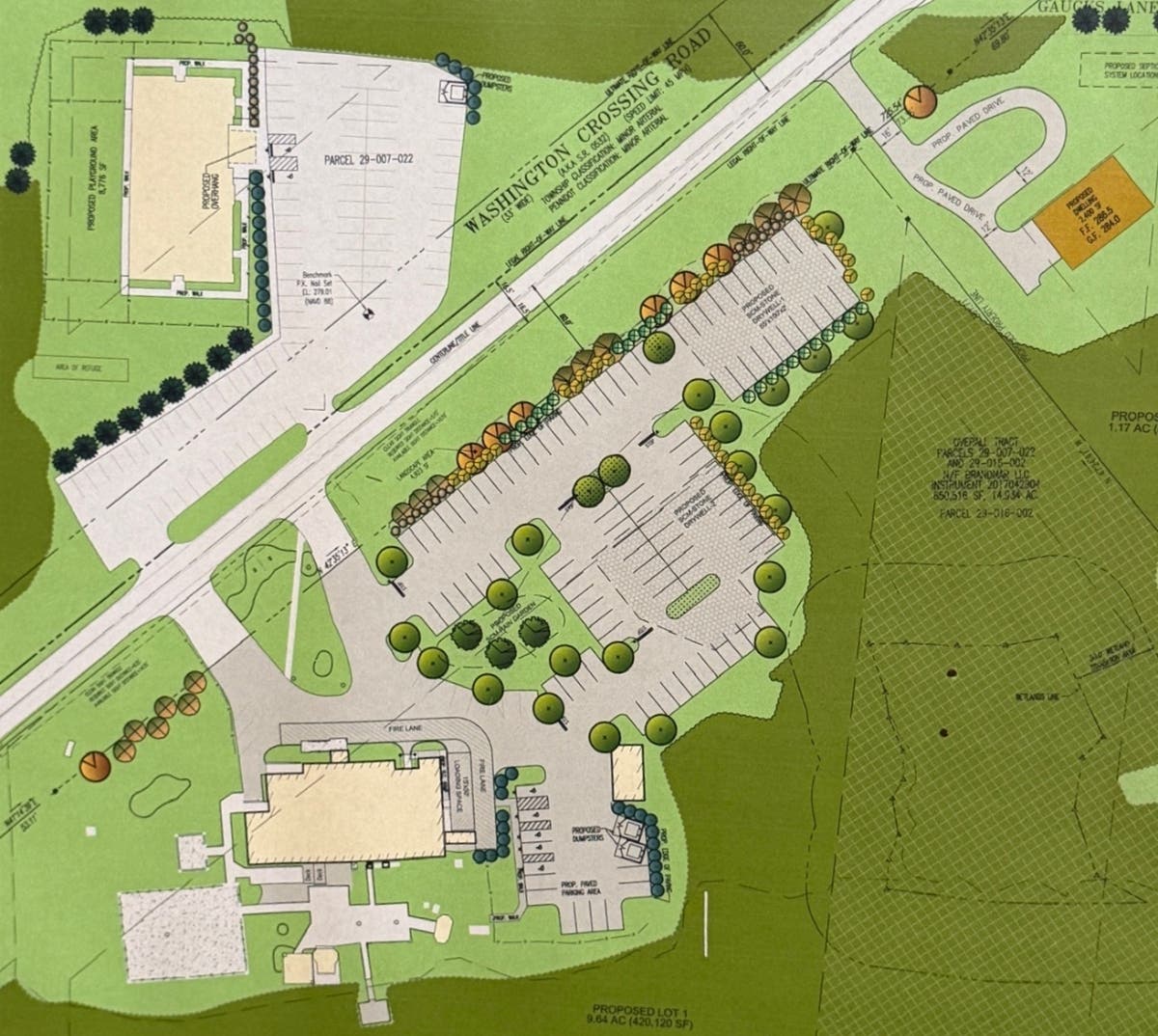
This article summarizes the zoning appeal and land development proposal submitted by Brandmar, LLC, the Grey Stone Restaurant, for the property located at 552 Washington Crossing Road, Newtown Township.
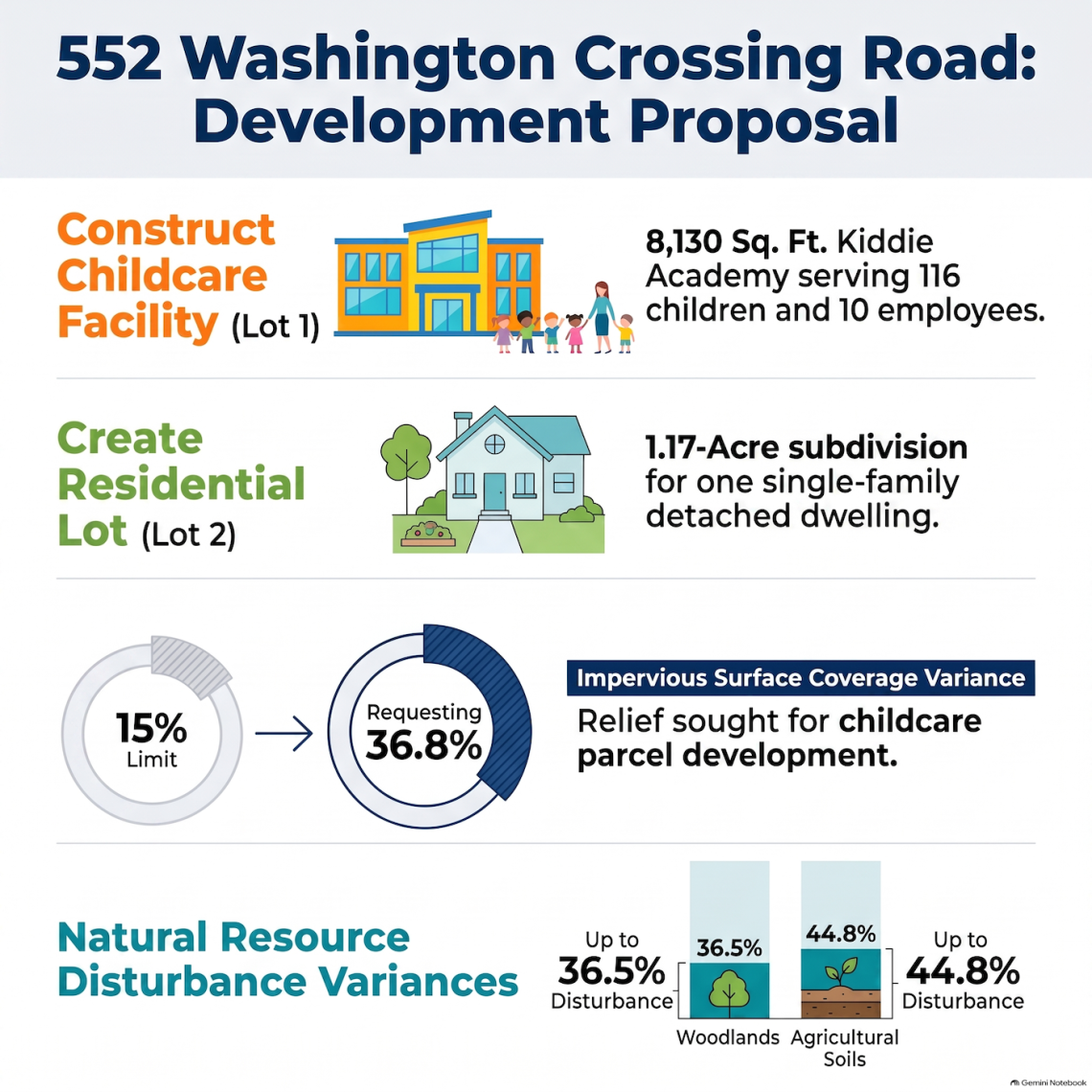
The applicant sought a combination of variances and a special exception to facilitate a mixed-use development across two primary tax parcels: #29-16-2 and #29-7-22.
Find out what's happening in Newtownfor free with the latest updates from Patch.
The core of the proposal involves three distinct components:
- Subdivision and Residential Development: Subdividing the existing restaurant site to create a 1.17-acre lot for a single-family detached dwelling.
- Child Care Facility: Constructing an 8,130-square-foot Kiddie Academy on a non-conforming parcel across the street from the restaurant.
- Site Consolidation and Conservation: Utilizing shared parking between the restaurant and childcare facility while establishing a conservation easement to permanently protect the majority of the site's natural resources.
The most consequential portion of the application is the proposed Kiddie Academy parcel: it seeks approval for a 2.117-acre lot where the CM district normally requires 10 acres, 36.81% impervious surface where 15% is permitted, a 59.20-foot front setback instead of 100 feet, front-yard play areas, and relief from the five-acre child-care lot requirement. The document also reports proposed disturbance of 17.5% of total woodlands and 44.8% of agricultural soils.
Find out what's happening in Newtownfor free with the latest updates from Patch.
The applicant argues that the unique physical conditions of the property—including irregular parcel shapes, extensive protected natural resources, and a long-standing non-conforming restaurant use—create an unnecessary hardship that justifies the requested relief.
Zoning Hearing Board Denies Request
September 3, 2026 — The Newtown Township Zoning Hearing Board considered Appeal #1261-26 and officially denied the request.
Parking Became a Major Issue
One of the most significant issues raised by the Zoning Hearing Board involved the amount of parking proposed for the childcare facility.
The applicant proposed approximately 82 parking spaces, despite testimony indicating that only about 41 spaces would be required. Board members questioned why the applicant was requesting substantial relief from impervious-surface limitations while simultaneously proposing approximately twice the minimum amount of parking. The applicant explained that some of the additional parking could also be used as overflow parking for the Greystone Restaurant.
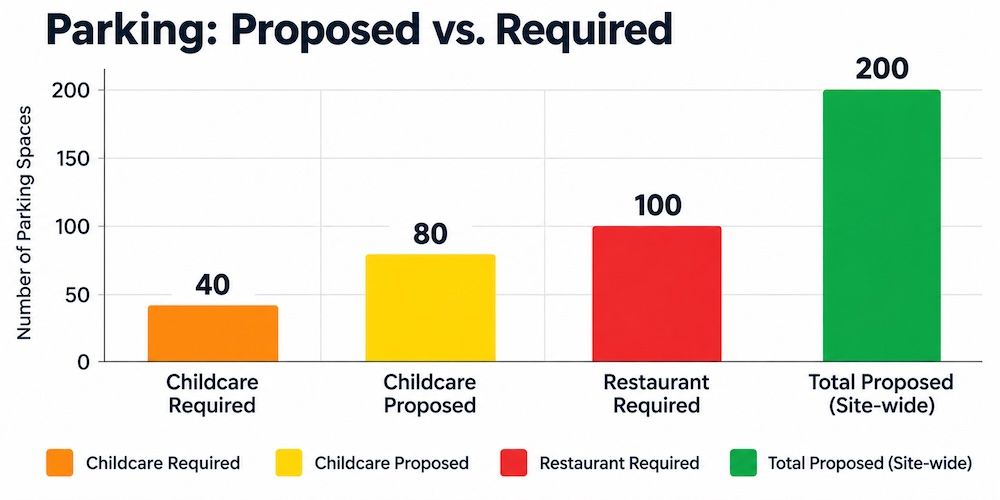
Board members pointed out, however, that the restaurant and childcare facility would be located on separate tax parcels. A formal shared-parking agreement therefore could be necessary.
The central question became: Why exceed the Conservation Management district's impervious-surface limits in order to construct parking that may not actually be required?
Possible Reduction in Parking
During the hearing, the Board recessed briefly so that the applicant's engineer could calculate how much impervious coverage could be reduced if some of the proposed parking spaces were eliminated.
The resulting discussion suggested that removing approximately nine parking spaces along the northeast portion of the property could reduce impervious coverage by about 5%, lowering the childcare parcel's proposed impervious coverage from roughly 36% to approximately 31%.
Although that would represent an improvement, the resulting coverage would still substantially exceed the 15% normally permitted in the Conservation Management district.
Why the Applicant Says the Project Is Needed
The property owner Brandon Smith testified about the economic circumstances behind the proposal.
According to his testimony, the Greystone Restaurant has experienced increasing competition from newer shopping centers and restaurants during the past several years.
Rather than pursue a previously contemplated expansion of the restaurant, Smith said he decided to pursue the Kiddie Academy proposal because of the greater financial stability associated with a national childcare franchise and the difficulties involved in independently operating a larger restaurant.
The applicant also argued that formalizing additional parking on the property could improve safety by reducing the current use of an overflow parking area across Washington Crossing Road.
Resident Concerns
Nearby residents raised several significant concerns about the proposal.
Traffic and Child Safety
Residents described Washington Crossing Road as a high-speed roadway and questioned whether the location was appropriate for a childcare facility serving approximately 116 children.
Concerns were also raised about the number of vehicles entering and leaving the site during morning drop-off and afternoon pickup periods.
Environmental Impact
Residents questioned the amount of impervious surface and natural-resource disturbance being requested in an area specifically designated for conservation management.
Concerns included:
- Groundwater recharge
- Protection of the underlying aquifer
- Disturbance of agricultural soils
- Woodland disturbance
- Stormwater impacts
Integrity of Conservation Management Zoning
Several speakers argued that granting numerous variances for one development could undermine the intent of the Conservation Management district and the goals of the Joint Comprehensive Plan.
One concern expressed during the hearing was that repeatedly granting individual variances could gradually erode the protections intended for land designated for conservation.
Eric Pomerantz: The cumulative effect of repeated zoning variances is steadily weakening the protections intended for the Conservation Management district.
Pomerantz argued that the property was originally consistent with Conservation Management zoning as a farm and residence, but was later converted to commercial use. Approving additional relief for a daycare, parking, impervious coverage, setbacks and related improvements would continue to erode the district’s conservation purpose.
He questioned why an applicant should receive relief from minimum lot-size requirements without providing a corresponding public benefit, such as preserving or dedicating additional open space.He emphasized that he was not opposed to daycare services, but questioned whether this was the appropriate location. He urged the Board to consider who will speak for open space, natural resources and the township’s zoning protections as development continues to “chip, chip, chip” away at conservation land.
Kim Caputo: The Zoning Hearing Board should follow the 2024 Joint Comprehensive Plan and carefully control development within the Conservation Management district.
Caputo said variances and exceptions have been granted too freely over many years, contributing to increased development, traffic and pressure on local infrastructure.
Her concerns included:
- Heavy traffic and limited roadway capacity on Washington Crossing Road and nearby roads
- Inadequate public sewer and water infrastructure
- Increased impervious coverage and reduced groundwater recharge
- Loss of woodland, wetlands, agricultural soils and natural land
- Reduced lot-area and setback requirements
- Traffic generated by approximately 116 children, their parents and employees
- The possibility of additional expansion in the future
Caputo argued that the requested variances are substantial rather than minor. She urged the Board to make this application a turning point by consistently enforcing the zoning ordinance and protecting the remaining Conservation Management district.
Applicant's Hardship Argument
The applicant's attorney argued that the property qualifies for variance relief because of its unusual physical characteristics.
Among the conditions cited were:
- The triangular or irregular shape of portions of the property
- Existing natural-resource protection areas
- Existing nonconforming conditions
- Constraints on how the site can reasonably be developed
The applicant also argued that consolidating parking on the property could provide a safety benefit by reducing the need for restaurant patrons to cross Washington Crossing Road from an overflow parking area.
Conditional Use Would Still Be Required
The applicant's attorney emphasized that approval of the requested zoning relief would not constitute final approval of the project, especially the childcare use. If the necessary variances were granted, the proposal would still need to proceed through the Township's conditional-use process, during which the Board of Supervisors could impose additional conditions involving operations and site development. Obviously, the variance were denied and there will be no Condition Use hearing by the township Board of Supervisors at this time.
Final Determination
The Board ultimately voted unanimously among the four members present to deny the request to remove the density restrictions associated with the proposed development. The chair indicated that the Board's formal decision reflecting that action would be recorded.
Key Takeaways
- The proposal would divide the 11.9-acre site into three parcels for a residence, childcare facility, and the existing Greystone Restaurant.
- The Kiddie Academy would serve approximately 116 children and employ about 21 people.
- The childcare parcel proposes approximately 36% impervious coverage where 15% is normally permitted.
- The amount of proposed parking became one of the Board's biggest concerns.
- Removing approximately nine parking spaces could reduce impervious coverage by about five percentage points.
- Residents raised concerns about traffic, child safety, groundwater, woodland disturbance, agricultural soils, and the long-term integrity of Conservation Management zoning.
- The applicant argued that the property's configuration and natural-resource constraints create a hardship justifying zoning relief.
- The Board ultimately denied the request involving increased density.
The September 3 hearing illustrates the central tension surrounding this property: how much development should be permitted on land specifically zoned for conservation management, and how far should zoning regulations be relaxed to accommodate economically viable new uses?