Weather
CA Snowflakes Filled With Microplastic: Why It's Happening And What It Means For Our Water Supply
The snowpack can eventually become part of California's water supply, which is why researchers say the findings matter.


Tiny particles of plastic are falling from the sky during snowstorms in California's Sierra Nevada, even in remote mountain areas far from human activity, according to new research from UC Riverside.
Scientists detected microplastics at all seven locations where they collected snowfall samples in even isolated areas of the Sierra Nevada, the mountain range that stretches 400 miles along eastern California. The findings have implications for California's water supply, as the Sierra Nevada snowpack provides about 30% of the state's freshwater, according to researchers.
Snowmelt from the mountain range feeds several of California's major water systems, including the Los Angeles Aqueduct, San Francisco's Hetch Hetchy system, the State Water Project and the federal Central Valley Project, which collectively help supply drinking water to millions of Californians and irrigation water to farms across the state.
Find out what's happening in Across Californiafor free with the latest updates from Patch.
The study, published in the journal Environmental Science & Technology, is the first to measure how much microplastic pollution falls during individual Sierra Nevada snowstorms, researchers said.
Researchers found that snowfall deposited between 270 and 3,200 plastic particles per square meter per day at remote locations during the height of storms. At a sampling site in the Mammoth Mountain ski area, the amount was roughly three times higher, reaching as many as 7,500 particles per square meter per day.
Find out what's happening in Across Californiafor free with the latest updates from Patch.
The findings surprised lead researcher Aleksandra Karapetrova, a UCR environmental toxicologist, who expected to find little or no plastic at some of the most isolated sites.
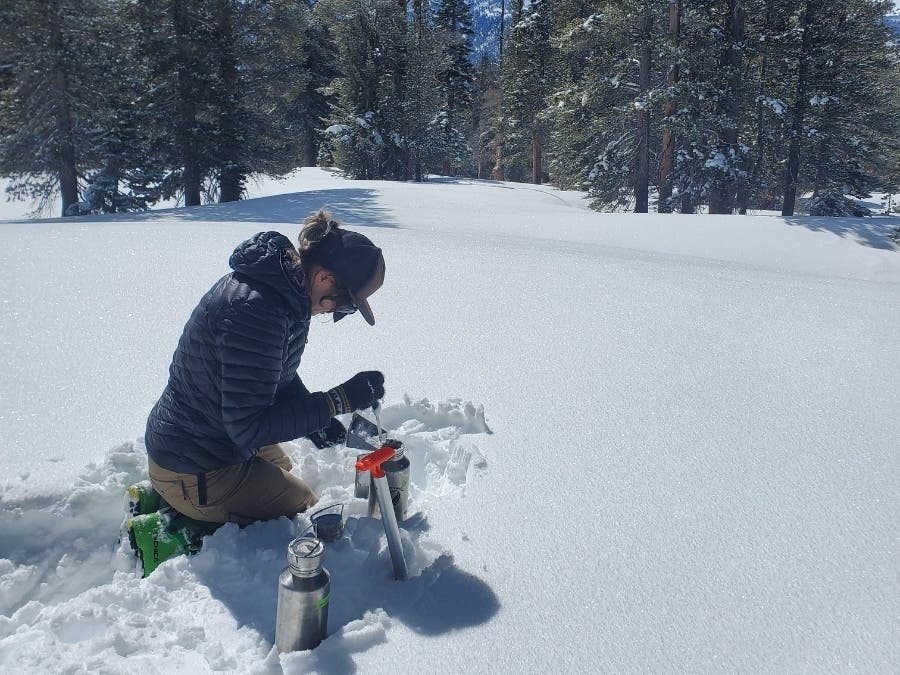
"One site was accessed by chairlift. I had to ski to the rest of the remote sites. That's how isolated they are," Karapetrova said. "But no matter how far out the site, I always found microplastics there."
Researchers collected samples between January and July 2024 at seven locations in the Sierra Nevada.
Three sampling sites were near Pear Lake in Sequoia National Park, on the western side of the mountain range about 10 miles west of Mt. Whitney, the highest point in the contiguous U.S.
Others were outside populated areas in the Eastern Sierra: Earthquake Dome and TJ Lake outside of Mammoth Lakes along with one at Yost Meadow near June Mountain.
The seventh was at a research station in the heart of the busy Mammoth Mountain ski area.
The sites ranged in elevation from about 9,200 to 9,650 feet. The six remote locations were approximately 2 to 4 miles from the nearest population center with more than 10,000 residents, according to the study.
Scientists collected freshly fallen snow in stainless-steel containers and analyzed the melted samples to identify plastic particles.
The researchers also measured pollution reaching the ground during dry weather.
They found that significantly more plastic was deposited during snowstorms, suggesting falling snow helps remove airborne plastic particles from the atmosphere and carry them to the ground.
As snowflakes fall, they collect microscopic particles suspended in the air through a process known as scavenging.
"We are at a point where microplastics are in our atmosphere, not just the ocean, not just rivers. It comes down with the snowfall, making its way to places humans typically don't go," Karapetrova said.
Microplastics can enter the atmosphere when clothing sheds synthetic fibers or when plastic products break down into small fragments. Fibers can escape through dryer vents or be released through everyday clothing use. Wind can also carry plastic particles from the ground into the atmosphere.
To investigate where the pollution might have originated, researchers used computer models to trace the air masses associated with the storms.
Most of the air had traveled over Fresno and Madera counties, suggesting that the Central Valley could be one source of the plastic particles. However, the researchers could not identify specific sources or rule out pollution traveling from more distant locations.
The researchers also found higher concentrations of plastic at Mammoth Mountain than at the remote sites.
Snowfall there deposited an estimated 2,600 to 7,500 plastic particles per square meter per day. Nearby human activity and heavier snowfall may have contributed to the higher measurements.
Despite the large particle counts, the actual amount of plastic was relatively small. At the highest estimated deposition rate, snowfall would deliver about 1.5 grams of plastic across an acre in a day.
Laboratory analysis identified polyethylene, polypropylene and polyester, plastics commonly used in clothing, food packaging and other consumer products.
The team also detected cellulose derivatives, chemically modified plant-based materials used in consumer products.
The researchers did not determine how much of the plastic deposited in Sierra Nevada snow ultimately reaches California's drinking water.
The study also did not examine whether exposure to the particles found in the snow poses health risks. Some chemicals used in plastics have been associated with hormone disruption, inflammation and cellular damage, but the findings do not establish that the levels measured in the Sierra Nevada cause those effects.
For Karapetrova, the findings demonstrate how widely pollution from everyday plastic products can spread, reaching areas far removed from where those products are manufactured or used.
"We've reached a point where plastic pollution is falling out of the sky every day, across this entire region, even when it isn't snowing," Karapetrova said.
Get more local news delivered straight to your inbox. Sign up for free Patch newsletters and alerts.