Schools
Dublin Teen Makes Science Click For Neurodivergent Students
Emerald High senior Bhavya Dwivedi creates hands-on lessons to help neurodivergent students grasp concepts from magnetism to anatomy.


DUBLIN, CA — Emerald High School senior Bhavya Dwivedi says that one of her favorite parts of teaching is when curiosity grips her students, and suddenly they can’t stop asking questions.
“It is fulfilling to watch them understand a new concept or come up with more questions, but mostly I’ve enjoyed watching how they approach learning after my lessons,” she said, remembering one student in particular who came alive when she told him that during her magnetism lesson, she would show him how to make a paper clip fly.
“Experiences like these are how I’ve seen students go from being quiet and disengaged in lessons to constantly asking to see the next slides, their eyes brimming with uncontrollable curiosity,” Dwivdei said. “In my lessons, I aspire to bring that curiosity forward and have it be something they have in all aspects of their lives.”
Find out what's happening in Dublinfor free with the latest updates from Patch.
For nearly two years, Dwivedi has taught science to a group of 10-12 neurodivergent students in elementary and middle school. She first got involved during her freshman year, when she began volunteering with the Federation for Children with Special Needs, a nonprofit providing information, support, and assistance to children with disabilities and their families. She helped organize a talent showcase, participated in a social play group, and helped during Muay Thai boxing classes.
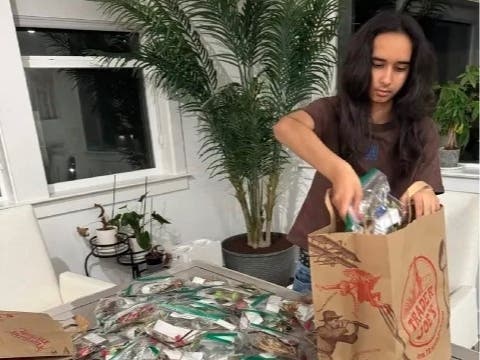
Dwivedi began creating DIY STEM kits that used items like balloons, plastic straws, and plastic cups to teach students a lesson on the human respiratory system. She was inspired to create the kits because she saw how concrete examples and visuals helped students grasp abstract concepts.
Find out what's happening in Dublinfor free with the latest updates from Patch.
“A lesson was being done on cohesion and adhesion, and students were provided a textbook definition about molecules binding to other molecules and capillary action,” she recalled. “I noticed that students were disengaged and uninterested, so I asked the class if they had ever seen water droplets on a car window after it rains. This piqued students’ attention, and they slowly were able to understand the concept of cohesion and adhesion. I realized that they were able to understand these concepts because they were able to establish a connection to something they had observed in their daily life.”
The instructor of the Muay Thai classes she’d volunteered with felt the kits could be used in science classes, and the program coordinator offered her the chance to teach their weekly Science Explorers classes. She designed curricula for the spring and fall semesters, and developed kits that could help explain further science concepts like plant anatomy, the solar system, magnetism, phases of the moon, states of matter, layers of the Earth, the food chain, and more. Each kit comes with a slideshow explaining how to assemble it.
Dwivedi said that working with young, neurodivergent children can present challenges, but she works hard to adapt her teaching to suit them.
“I often have to pivot my techniques—interactive videos, demonstrations, or verbal explanations—depending on how students grasp different concepts,” she said. “I’ve had to explain magnet attraction through demonstrations and experimentation, the respiratory system through a hands-on model, and the human body system through a puzzle I crafted. All of these are ways that students learn, and it is always fulfilling to see their eyes light up as they understand a new concept or ask an engaging question.”
Get more local news delivered straight to your inbox. Sign up for free Patch newsletters and alerts.