Community Corner
Betting On Italian Grapes To Give CA Wine Country Rare Lift: Wine Talk
Centennial Mountain bets on Etna grapes as California wineries again chase younger, adventurous wine drinkers.



NORTHERN CALIFORNIA — A Northern California winery planted two grapes from Sicily’s Mount Etna years before the latest rush toward unusual wines — and now finds itself holding exactly what the industry says it needs.
Centennial Mountain planted two Sicilian grapes that it says no other U.S. vineyard grows, giving the winery an unusual hand as the wine industry again searches for something that can pull younger drinkers toward the bottle.
The winery started with Pinot Noir and Chardonnay in the Santa Cruz Mountains and northern Mendocino County
Find out what's happening in Healdsburgfor free with the latest updates from Patch.
Carricante and Nerello Mascalese came to Centennial Mountain from Mount Etna, where growers use the grapes in the volcanic slopes’ white and red wines.
Centennial Mountain planted rootstock in 2013 and grafted plant material from Sicily onto the vines in 2015 and 2016, according to the winery.
Find out what's happening in Healdsburgfor free with the latest updates from Patch.
“We are the only ones growing them in the U.S. as far as we are aware,” Centennial Mountain tasting room director Julia Carlyon said during a July interview in Healdsburg . “And we were the first ones to bring them over into the United States.”
The winery grows them on 27 planted acres near Lake Sonoma, between the Dry Creek Valley and Rockpile American Viticultural Areas.
Warnings
Founder Kevin Harvey chose the grapes after visiting Sicily and falling in love with them, Carlyon said.
The timing now looks prescient. Little by little, some of the gloom is lifting from wine country like morning fog burning off a vineyard. But the bottoming out of wine sales has been painful, and it was not unforeseen.
The industry diagnosed one of its biggest problems a decade ago.
By 2016, the long expansion in American wine consumption was losing steam. Silicon Valley Bank warned of the first decline in U.S. per-capita wine consumption in more than 20 years. Cheap wines were struggling, while premium bottles continued to grow.
Behind the numbers sat a demographic problem: Baby Boomers remained the core fine-wine customers, and wineries could not assume Millennials would replace their spending as Boomers aged.
For a while, the industry saw reasons for optimism. Premium wine remained strong in 2017, and Millennials appeared to be moving up the wine ladder.
The question became how to turn younger, more casual drinkers into lifelong wine consumers.
Wine marketers tried rosé, cans, single-serving packages, digital discovery, casual language, and labels designed to make wine feel less intimidating.
Wine writer Jason Wilson captured some of the effort in his 2018 book, “Godforsaken Grapes.” He described marketing that presented familiar grapes such as Chardonnay, Riesling, Pinot Grigio, and Pinot Noir as approachable and unpretentious — wine to enjoy with friends without the geek talk.
Cutesy labels featuring cupcakes, sisters, flirtation, and jokes competed for Millennials, the enormous generation that marketers hoped would become the wine industry’s savior.
But the assumptions did not always survive contact with consumers.
Wilson wrote that Millennials in a blind tasting rewarded innovative graphics and bottle designs but rejected some of the gimmicky branding aimed at them, preferring packaging that conveyed maturity. If they simply wanted to get drunk, wine also faced plenty of competition from vodka and other spirits.
By 2018, Silicon Valley Bank issued a louder warning. The American wine business was approaching the end of a roughly 20-year growth cycle. Millennials were buying wine, but their spending had not replaced older customers aging out of the market.
COVID-19 interrupted the trajectory as Americans bought wine for home consumption, but it did not settle the underlying demographic problem.
Now the industry is again looking for ways to make wine feel new. “I think in general, young people want something that’s different from what their parents were always drinking,” Carlyon said. She said she recognized the impulse in herself.
Growing up, Carlyon said she saw the same few major wineries on her parents’ table. She loved wine, but she did not necessarily want the same bottles. Natural wine attracted her partly because it offered something different, even when the wine itself was not always good.
“It kind of changes the perception of what wine can be,” she said.
Centennial Mountain is betting California can change that perception with what it plants.
“We have all of these microclimates in California,” Carlyon said. “Why are we pigeonholing ourselves into a handful of, like, what everybody’s drinking? Why can’t we try other things?”
The Carricante and Nerello Mascalese vines suggest the experiment can work.
“We found the perfect climate for these Italian varietals,” she said. “They really like it.”
Pinot’s cooler cousin and the sushi sidekick
Yet Etna itself is hardly undiscovered territory. Mount Etna wines were already fashionable more than a decade ago, when drinkers chased volcanic soils, old vines, indigenous grapes, and wines that offered an alternative to familiar French and California varieties.
And Carricante and Nerello Mascalese hardly qualify as the outer limits of obscure wine.
Wilson hunted far stranger grapes for “Godforsaken Grapes”: Tannat in Madiran, Braucol, also called Fer Servadou, in Gaillac, Mansois in Marcillac, and Négrette in Fronton. Elsewhere, he sought wines made from grapes so scarce that only about 50 liters existed. He likened tasting those vanishingly rare wines to encountering an almost impossible-to-find creature. The appeal was discovery itself.
Centennial Mountain offers discovery without requiring a wine encyclopedia.
Carlyon describes Carricante as almost impossible to compare with another white grape. It combines body and acidity with fruit, herbs, minerality, and salinity.
“You can find a lot of complexity in it, but it doesn’t feel like you have to analyze it in order to enjoy it,” she said.
Her shorthand for Nerello Mascalese is even simpler: “Pinot’s cooler cousin.”
The light red brings cherry and raspberry flavors, herbal notes, a hint of eucalyptus, and a savory finish. It also fits another change Carlyon sees among customers.
“People love a light Italian red,” she said. “They’re fun. They pair well with food.”
Travel helps. Visitors tell Carlyon they have returned from Italy remembering easy-drinking restaurant table wines. Others arrive in Healdsburg after visiting Sicily and drinking Etna Rosso without necessarily knowing Nerello Mascalese formed its base.
Centennial Mountain turns that curiosity into an experience — and, ideally, a sale.
“Traditionally, historically, a tasting flight is to help you buy wine,” Carlyon said. “I kind of think that that’s what the industry needs to get back to.”
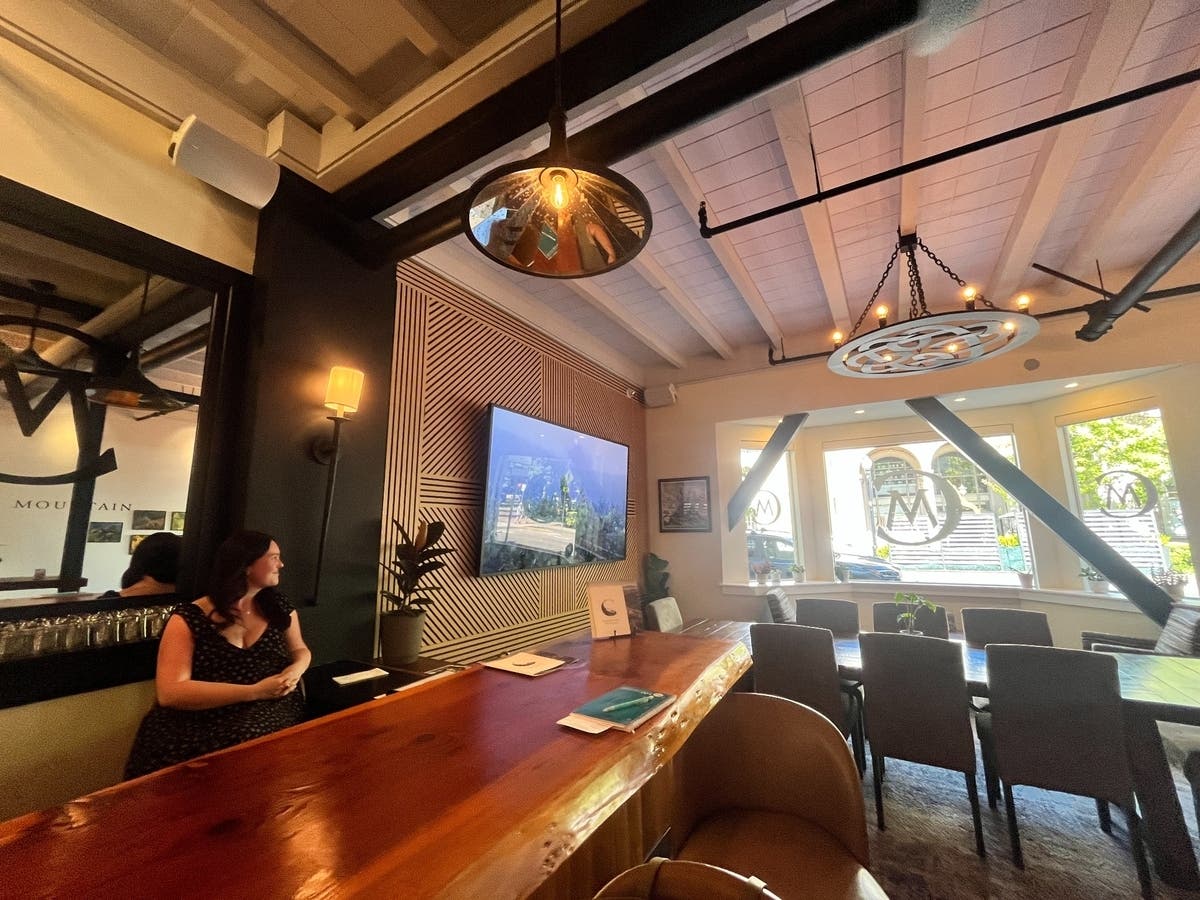
The Healdsburg tasting room also offers wines by the glass for people who find a full flight intimidating. Carlyon walks first-time tasters through everything from glassware to tannins, while experienced wine-industry visitors can dig into technical details.
Then there is sushi. Centennial Mountain works with neighboring Asahi Sushi on pairings that include sparkling wine with snow crab and cucumber sunomono, Carricante with salmon sashimi, Nerello Mascalese with spicy tuna tartare, and Nebbiolo with fried pork gyoza.
Carlyon said initially she doubted the idea.“Wine and sushi,” she recalled thinking. “Who wants to do that?”
Then she tasted the pairing.“It was very intentional, the bites that are going with each wine,” she said.
That pairing reflects the same challenge that has haunted the industry for a decade. Younger consumers, Carlyon said, carefully consider how they spend their money, and they increasingly want more than liquid in a glass.
“They want an experience,” she said. “That is the big draw right now for most people.”
Wine country has heard versions of that prescription before.
A decade ago, the industry tried approachability, clever packaging, casual language, rosé culture, and promises that consumers did not need expertise to enjoy wine.
Now wineries are again courting younger drinkers, this time with lesser-known grapes, lighter wines, distinctive experiences, and a wider definition of what California wine can be.
Centennial Mountain made that bet before the latest downturn forced the question.
Its Carricante and Nerello Mascalese vines took root years before Etna returned to the industry’s vocabulary and before today’s slump sharpened the search for something beyond California’s familiar grapes.
Those vines will not solve the wine industry’s demographic problem.
But they test a different proposition: Instead of teaching another generation to drink what its parents drank, California can give it something else to discover.
Wine Talk is a recurring column, written by Patch Editor Angela Woodall, where she will share her observations on Northern California's wine industry and culture. The opinions expressed are her own.
Get more local news delivered straight to your inbox. Sign up for free Patch newsletters and alerts.