Community Corner
Ice House Buoying NorCal Coastal Economy, Cuisine Readies For Refit With $2.78M
Officials secured federal and state money to replace aging equipment vital to keeping NorCal catches, coastal economy, and tradition alive.



BODEGA BAY, CA — At the Spud Point Marina, ice shoots through a four-inch hose by the ton, keeping fishermen’s catches fresh for the trip from boat to dinner plate.
Behind that flow, aging machinery has kept workers hunting for obsolete parts and fielding midnight breakdown calls.
Now, after roughly two decades of effort, officials have secured the money to replace an ice house that helps sustain Bodega Bay’s fishermen, supply its seafood businesses, and keep its working waterfront afloat.
Find out what's happening in Healdsburgfor free with the latest updates from Patch.
Federal and state funding will pay for a $2.7 million project to replace Spud Point Marina’s aging ice house, whose breakdowns threaten fishermen’s ability to keep their catches fresh and deliver them to market and that runs on a refrigerant since banned in California.
Without the facility, fishermen would have to travel to San Francisco for ice, said Dick Ogg, a fisherman and president of the Bodega Bay Fishermen’s Marketing Association.
Find out what's happening in Healdsburgfor free with the latest updates from Patch.
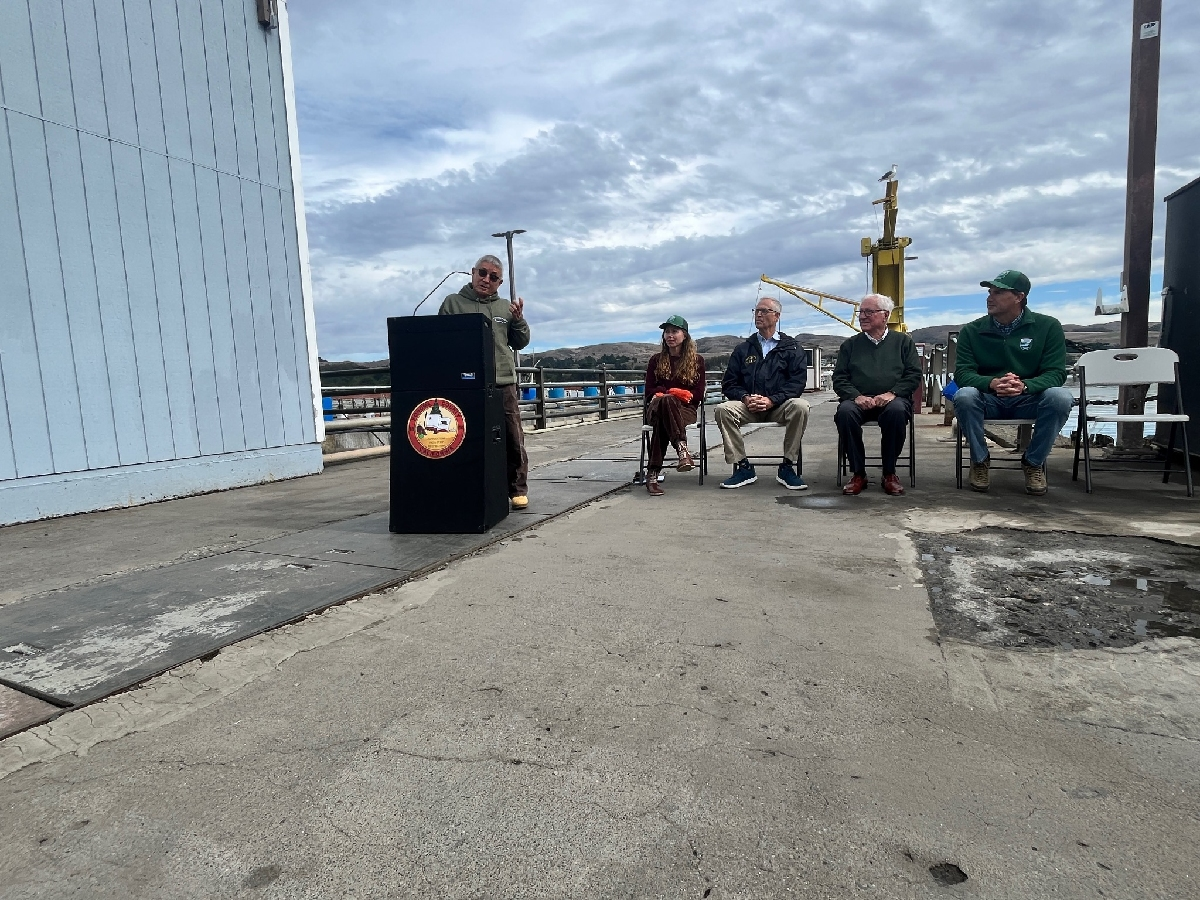
He was standing in front of the aging building on Bodega Harbor surrounded by elected officials, park managers, marina workers, and coastal conservation officials.
To his right stood the ice house, painted in a light blue hue that matches what is produced there, and whose stature disguises the importance of the machinery inside.
Key Infrastructure
Spud Point has the only bulk ice production and distribution facility between San Francisco and Fort Bragg.
“Every single year, you know, the fishing community walks on eggshells thinking that at any time the ice house might go down,” Ogg said.
To fishermen — and the industry they are part of — the ice house is a key piece of infrastructure that puts fresh fish on diners’ plates and helps support livelihoods and a way of life.
Rep. Jared Huffman (D-San Rafael) secured $1.2 million in federal funding. The California Air Resources Board provided $75,000.
The California Coastal Conservancy contributed $1.5 million.
The agency's chairman, Doug Bosco, attended the marina’s dedication as a congressman in October 1985.
He was returning Tuesday for the funding celebration 41 years later.
He recalled fishermen finally gaining a place to berth their boats and described a community whose families have long helped one another through the dangers and demands of earning a living at sea.
Officials hope to seek bids for project management within the next couple of months and move the project forward in 2027 and into 2028.
They plan to coordinate work around crab and salmon seasons to limit disruptions to fishermen.
“Ice is not a luxury,” Sonoma County Supervisor Lynda Hopkins said Tuesday. “This is a necessity in order for our fishermen to deliver their product to market.”
Working Waterfront Under Pressure
The ice house dates to 1985, when the marina opened. Noah Wagner, the longtime Spud Point Marina supervisor who retired in September, started working there in 1988 and spent years helping keep its specialized machinery running.
Replacement parts have become difficult to find. Hopkins recalled searches for obsolete components online and panicked calls about whether the equipment would keep working.
The existing machine also uses a refrigerant that officials said was banned because of its climate impacts. Wagner said planners are considering ammonia for the replacement system.
The facility produces about a ton of ice an hour, stores roughly 35 to 40 tons, and dispenses a ton in about five minutes through a four-inch hose, Wagner said. Customers must purchase at least 600 pounds.
Commercial fishermen use the ice to preserve salmon, crab, and rock cod. Fish buyers and recreational fishermen also purchase it.
Its reach extends beyond the local fleet. Wagner said boats travel along the coast from Alaska to Southern California and converge on Bodega Bay when fishing conditions and seasons draw them there.
The replacement effort has stretched across roughly two decades, according to Wagner.
Keeping Fishing Viable
The replacement effort has stretched across roughly two decades, according to Wagner.
During that time, the industry faced repeated salmon closures, toxic algae outbreaks, crab fishing restrictions intended to protect whales, and the COVID-19 pandemic.
Those disruptions have cut fishermen’s income, pushed charter operators into other businesses, and forced restaurants to seek seafood elsewhere.
Despite the strains on Bodega Bay’s commercial fleet and the resulting financial volatility at Spud Point, the marina has held its own.
But reliable ice remains essential to preserving catches and sustaining the fishermen, seafood businesses, and marinas that depend on a working waterfront.
Huffman said a visit roughly three years ago showed him how much the fishing community depended on the antiquated machinery.
“This was one I really wanted to bring home,” he said.
Ogg credited county and marina workers with repeatedly repairing the equipment when it seemed beyond saving. He said a replacement would help attract fishermen and generate revenue for the marina.
“This means the world to all of us,” he said.
Get more local news delivered straight to your inbox. Sign up for free Patch newsletters and alerts.