Traffic & Transit
Wrong Turn Puts Air France And American Airlines Jets On Collision Course Over LAX
The FAA confirmed an unauthorized turn near LAX. Aviation reports document two earlier departure deviations involving the same runway.


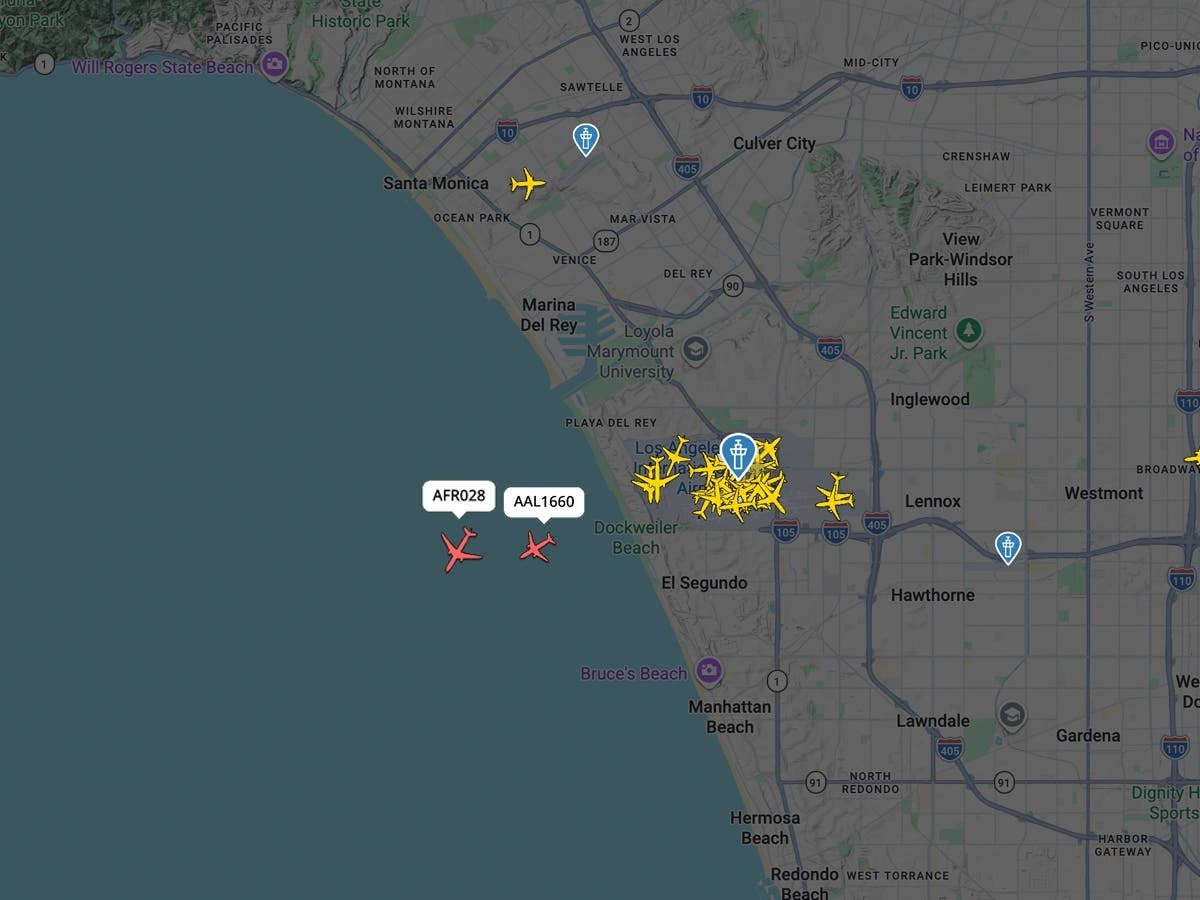
LOS ANGELES, CA — An Air France passenger jet made an unauthorized turn shortly after taking off from Los Angeles International Airport early Saturday, bringing it into the path of an American Airlines aircraft and prompting an air traffic controller to issue urgent instructions to keep the planes apart.
The close call, which occurred around 12:20 a.m. Nov. 7, according to the Federal Aviation Administration, follows two other reported incidents involving unexpected turns by aircraft departing the same LAX runway within approximately 13 months, including a remarkably similar encounter last year.
"The crew of Air France Flight 28 made an unauthorized turn after departing Los Angeles International Airport and went into the path of another aircraft that departed from a parallel runway," the FAA said in a statement provided directly to Patch on Monday. "Air traffic control immediately issued corrective instructions to the Air France flight."
Find out what's happening in Los Angelesfor free with the latest updates from Patch.
The agency cautioned that its information was preliminary and subject to change.
Air France Flight 28, an Airbus A350-900 bound for Papeete, Tahiti, had departed Runway 24L when it turned left toward the departure path of American Airlines Flight 1660, an Airbus A321 headed to Dallas-Fort Worth from Runway 25R.
Find out what's happening in Los Angelesfor free with the latest updates from Patch.
What followed was a series of urgent instructions from air traffic control, captured in radio communications reviewed by Patch, as the controller worked to prevent the aircraft from converging.
Controller Orders Immediate Course Correction
"Air France 028 heavy, fly heading of 270 immediately," the controller instructed, directing the crew westward.
Moments later, the controller warned the American Airlines pilots of traffic directly ahead.
"Traffic alert, traffic 12 o'clock, less than a mile. Maintain 2,000," the controller said.
The American Airlines crew acknowledged the instruction to remain at 2,000 feet, while the Air France aircraft was directed away from the developing conflict.
Flight-tracking data reported by AIRLIVE indicated that the aircraft came within approximately 0.76 nautical miles, or 0.87 statute miles, horizontally. At a different point in the encounter, they were reportedly separated vertically by approximately 300 feet while 1.6 nautical miles apart horizontally. Those figures are based on flight-tracking estimates rather than confirmed FAA measurements.
A review of historical Flightradar24 playback by Patch showed the Air France aircraft making a rightward course correction shortly before 12:18 a.m., with the American Airlines jet following behind. The playback provides a visual reconstruction of the aircraft's movements but does not independently establish their precise separation or the timing of the controller's instructions.
After directing the aircraft apart, the controller questioned the Air France pilots about their unexpected maneuver.
"You were instructed to climb via SID, not turn to a heading," the controller told the crew, referring to a standard instrument departure, a published procedure designed to guide aircraft safely away from an airport.
The controller repeatedly asked why the aircraft had turned and which departure procedure the pilots had been assigned. The crew eventually confirmed the SUMMR TWO departure procedure, but the exchange did not establish why the unauthorized turn had occurred.
The controller subsequently advised the pilots of a possible deviation from their instructions and provided a telephone number for follow-up. Both aircraft continued to their destinations without reported injuries.
Similar Encounter Involving Same Runways
Saturday's incident bears a striking resemblance to another encounter at LAX on Oct. 31, 2025, when an ITA Airways Airbus A330-900 departing Runway 24L for Rome unexpectedly turned left toward an American Airlines Airbus A321 departing Runway 25R for New York.
According to an incident report published by The Aviation Herald, the ITA Airways aircraft began turning approximately 0.8 nautical miles beyond the runway's departure end, bringing it toward the southern runway complex's departure path.
Air traffic control instructed the American Airlines pilots to stop climbing at 1,500 feet and directed the ITA Airways aircraft onto a heading of 270 degrees, steering it away from the developing conflict. Flight-tracking data highlighted by Flightradar24 indicated that the aircraft came within approximately 0.6 nautical miles horizontally while at the same altitude. Both flights continued to their destinations.
More recently, on Oct. 20, 2026, a TAP Air Portugal Airbus A330-900 bound for Lisbon also made an unexpected left turn shortly after departing Runway 24L. According to another Aviation Herald incident report, the aircraft began turning after climbing through approximately 1,000 feet, prompting air traffic control to direct it back toward its intended heading.
Later in the departure, the pilots reportedly turned right after being instructed to turn left. The controller questioned the crew about its operation and assigned departure procedure before advising the pilots of a possible deviation. The flight continued to Lisbon without further reported incident.
Although all three incidents involved unexpected turns following departures from Runway 24L, no common cause has been established, and there is no indication that investigators have formally linked them. The TAP incident has not been established as a near-collision.
Questions Remain About Air France Turn
Air France confirmed the latest incident in a statement to KTLA, saying its crew received a request from air traffic control to adjust the aircraft's flight path shortly after takeoff and immediately complied. The airline said the aircraft continued to Tahiti, landing normally at 5:59 a.m. local time.
The FAA has not publicly explained why the Air France pilots deviated from their assigned departure procedure or whether either aircraft received an onboard collision avoidance warning.
In its inquiry to the FAA, Patch sought confirmation of the aircraft's closest recorded separation, whether the Air France crew had correctly acknowledged its departure instructions and whether investigators had determined what caused the unauthorized turn.
The agency's response confirmed the unauthorized maneuver and the controller's intervention but did not address those additional questions.
The incident remains under FAA investigation.
More California News:
- Meghan Markle's Father Arrested After Child Pornography Found In LA Storage Units
- Trump Names Controversial Santa Monica Native As White House Chief Of Staff: Reports
- IRS Announces 2027 Tax Changes: What CA Taxpayers Need To Know
- ChatGPT Helped Wife Plan Husband's Poisoning, Bay Area Lawsuit Claims
- Longtime CA News Anchor Dies At 82
- 'Armageddon' Or Not, Nithya Raman Could Bring 4 Big Changes To LA
- Fremont Woman Accused Of Assaulting East Bay Councilmember
Get more local news delivered straight to your inbox. Sign up for free Patch newsletters and alerts.