Community Corner
Plan To Build Data Centers On 70 CA Fairgrounds Triggers Backlash
American historic fairgrounds mix utility with nostalgia but a statewide tech-hub may be a step too far.


CALIFORNIA — Fairgrounds have long held a place in American lore. They are mirrors that Americans use to see a vision of the country and their home towns — the midway lights, the livestock barns, the demolition derbies, the funnel cakes, the fireworks, the 4-H kids, and the annual rituals that make a town feel like itself.
And, when wildfires sweep across the Golden State, those same open spaces were turned into evacuation centers, fire camps, incident command posts, and emergency staging grounds.
That blend of nostalgia and necessity now sits at the center of a new fight.
Find out what's happening in Napa Valleyfor free with the latest updates from Patch.
A private proposal to turn fairgrounds up and down California into hubs for data centers, vertiports, emergency response, and multistory parking garages hit strong headwinds in a Northern California town whose wntire population is smaller than the number of seats in U.C. Berkeley's Hearst Greek Theatre.
Calistoga, a wine county town in Napa Valley whose population is 5,200, became one of the first testing grounds for Global Stack LLC.
Find out what's happening in Napa Valleyfor free with the latest updates from Patch.
The Santa Ana corporation wants to turn California fairgrounds into privately financed “revenue and resilience” hubs by adding data centers, parking garages, vertiports, and infrastructure on fairgrounds land across the state.
Calistoga residents balked at the idea of placing an 8- to 10-megawatt data center on land many still see as a public gathering place, an emergency asset, and a piece of local history.
The Calistoga backlash may preview a larger debate heading toward fairgrounds across the state. Global Stack LLC has pitched a model that targets up to 70 California fairgrounds by 2030, according to company materials, framing fairgrounds as underused public land that can generate year-round revenue through private infrastructure.
In Calistoga, however, residents told the city they wanted the reverse order: first a public master plan, then any discussion of private development.
They pushed back against idea presented by one of two Global Stack executives at a June 25 Fairgrounds Advisory Committee meeting.
Deputy City Manager Rachel Stepp said Calistoga would not move forward with the concept and had never planned to do so.
Stepp said the item came to the committee as a presentation, not as a city proposal, and no vote, recommendation, or action was requested.
Stepp said the California Department of Food and Agriculture, which oversees California fairgrounds through its Fairs and Expositions Division, brought the Global Stack concept to Calistoga.
The California deputy secretary of fairs and expositions, Michael Flores, did not return messages, and his phone extension was out of order, as were others Patch tried to contact. None of the four calls to the California Department of Food and Agriculture were returned.
The Cow Palace and other fairground operators did not return messages. None of the documents filed with the California Secretary of State, or presentations, included contacts for Global Stack executives. Kovacevich did not respond to a LinkedIn message before this report was published.
Calistoga placed the item on the agenda so the committee could hear what the company wanted to present, she said.
Priorities
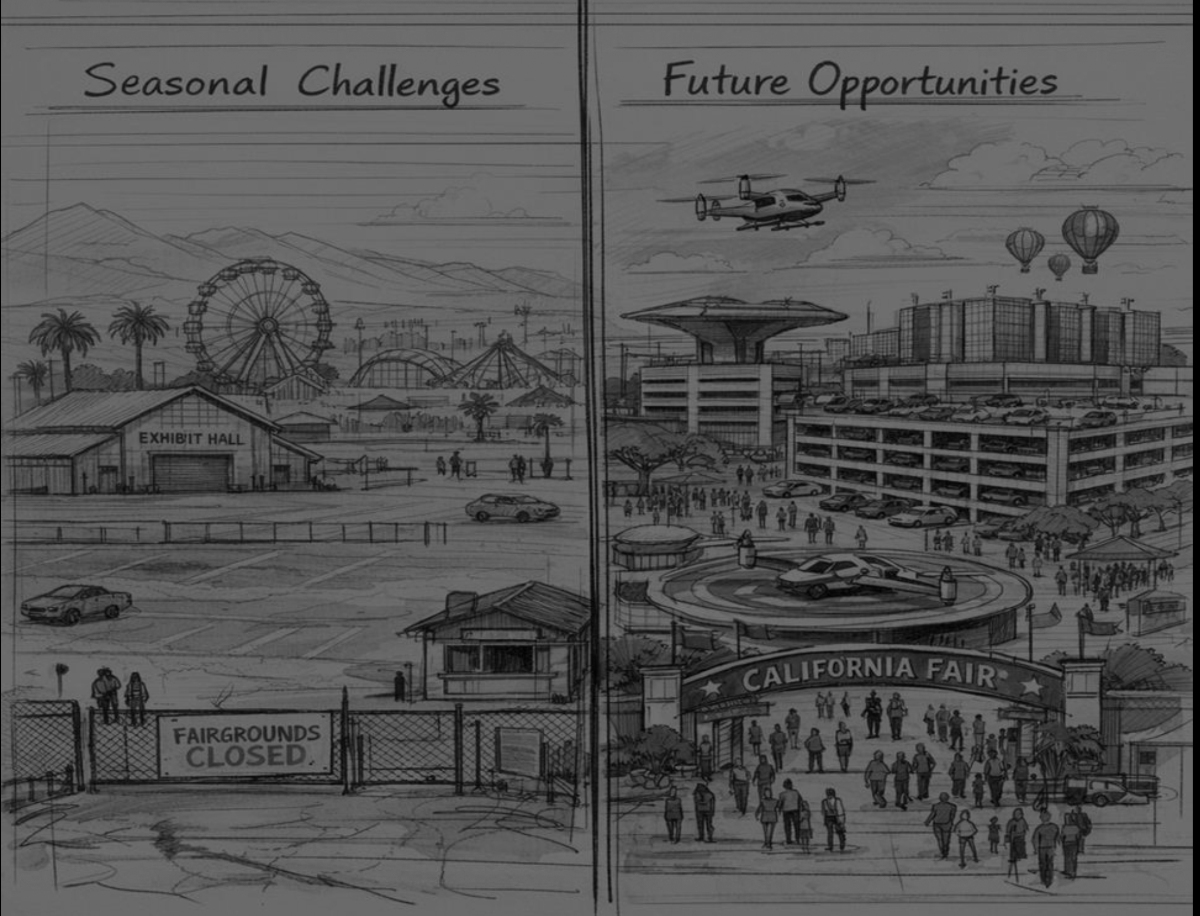
Nearly 100 people packed the meeting, where Global Stack president Nicholas Kovacevich presented renderings that mixed flying cars, evacuation zones, hot-air balloons, turbines, and a small-scale data center.
Residents objected to the proposal’s scale, environmental effects, water and power demands, traffic, noise, helicopter activity, and fit with Calistoga’s small-town character.
Global Stack framed the concept as a private-capital answer to a real public problem: fairgrounds need money.
Its materials describe a statewide redevelopment model that would combine parking structures, emergency-response infrastructure, helicopter and eVTOL access, and 8- to 10-megawatt edge data centers.
The company’s rollout plan calls for up to 70 California fairgrounds sites by 2030, with MeshClusters LLC operating the data centers, DAA Parking LLC handling parking, and PanGalactica LLC operating the aviation network. Global Stack is the holding company for all of the above.
Residents questioned whether those benefits justified the scale of development.
"I think it's outrageous that the fair board would even consider something like this," resident Vicki Edwards wrote in comments responding to the proposal.
Another resident wrote that there is a lot of conversation and concern in the community about this presentation by Global Stack. "What they’re presenting does not align with Calistoga’s ‘small town character’ in any way and many in the community are shocked that it’s on the agenda."
In other letters, comments called the proposal "overblown," "inappropriate," and "tone-deaf."
Kovacevich acknowledged he was surprised by the backlash. He added that he did not "know the fairgrounds intimately," Bay City News reported.
Global Stack's pitch for a 100-year service and land-use agreement landed in a city that already knows the fairgrounds carry both emotional value and financial risk.
In 2023, Calistoga voters rejected Measure E, a tax-backed plan tied to a nearly $16 million purchase of the Napa County Fairgrounds. In 2024, the city bought the 70-acre property for $2 million, according to the San Francisco Chronicle.
A 2025 survey shows why residents reacted so strongly. Nearly all of the 641 people who filled out the survey said they were familiar with the fairgrounds. More than three-quarters had visited before the site shut down in 2018.
Almost all of them (96%) agreed the property needed maintenance, but 95% agreed the fairgrounds remain an important part of Calistoga’s identity and legacy.
Residents did not reject revenue. They ranked maintenance, reopening, and financial sustainability as real needs. Eighty percent supported leasing portions of the property to vendors and businesses to fund improvements.
But residents described a different future than the one Global Stack sketched. In an open-ended question, a little under half named community events and spaces as what they most wanted to see at the fairgrounds.
The golf course, racing, the fair, concerts, parks, open space, repairs, upgraded facilities, RV camping, sports, and recreation — the community could see those uses for the fairgrounds.
They called for “an actual fair like we used to have,” “a place where community members can gather,” and “a comprehensive plan to maximize the social and financial benefit to the town.”
When the survey forced respondents to choose between priorities for the fairground, clustered at the top were the Speedway, RV park, emergency evacuation center, annual fair, and public open space.
Modern Role, Old-Time Nostalgia
Calistoga's survey reflects the strong attachment many communities have to their fairgrounds, even when the properties are aging and neglected. The reality is that many are. But they are far from empty.
The emergency focus reflects the property's modern role as much as its history. Stepp said fairgrounds offer the open land, access, and utilities that fire agencies need for staging, incident command, evacuation support, and logistics.
In Napa and Sonoma counties, repeated wildfire seasons have turned fairgrounds into emergency infrastructure precisely because they remain large, flexible, and publicly owned.
Fairgrounds have always brought together memory, commerce, agriculture, and infrastructure. Agricultural fairs grew out of markets, livestock shows, harvest festivals, religious celebrations, and sheep-shearing feasts, according to the Smithsonian.
One report described state fairs as celebrations of local culture, agriculture, and community that evolved into regional showcases for farmers, artisans, and innovators.
Photographer Pamela Littky, whose book "American Fair" documents fairs across the country, describes them as places that celebrate "diversity" and "community."
Global Stack's presentation leaned into that legacy.
Global Stack used AI-generated pencil sketches with a nostalgic, retro-futurist fairgrounds style, blending Ferris wheels, tents, barns, open fields, and crowds with flying cars, vertiports, data centers, parking garages, and emergency command hubs.
The images softened an industrial-scale proposal by presenting it as a sentimental leap from small-town tradition to high tech resilience.
In between, are slogans — "Job Creation" and "NO COST to Californians!" next to men and women in hard hats.
The images make a major commercial technology project appear like a natural extension of Calistoga’s civic past.
However, the presentation is generic, ready to present to any of the sites, from Calistoga and to Ventura. In fact, the company were presenting it to the Cow Palace stakeholders in San Francisco and in Solano before moving south, according to reports.
The Power Problem
Global Stack's proposal describes fairgrounds serving multiple roles, including festivals and community events, as well as wildfire evacuations and disaster response centers, with small data centers providing immediate power if the electrical grid fails.
The classic fairground imagery softened the proposal's industrial elements and cast the data center, parking garage, and aviation hub as the fairgrounds' next chapter rather than a break from their past. The energy numbers could make that pitch hard to sell.
Data centers have moved from a niche technology issue to a mainstream energy-planning challenge faced by California cities and towns and across the nation.
California fairgrounds typically range in size from 40 to 350 acres, with an average of about 150 acres. They are some of the last parcels of public land available in California. In other words, they are perfect for a data center.
An 8- to 10-megawatt edge data center could help meet the power demands for fairground operation and events that, however nostalgic the facility, are considerable.
A typical mid-sized county fair draws upwards of $10,000 to $30,000 worth of electricity during a standard week-long run, according to some estimates. Data centers, however, would be consuming electricity year-round.
The International Energy Agency expects data centers will account for nearly half of U.S. electricity demand growth through 2030.
Electricity is generated by other energy sources, including water, wind, and coal.
The electricity sector accounts for almost 90% of U.S. coal consumption, according to the IEA, meaning new data center demand can ripple backward into fossil-fuel generation when clean power, substations, and transmission lines cannot expand quickly enough.
The resource question extends beyond the electric meter. The Congressional Research Service says data centers consume energy for servers, storage, networking equipment, cooling, power conversion, backup power, and other supporting systems.
CRS researchers also pointed out that cooling can increase water demand, particularly when facilities rely on evaporative cooling systems or are built in water-stressed regions.
Back Home
For Calistoga, that changes the land-use question. A fairground can host tents, livestock barns, concerts, RVs, emergency shelters, and fire crews without becoming a round-the-clock industrial power user.
An 8- to 10-megawatt edge data center would bring continuous electricity demand, grid interconnection requirements, backup-power needs, cooling systems, and possible utility-cost impacts for the surrounding community.
The Global Stack proposal promised revenue, parking, emergency communications, AI infrastructure, and private investment. Residents did not dismiss those needs.
But they also rated strengthening the local economy as an extremely or very important benefit and placed maintaining the community's character at the top of the list.
That priority defined the backlash. Residents did not ask the city to freeze the fairgrounds in time. They asked city leaders to decide, in public, whether a private, year-round industrial energy use belongs on civic land that residents still see as a fairground, an evacuation site, a gathering place, and a defining part of Calistoga's identity.
Even though the Global Stack proposal had little chance of moving forward, opposition played a role in ending discussions and may do so again in the other dozens of fairgrounds on the company's list.
In the meantime, Stepp said Calistoga's Fairgrounds Advisory Committee, which the city formed in 2025 to evaluate future uses for the property, will continue its work, but a data center will not be among the concepts it studies.
Related: Data Center Vision For North Bay Fairgrounds Gets Hearing
Bay City News contributed to this report.
Copyright © 2026 Bay City News, Inc.
Get more local news delivered straight to your inbox. Sign up for free Patch newsletters and alerts.