Crime & Safety
Waves Smash Records And A Pier As King Tides Batter CA Coast
King tides peaked for the week in Southern California Wednesday, but coastal flood hazards will remain in place through Thanksgiving.


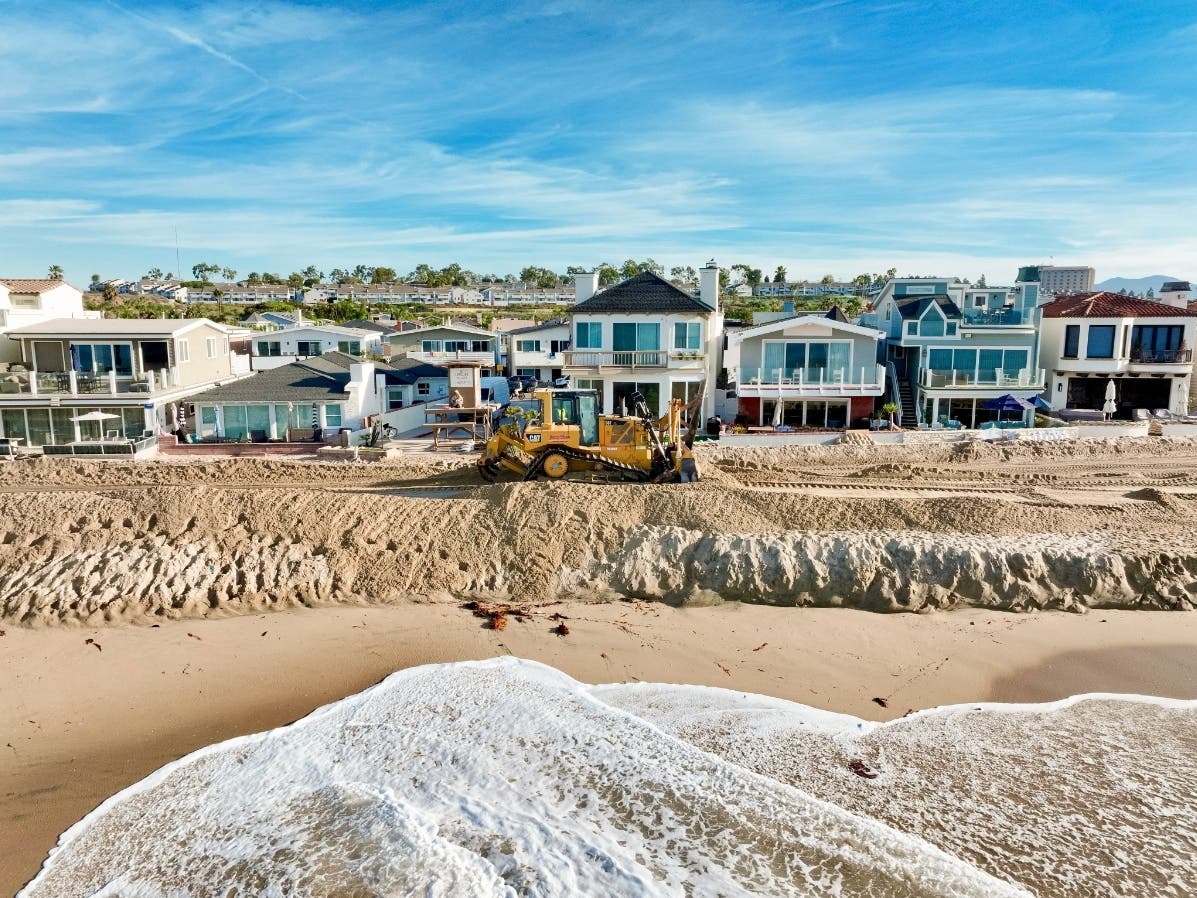
ORANGE COUNTY, CA — King tides smashed all-time high tide records in California Wednesday, destroying a pier and threatening homes up and down the coast. The worst is yet to come.
Some Central Coast communities are under evacuation warnings heading into the Thanksgiving holiday, and a major stretch of PCH is closed in Orange County as floodwaters could make it undriveable. Low-lying beaches, including Seal Beach, Sunset Beach and Laguna Beach are under coastal flood warnings. The King Tides are also battering Northern California, where the iconic Pacifica pier was partially washed away by a massive wave caught on camera Wednesday.
Already Wednesday, high tide records were broken in La Jolla and Santa Barbara and tied in San Pedro and Newport Beach Wednesday, according to the National Weather Service.
Find out what's happening in Orange Countyfor free with the latest updates from Patch.
Tide Records Broken
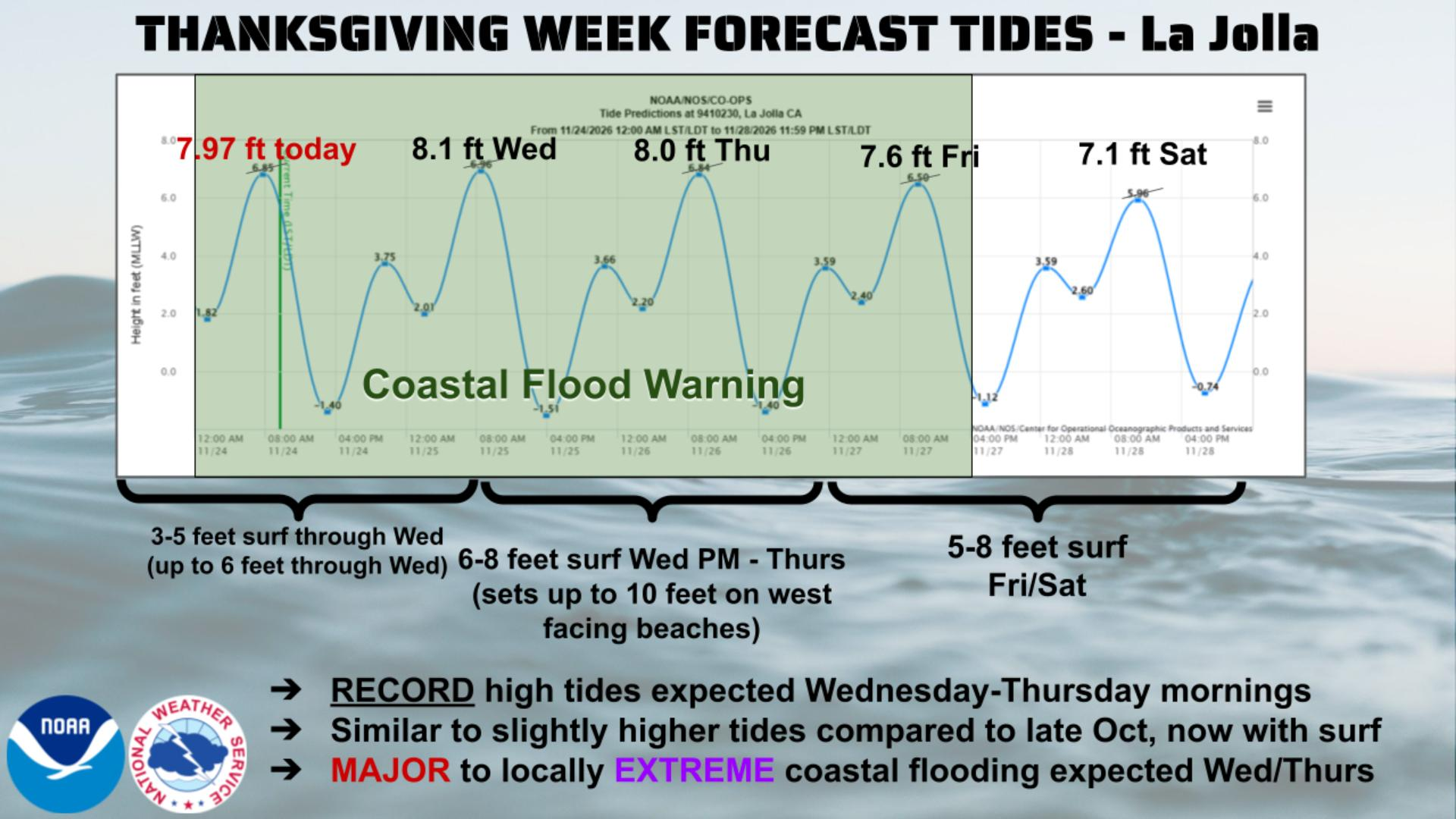
The tide came in La Jolla at 8.11 feet above the average low tide, breaking the record of 7.98 feet, National Weather Service Meteorologist Quinn Davidson told Patch.
The ocean water level at the Los Angeles Harbor reached 8.19 feet Wednesday morning, tying the record set on Oct. 27.
Find out what's happening in Orange Countyfor free with the latest updates from Patch.
Santa Barbara's highest tide was recorded at 8.1 feet so far, breaking the old record of 8.04 feet, according to the service. According to the Los Angeles Times, an evacuation warning was issued due to potential coastal flooding in Montecito, Summerland and Carpinteria.
In San Pedro, the tide hit 8.19 feet, tying the record last broken on Oct. 27.
In Newport Beach, the tide peaked at 8.4 feet, which matched October's highest recorded tide.
Thanksgiving Day Flooding Threat
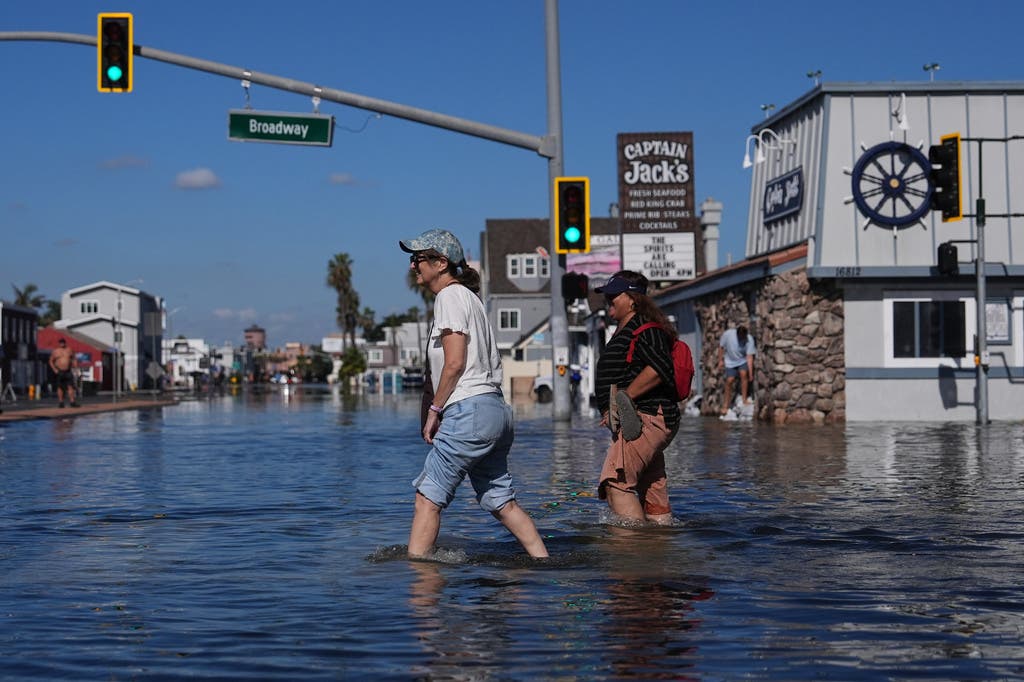
SoCal residents can expect the brutal ocean conditions to stick around through Thanksgiving, Davidson said.
"We have a swell coming in Thursday," Davidson told Patch. "That on top of the high tides can create more coastal erosion and flooding."
The stronger surf is expected to impact Thursday morning's high tide. According to Davidson, Thursday's high tide starts at 9:23 a.m. and goes until 10 a.m.
In Los Angeles County, residents can expect a peak tide of 8.2 feet and surf ranging from six to 11 feet.
In Orange County, residents can expect a tide ranging from 7.9 to 8.3 feet, with breaking waves potentially reaching seven to eight feet.
High surf advisories were issued in Ventura and San Diego counties for Thanksgiving Day.
In Ventura County, residents can expect a peak tide of 8.2 feet with surf ranging from eight to 15 feet in height.
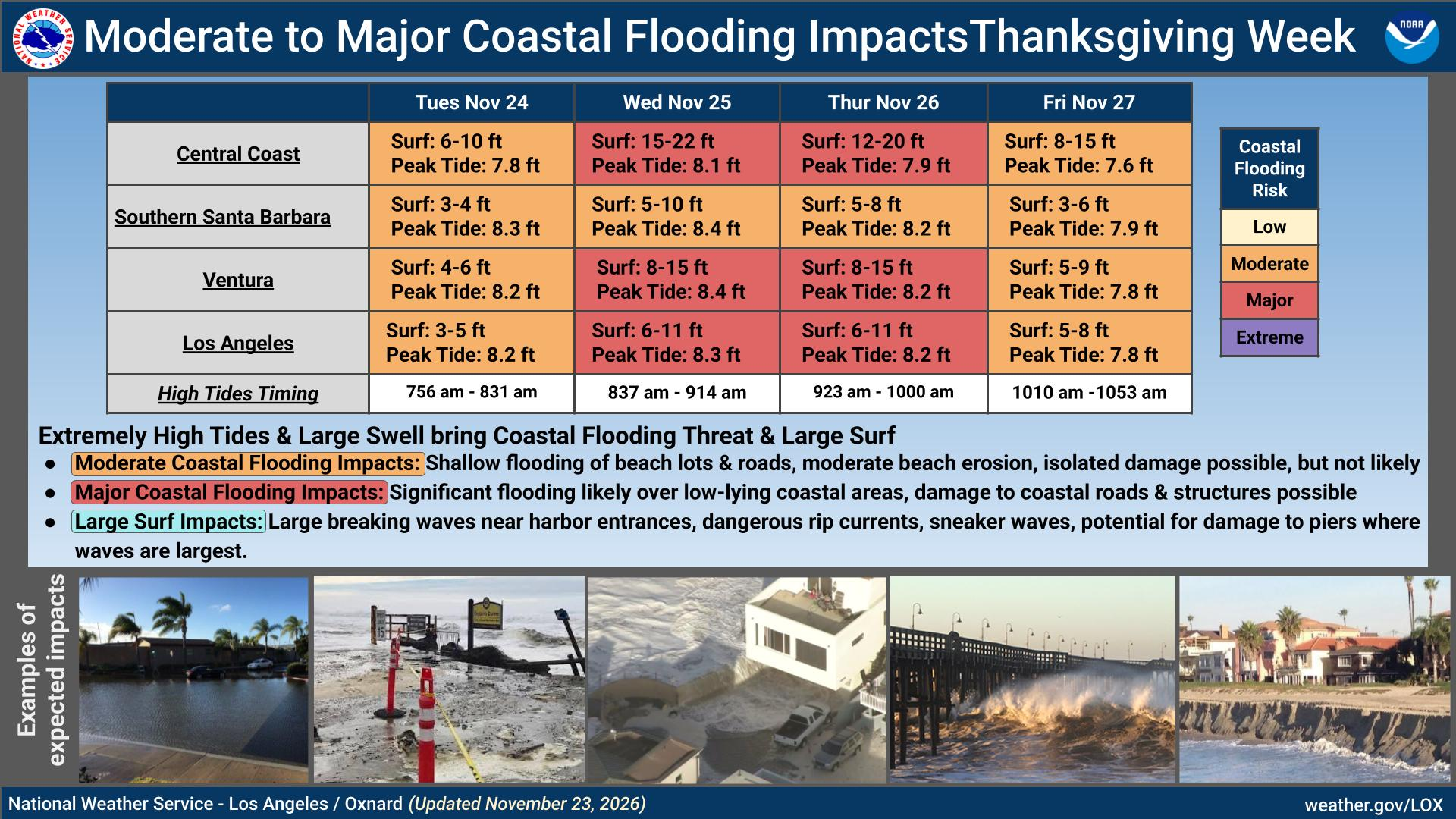
In San Diego County, residents can expect large breaking waves of six to eight feet, with sets ranging from 10 to 12 feet, peaking during morning's high tide on Thursday.
"We are definitely telling people to heed caution and to not head toward the water during morning high tides," Davidson said.
The slew of ocean advisories comes amid persistent king tides that have been pestering the Southern California coast.
King tides are the highest tides of the year, and they are increasingly flooding coastal communities as sea levels rise.
King tide is a non-scientific or colloquial term that people often use to describe these exceptionally high tides. The 2026 super El Niño — the natural and temporary warming of parts of the Pacific — has raised coastal water levels and intensified the effects of king tides.
“Tides are incredibly complicated. Really every location has different tidal cycles and that’s the basis for what a king tide is,” said Alec Bogdanoff, an oceanographer and meteorologist in Fort Lauderdale, Florida. “It’s a local term for the highest high tides of the year in a location. And when it impacts you, that’s when they call it a king tide.”
King tides typically occur when the sun, moon and Earth are nearly aligned because their gravitational pull adds together. This raises water levels and produces the greatest tidal effects of the year. This can happen on both coasts around the same time because the tides are responding to the same alignment and proximity of the moon and sun. In 2026, El Niño caused higher baseline water levels on both coasts, Bogdanoff said.
The highest high tides happen during full moons and new moons and seasonal cycles that can raise or lower sea levels, he added.
Historically, many coastal areas saw king tides once or twice a year, but some places are experiencing them more often than that as sea levels rise.
Associated Press and City News Service contributed to this report.