Politics & Government
The $6 Million Problem Petaluma Residents Tried To Solve
Citizen-led workshops examine Petaluma's revenue sources, funding limits, and difficult tradeoffs behind local government decisions.


PETALUMA, CA — Imagine being handed $1 million to improve your city. Do you spend it repairing a dangerous sinkhole, fixing a crumbling fairgrounds building, building affordable housing, improving traffic safety, or saving some for the next emergency?
There isn't enough money to do it all, and every choice means something else goes unfunded.
That was the challenge organizers posed to residents Thursday at a "Follow the Clucking Money" workshop.
Find out what's happening in Petalumafor free with the latest updates from Patch.
The exercise was designed by the group, Petaluma Urban Chat, to reveal the difficult tradeoffs that shape every city budget.
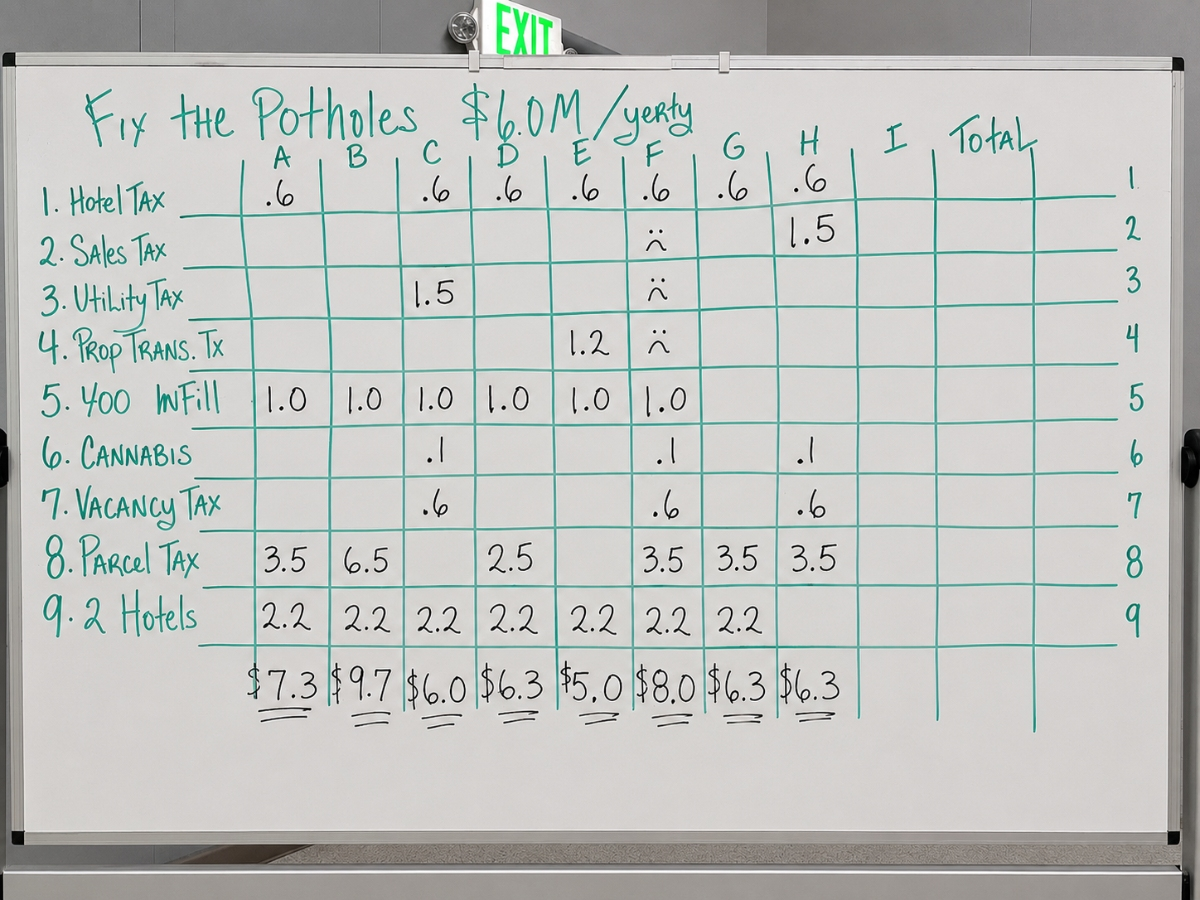
In one exercise, dozens of Petaluma residents grappled with how to find an additional $6 million to fund programs on top of the city's current $348 million budget instead of cutting services.
Find out what's happening in Petalumafor free with the latest updates from Patch.
They had a menu of options—including raising the hotel tax, adding new hotels, approving a parcel tax, and allowing additional cannabis retailers, eating a luxury restaurant, and ordering online—each carrying political tradeoffs.
They had to wrestle with the same choices elected officials face every year: address immediate problems, invest for the future, or stretch limited dollars by pursuing matching funds and grants. And they had to do it with only a small portion of the budget that is not legally restricted.
But the first step was to understand the taxes themselves and how much from each bucket they could take. It turned out that many of the buckets were less accessible than most of the 60 or so participants assumed, but a few were more so.
Like online ordering, luxury hotels, and eating out. Spending on those generated tax income that Petaluma could keep. Others, like groceries or property tax don't add up to much local impact for Petaluma. That's because only a small percent stays in Petaluma and is available for spending.
"The mission is to find realistic, politically viable ways that grow Petaluma's revenue," said one of the organizers as he tested the tax know-how among the dozen or so tables filled with people walking through the difficult decisions that city officials face. "The catch is every new dollar has a trade-off, some problem."
Follow the money
The budget workshop highlighted how relatively little local tax revenue stays with Petaluma and why residents who want to shape their city's future first need to understand where the money comes from—and where it can legally go.
Only a relatively small share of the city's $400 million budget is available for the City Council to reallocate from year to year. And they are constantly making trade-offs.
Organizers told attendees Thursday that about 20 cents from an $11.30 restaurant purchase returns to Petaluma through local sales tax, while about 11 cents of every property tax dollar comes back to the city for municipal services.
Cities keep only a small share of some taxes—as little as about 10 percent of property tax revenue, for example—but retain all of others, including hotel taxes, parcel taxes, and business license taxes.
Many tables gravitated toward raising the transient occupancy tax because visitors, rather than residents, would shoulder much of the cost.
Several groups also endorsed allowing two additional four-story hotels, arguing the projects would generate tax revenue while bringing more visitors downtown to shop and dine.
Others supported additional infill housing as a long-term way to strengthen the city's finances, while debates over a parcel tax centered on whether seniors and lower-income homeowners should be exempt.
By the end of the exercise, attendees had found several areas of agreement. Raising the hotel tax, encouraging infill housing, and expanding lodging capacity emerged repeatedly across the room, while only one table chose another local sales tax increase.
The outcome was a contrast with fights waged against hotels and development in Petaluma.
For years, enough Petaluma residents have pushed back against proposals for larger hotels and denser development, including a luxury hotel project in downtown Petaluma involving celebrity chef Charlie Palmer. Opponents shut down plans for a 6-story hotel at the intersection of Petaluma Boulevard and B Street with a ballot.
But, when asked to balance the city's budget themselves, many reached a different conclusion on Thursday.
Faced with the realities of a city that keeps only a small share of local property taxes, participants repeatedly chose to raise the hotel tax and build more hotels—preferring to shift more of the cost of city services onto visitors rather than local taxpayers. "We like taxing other people instead of ourselves first," one participant said, drawing laughter from the room.
Several advocates for new hotels that could be taxed said the trade off was worth it but that the hotels could be more to scale than the one rejected last year.
Peeling an onion
The workshop built on a previous June 27 session dedicated to understanding the budget from the revenue side.
"Have you ever stared at a city program and thought, 'Wait...we spent how much on that?!'" an organizer asked during the June 27 session. "You're not alone. And you're exactly who this workshop is for."
Petaluma has about 90 historic buildings, 700 acres of parkland, 400 lane miles of roadway, and a population of nearly 60,000. About 20 percent of residents are over the age of 65.
Not every city service is paid for from the same pot of money. While police rely largely on general tax dollars, Petaluma's ambulance service largely pays for itself through ambulance billing, while water and sewer operations are funded by utility customers.
"It's like peeling an onion," Urban Chat organizers said after spending six months digging through Petaluma's finances—including sales taxes, property taxes, enterprise funds, and annual financial reports—before inviting the public to learn alongside them.
The exercise revealed how quickly debates over growth become debates over municipal finance.
The workshop also served as an introduction to the nonprofit behind it, Petaluma Urban Chat, whose members have spent years trying to make city finance more understandable for ordinary residents.
Rather than presenting themselves as financial experts, organizers emphasized that they approached the budget as residents trying to understand the same documents available to everyone.
"None of us are accountants," one volunteer said. "We didn't come in here to blow you away with our financial knowledge. We're coming here to share how far we could get."
However, one of Petaluma Urban Chat's five board members is Petaluma Mayor Kevin McDonnell.
The group, which became a nonprofit in 2024, is part of a broader urbanist movement that combines civic education and urban planning through public forums and community projects focused on housing, transportation, city finances, and climate action.
Petaluma Urban Chat is behind the Vacancy Project, which documented empty buildings and underused lots downtown; the "Know Before You Grow" initiative, which makes city planning more accessible to residents; monthly meetups at Aqus Café; and the "Follow the Clucking Money" budget workshops.
Organizers said the series will continue to evolve based on public questions, with future sessions exploring additional layers of municipal finance.
Get more local news delivered straight to your inbox. Sign up for free Patch newsletters and alerts.