Neighbor News
When Property Managers Become Debt Collectors: A Conflict California Can No Longer Ignore
Should the same entity be allowed to manage accounts, impose financial penalties, and act as the debt collector on those same accounts?

In California’s HOA and common interest development landscape, property management companies (PMCs) are entrusted with maintaining property operations and facilitating relationships between homeowners and associations. However, a growing practice raises significant ethical and legal concerns: PMCs acting in the role of debt collectors while simultaneously administering the accounts they enforce.
This dual role creates a structural conflict of interest that warrants closer scrutiny—particularly in light of evolving California law, including AB 130 and existing consumer protection statutes.
A Documented Example of Dual Roles
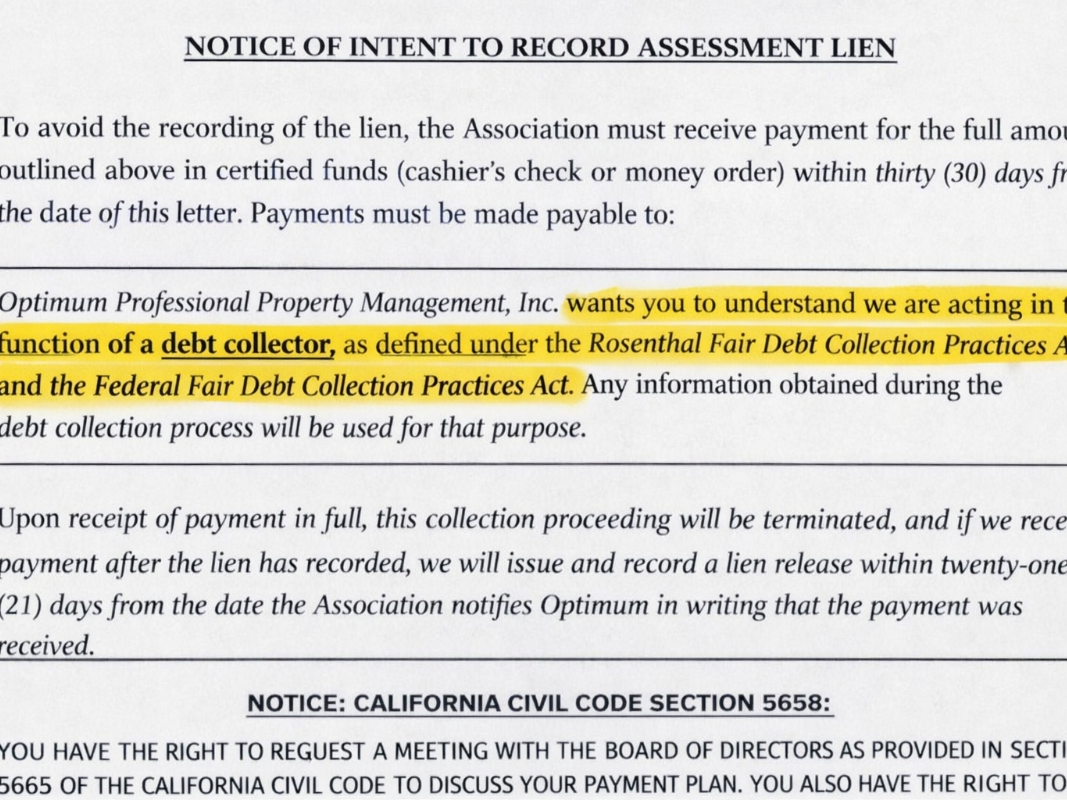
In a recent Notice of Intent to Record Assessment Lien reviewed by this author, a Southern California property management company (Optimum Professional Property Management, Irvine, CA) explicitly stated that it was “acting in the function of a debt collector” while pursuing delinquent assessments. This same entity was also responsible for managing the account, imposing fees, and administering communications with the homeowner. THIS IS OUTRAGEOUS, AND THIS PRACTICE SHOULD BE REGULATED IN THE STATE OF CALIFORNIA.
The notice included multiple charges, including late fees, interest, and a separate collection fee. When a property manager assumes the role of debt collector, these charges may no longer be viewed purely as administrative but instead fall under the scope of regulated debt collection activity.
Legal Implications Under Federal and State Law
Under the federal Fair Debt Collection Practices Act (FDCPA) and California’s Rosenthal Fair Debt Collection Practices Act, entities that regularly collect debts may be subject to strict regulatory requirements. These include obligations to provide accurate accounting, avoid misleading representations, and comply with communication limitations.
When a PMC explicitly declares itself a debt collector, it raises important legal questions:
- Are all fees and charges supported by a statutory authority?
- Are communications compliant with debt collection laws?
- Is the homeowner provided proper validation and transparency?
Failure to meet these standards may expose both the management company and the association it represents to legal risk.
Find out what's happening in Rancho Santa Margaritafor free with the latest updates from Patch.
AB 130 and Legislative Intent
California Assembly Bill 130, effective July 1, 2025, introduced reforms aimed at limiting excessive fines within common interest developments. While debate continues regarding the application of these limits to late fees on assessments, the legislative intent is clear: to reduce financial abuse and increase transparency in homeowner billing practices.
Find out what's happening in Rancho Santa Margaritafor free with the latest updates from Patch.
The continuation of layered fees—including late fees, interest, and collection charges—raises the question of whether some practices align with the spirit of these reforms.
Fiduciary Duty and Risk Exposure
Property managers owe a fiduciary duty to the associations they serve. This duty requires acting in the best interest of the client, including minimizing legal exposure and preserving community stability.
Aggressive or improperly structured collection practices may:
- Trigger legal disputes
- Damage homeowner relationships
- Increase liability exposure for the association
In such cases, the issue is not merely operational—it is a question of fiduciary responsibility.
Transparency and Accountability
A central concern is transparency. Homeowners may not be fully aware when their property manager is also acting as a debt collector. Without clear disclosure and separation of roles, the risk of confusion—and potential abuse—significantly increases.
Clear disclosure, independent oversight, and strict adherence to statutory requirements are essential safeguards that should be present in any such arrangement.
Conclusion
This is not an argument against lawful collection of assessments. Associations have a legitimate interest in maintaining financial stability. However, when the same entity manages accounts, imposes fees, and collects debts, the potential for conflict of interest becomes unavoidable.
California’s regulatory framework is evolving to address these concerns. Whether current practices will withstand increased scrutiny remains an open question.
What is clear is that transparency, accountability, and adherence to both the letter and spirit of the law must remain the standard.
Closing Observation
This issue extends beyond any single company or association. It reflects a broader structural question within California’s HOA management frameworShould the same entity be allowed to manage accounts, impose financial penalties, and act as the debt collector on those same accounts?
Should the same entity be allowed to manage accounts, impose financial penalties, and act as the debt collector on those same accounts?
As regulatory scrutiny increases—particularly under statutes such as the Rosenthal Act and evolving legislation like AB 130—this model may face greater legal and ethical examination.
For homeowners and associations alike, the key questions are transparency, accountability, and alignment of incentives.
Disclaimer: This article is for informational purposes only and does not constitute legal advice. Readers should consult qualified legal counsel regarding specific situations.