Community Corner
Environmental Nonprofit Unveils 2026 Report Card On Water Quality For Long Island Sound
Save the Sound released its 2026 Long Island Sound Report Card at Darien's Weed Beach on Tuesday.


DARIEN, CT — Regional environmental nonprofit Save the Sound on Tuesday released its 2026 report card, and while the results showed great progress on water quality, officials agreed there is more work to do.
Elected officials, local environmental organizations and community members gathered at Weed Beach Tuesday morning for the unveiling of the 2026 Long Island Sound Report Card. The event is available to watch on demand on DarienTV.
Nearly every section of Long Island Sound's open waters scored higher on water quality than in the previous report card, including the Western Narrows section closer to New York City, which received a passing grade for the first time in 18 years.
Find out what's happening in Darienfor free with the latest updates from Patch.
"If you go back in history and you read what the Long Island Sound used to be, it was incredible. Just the shape of it, the shallow depth, its nearness to the Gulf Stream, the way the currents circle in; It was one of the most productive estuaries on the planet," said Soundkeeper Bill Lucey, of Save the Sound.
"This was back when things were pristine. We've seen some ups and downs. Right now we're seeing an up."
Find out what's happening in Darienfor free with the latest updates from Patch.
Lucey said he expects people to be able to eat clams and other shellfish from anywhere in Long Island Sound in the future, and that beaches will eventually have no days when swimming is prohibited.
"Although we do have a long way to go, we've come a long way," he said.
The 2026 Long Island Sound Report Card uses data from the 2025 monitoring season.
The open-water grades are based on dissolved oxygen, chlorophyll a, water clarity and dissolved organic carbon data collected by the Connecticut Department of Energy and Environmental Protection, the Interstate Environmental Commission and the New York City Department of Environmental Protection.
All five open-water segments maintained or improved their grades compared with the 2024 report card.
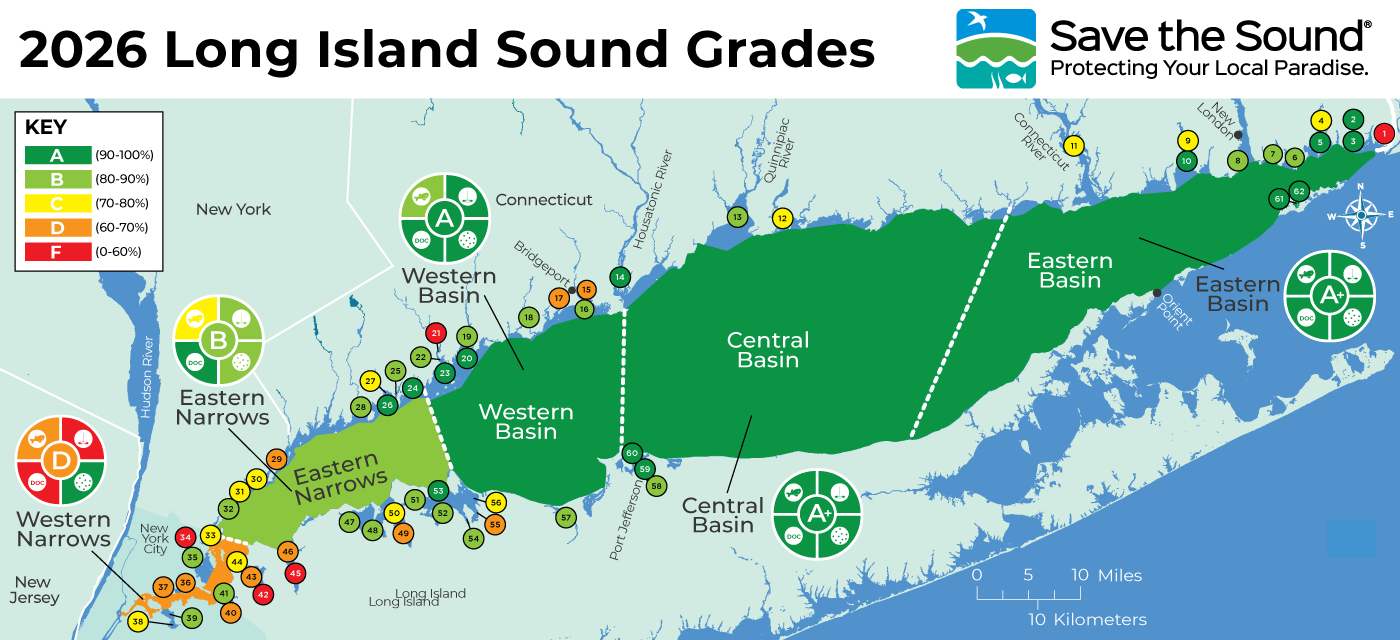
- Western Narrows: Improved from F to D, demonstrating an improving trend and receiving a passing grade for the first time in 18 years of grading
- Eastern Narrows: Received a B, demonstrating an improving trend and maintaining its B from the 2024 Report Card
- Western Basin: Improved from A- to A, still variable over the 18 year trend
- Central Basin: Improved from A to A+, remained stable over the 18-year trend
- Eastern Basin: Received an A+, remained stable over the 18-year trend
U.S. Rep. Jim Himes (D-CT) called the Long Island Sound "an incredible jewel."
"Overall in Long Island Sound, pretty much every grade is an improvement. We do have hot spots where the grades are not what they should be," he said, noting challenges in Bridgeport Harbor, Norwalk Harbor and the Holly Pond area on the border of Darien and Stamford.
"We've got more to do," Himes added.
Darien First Selectman Jon Zagrodzky credited efforts by the federal government, municipalities, local residents and businesses with contributing to the improving grades.
"Everything we do together to try and improve water quality ensures that the water we see in front of us and all the waters surrounding Connecticut are going to be even better for our children and grandchildren," Zagrodzky said. "Our work is not done. We're going to continue to work at the federal level, the municipal level, and the individual level to make it even better next time."
Save the Sound credited decades of regional work, including billions of dollars in upgrades to wastewater treatment plants in Connecticut and New York that reduced the amount of nitrogen entering the Sound, as a leading factor in the improved open-water grades.
Save the Sound Laboratory Manager Elena Colón said although there have been improvements and stable conditions over the last 18 years, climate change, continued population growth and coastal development continue to threaten progress.
"Rising water temperatures have a range of potentially damaging impacts on the marine environment, including elevating the risk for hypoxia, which is low levels of oxygen in the water," Colón said. "Put simply, the warmer the water, the less oxygen it holds."
Results for bays were less consistent, according to findings from Save the Sound.
Of the 62 bay segments graded, 56 percent earned an A or B for overall water quality. Half received a C, D or F for dissolved oxygen. Low dissolved oxygen levels can reduce marine life’s growth and reproduction and, when severely reduced, lead to death.
Save the Sound also issued trends for bay grades using eight years of data, from 2018 through 2025, collected through the Unified Water Study. In 2025, 27 partner groups, including Save the Sound, collected data for the study, which is in its 10th season.
Along the Connecticut shoreline, Wequetequock Cove received an F despite its proximity to the Eastern Basin’s A+ open waters.
The report card also lists actions residents can take to protect and restore water quality in the Sound and its bays.
For more information on Save the Sound and the 2026 Long Island Sound Report Card, click here.
Get more local news delivered straight to your inbox. Sign up for free Patch newsletters and alerts.