Neighbor News
On Fairfield's Speed Cameras, Residents Deserve a Seat at the Table
Residents can ask the RTM to reopen Fairfield's speed-camera ordinance — here's a one-minute way to weigh in: fairfieldspeedcams.netlify.app


FAIRFIELD, CT — A lot of us have opinions about the school-zone speed cameras. Until recently, almost none of us were asked.
The program was adopted without the kind of public hearing many residents expected on the details that matter most: whether the cameras run around the clock or only at drop-off and pickup, how large the fines are, and how long our license-plate data is kept and who is allowed to see it. Who decides those details, and in what forum, was the question at the center of Wednesday's Board of Selectpersons meeting.
The debate at Wednesday's meeting
At Wednesday's meeting — reported in detail by the Fairfield Dispatch — Selectperson Brenda Kupchick urged First Selectperson Christine Vitale to follow the example of Greenwich, where the RTM held a public hearing and then voted on the specifics of its program, including hours and fines.
Find out what's happening in Fairfieldfor free with the latest updates from Patch.
"I really, really wish that you would follow the lead of Greenwich," Kupchick said. "Their RTM held a public hearing. The First Selectman did one as well, and then the RTM actually voted on the actual details, all of it. The hours, the fines. To me, that's the right [way]."
Kupchick, who has said she supports cameras in school zones, argued that much of residents' frustration stems from feeling shut out of the process. The RTM — the town's legislative body — should hold a public hearing and let the community speak, she said, and it has the power to make changes to the ordinance that permitted the use of speed cameras. Among the changes she floated: limiting enforcement to school hours, and folding the processing fee into the fine itself. She has also questioned whether the original approval followed the town charter, saying she read Section 5.3 as requiring a public meeting before such regulations are enacted, and that she emailed the town attorney for a legal opinion in June but had not received a response.
Find out what's happening in Fairfieldfor free with the latest updates from Patch.
Vitale said she was not ready to pause the program. "I'm not ready to pause the program, in part because the data is showing that it is working," she said. She defended the approval process — "I know that we got the approvals. The RTM discussed it. I know the FTA discussed it. We approved the contract" — while acknowledging she was not first selectperson when the program was adopted and that the public "still had questions." She distinguished Fairfield from Greenwich, noting the towns operate under different charters, and said the RTM will receive a report in the coming month or in September, and that any changes fall within the RTM's purview. Pausing after three months, she warned, could create confusion, and she noted that children remain at schools over the summer for camp, summer school, and recreation. Pavement markings alerting drivers to school zones are expected before the school year begins.
Selectperson Marcy Spolyar noted that amending an ordinance would require action across three separate meetings and could take at least three months.
Vitale also acknowledged the town had worried a summer meeting would fall flat. "There were a lot of people at the meeting last week that we were afraid that if we had a public meeting in July, there would be nobody there," she said. "That was not the case." By her own estimate, about 200 residents turned out. To me, that is the case for a hearing, not against one: if the town feared an empty room and it filled anyway, residents have plainly earned the chance to be heard by the body that can actually change the ordinance.
How we got here
The debate followed the July 14 public information meeting, where officials defended the program. Vitale said the town adopted it after two fatal crashes on Redding Road, framing it as part of a broader Vision Zero road-safety effort. The vendor, Altumint, reported that speeding violations at camera locations fell 87.2 percent over the first two months, and said the cameras capture only vehicles traveling at least 11 mph over the limit, with citations reviewed by both company and town staff before being issued. Police Chief Michael Paris, initially skeptical of automated enforcement, said investigating fatal crashes changed his mind; he and traffic-unit head Captain Hector Irizarry emphasized prevention over reaction.
Officials also acknowledged a backlog of roughly 700 violation appeals, with Friday hearing sessions under consideration to work through it, and flagged language in the vendor's contract that referenced Florida law — which Vitale said was not pertinent and would be clarified. Residents and officials alike noted ongoing confusion over shifting speed limits — 20 mph in school zones, 25 mph, and 30 mph elsewhere — and that the 20 mph limit is not being enforced this summer, a decision tied to how the Police Commission originally set it.
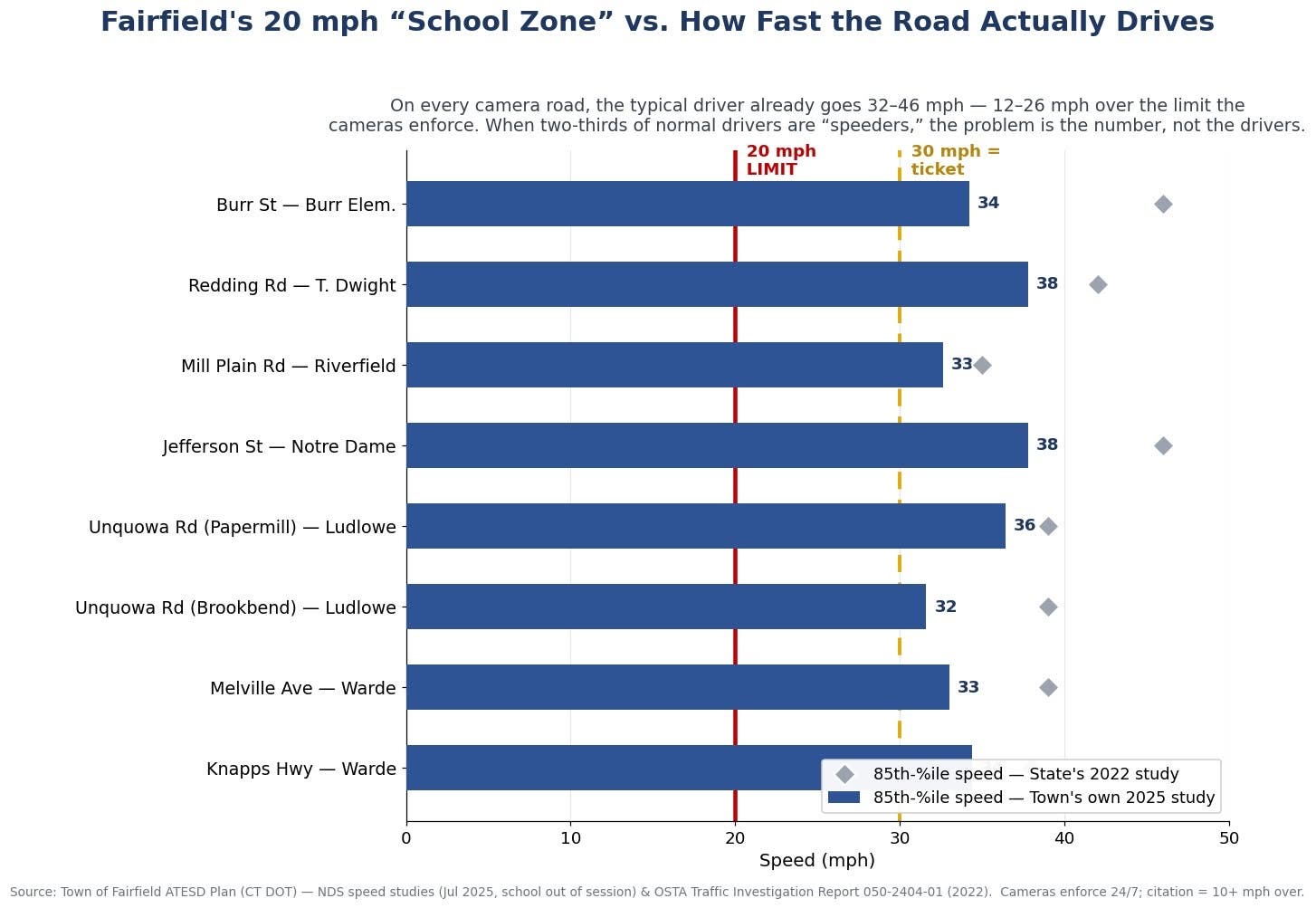
Some of that friction is visible in the town's own data. The speed studies in Fairfield's OSTA-approved ATESD plan were conducted in July and August 2025, while school was out of session, and they clocked typical (85th-percentile) speeds of roughly 32 to 38 mph on the camera roads — streets where the limit was then set to 20 mph, with citations triggering at 30. When a large share of ordinary, careful drivers register as violators, that is worth examining in the open: it may say as much about where the limit was set as about how people drive. These are exactly the details — the hours, the thresholds, the fines — that a public RTM hearing exists to weigh.
The framework itself dates to 2025, when the RTM approved amendments to Chapter 102 of the Town Code (Sections 102-4 to 102-17), formally establishing the rules for Automated Traffic Enforcement Safety Devices in local school zones. The measure was sponsored by a bipartisan group of RTM members — Dave Rock, Michelle McCabe, Chris Carroll, Christine Ludwiczak, Karen Wackerman, and Pierre Ratzki — and backed by then-First Selectman Bill Gerber and then-Police Chief Robert Kalamaras. The RTM adopted it 32–6 at its February 24, 2025 meeting, after four residents spoke during public comment, all in favor.
When the RTM adopted that framework, its own members were told the substantive public input was still to come. Presenting the ordinance that January, Representative Michelle McCabe explained that the next step was for the Traffic Authority to "develop a plan," that "the plan needs to have a public hearing," and only then would it go to the state — a sequence the Moderator repeated for the body. Connecticut law requires that hearing on the plan before it is submitted to the state Department of Transportation. But when the plan reached the Traffic Authority in August 2025, it was taken up as a non-voting discussion item with no public comment taken, and submitted soon after. The public hearing residents were told to expect — the one where the community would weigh in on where the cameras go, when they run, and what they cost — does not appear in the record. That is the gap at the center of this: not that the ordinance was rushed, but that the step meant to give residents their say was described to the body, and then never came.
A one-minute way to be heard
Whatever your view, here's the key point: the RTM — our elected legislators — has the power to reopen this ordinance, hold a public hearing, and change it, and residents can ask them to.
That isn't just my opinion; it's in the Town Charter. Section 4.1 states that "all legislative power of the Town, including the power to enact ordinances, [is] vested in the RTM." The RTM can adopt, amend, or repeal an ordinance on its own motion — it does not need the Board of Selectpersons to authorize it first — and RTM members can put an item on the agenda by petition. Here it's simpler still: the RTM passed the speed-camera ordinance in 2025, so reopening and amending it is squarely within its authority.
So I built a simple, free website to make asking easy: fairfieldspeedcams.netlify.app.
It takes under a minute. You pick a position — keep the program as it is, or ask for public hearings so the details are decided in the open — add your address, and it drafts a short message and opens the Town's official "Contact the RTM" form for you to send. If you know your district, it points you to your four representatives; if you're not sure, it reaches all 40. Your name and email go to your reps, because that's how they know you're a real constituent, and only aggregate totals by district are ever shown publicly. And if one of your representatives writes back, there's a spot to share what they said.
I built it to work the same whether you love the cameras or want them reconsidered. I'm not trying to tell anyone what to think. I just believe that on a program that fines residents and records license plates, all of us should get to say it — and we should get to say it into the mic, in front of the people we elected.
Emily Hau is a Fairfield resident and Associate Director of the Yale Institute for Foundations of Data Science. Quotations are from the public July 22 Board of Selectpersons meeting and the July 14 information meeting; some meeting context draws on reporting by the Fairfield Dispatch.