Neighbor News
Fairfield's Traffic Rules Have Gaps Big Enough to Drive 1,500 Dump Trucks Through
Three commissioners filed the fix. They were held to five minutes each, under a rule nobody voted on. (Part 8)


Fairfield is rewriting Section 25.14 — the rule that decides when a developer has to study the traffic a project will create, and what that study has to examine. Sight lines at the driveway. Whether emergency vehicles can turn. Whether the intersection can absorb it.
It matters more than it did a year ago. Since July 1, under Connecticut's new housing law, a growing share of applications no longer come to the Town Plan and Zoning Commission for a public hearing or a vote at all. Staff check them against the text of our regulations, and if they conform, they are approved.
So the text is the whole review. Whatever is written into it happens. Whatever isn't, doesn't. It is the only protection left.
Find out what's happening in Fairfieldfor free with the latest updates from Patch.
That is what the Commission sat down to work on Tuesday night. The meeting ran three hours and fifty-one minutes and produced no vote on anything.
It is worth being precise about what that time was spent on, because it was not spent arguing about policy. Nobody on that Commission wants more traffic. Nobody wants unsafe driveways. There was no ideological fight Tuesday.
Find out what's happening in Fairfieldfor free with the latest updates from Patch.
The time was spent filling in a draft.
What the Commission spent the night adding
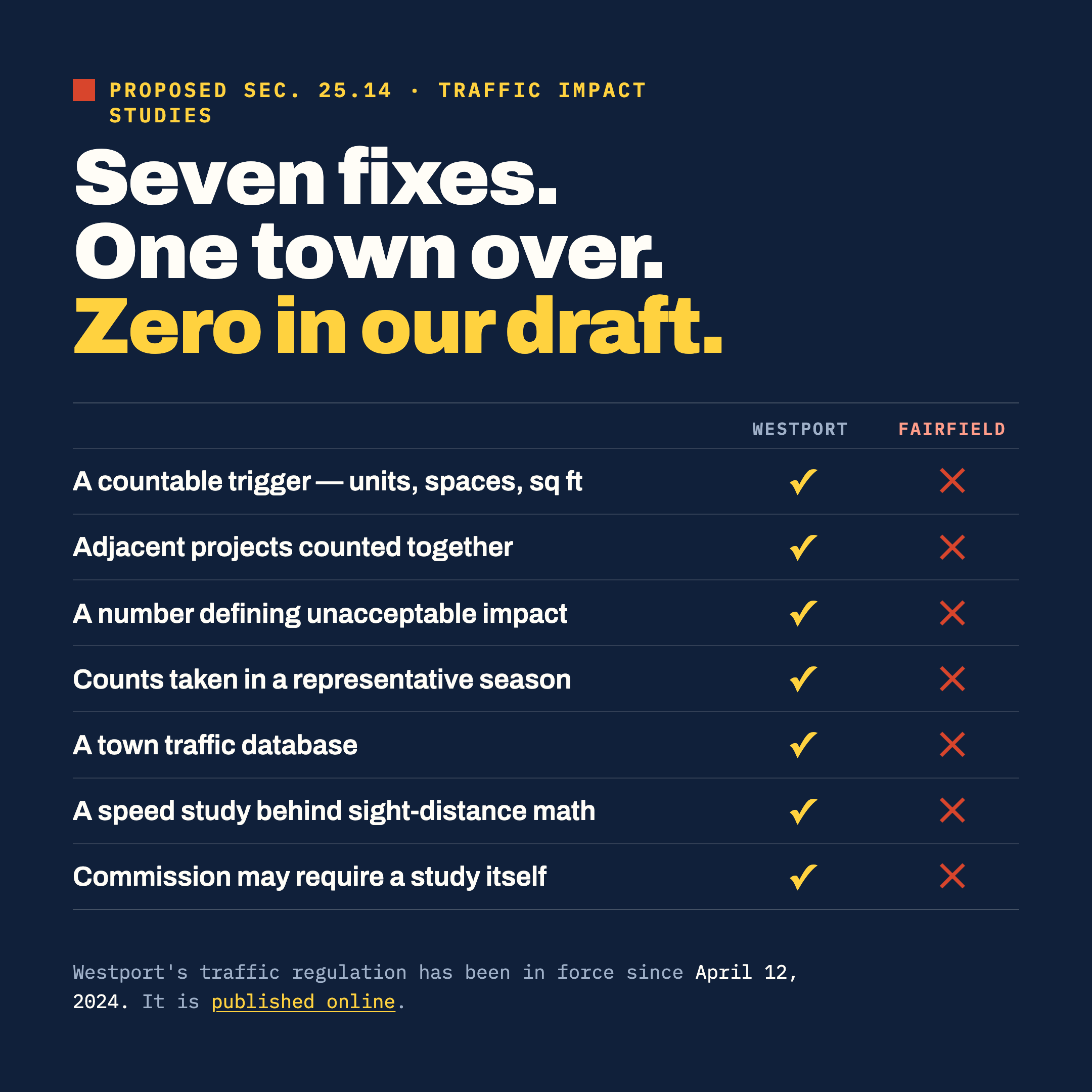
A threshold you can count — dwelling units, parking spaces, square footage — rather than a trip estimate the applicant calculates for themselves.
A rule that counts adjacent projects together, so a developer can't build in installments that each fall just under the line.
A number defining when traffic impact becomes unacceptable, in place of the phrase "acceptable traffic operations," which appears in the draft as an operative standard and is defined nowhere in it.
A requirement that traffic counts be taken when traffic is representative — not during a school vacation for a project next to a school.
A town traffic database, so the data from one application informs the next instead of vanishing.
A speed study, so sight-distance math rests on how fast cars actually travel.
A way for the Commission to ask for a study when staff hasn't required one.
Every one of those things is in Westport's traffic regulation. It has been in force since April 12, 2024. It is publicly available online. Westport is one town over.
"I wrote a first version of this"
I wrote about the Westport comparison on Sunday, before Tuesday's meeting, and asked why none of it was in Fairfield's draft.
Forty-five minutes into Tuesday night's Town Plan and Zoning meeting, Vice Chair Jeff Randolph answered a question nobody had quite asked, and what he volunteered was something that had not previously been on the record.
"Everybody keeps asking who wrote this. I wrote a first version of this and sent it to Commissioner Noonan a year and a half ago. So the very first version of this... I'm very familiar with what's written here."
Tom Noonan chaired this Commission then. He was voted out last November.
A year and a half before August 2026 is roughly February 2025. Public Act 25-1 passed that November. Section 16 took effect this July 1. The draft the Commission spent Tuesday night arguing over was written before the law that made it matter — and in February 2025, every one of these applications still came to the Commission with a public hearing, where a commissioner who doubted a traffic study could say so out loud before a vote.
Mr. Randolph's position on the markup was consistent all night: the draft is fine.
"I believe that the ordinance more or less as written addresses all of your questions by reference to state and national standards."
The specificity commissioners wanted, he said, was already there — in the manuals the regulation cites. "The rules are best established by reference, not writing them in here."
And on Westport: "I know we're referring to Westport, and Westport's a more affluent town, but I think their level of rigor here is a lot less than ours." Later: "Westport, which is half our size... their zoning ordinance is not necessarily something that has the best practices."
The man who actually does this for a living
Frank Petise, Fairfield's Director of Public Works, sat in the room for the entire meeting. He is the closest thing to a traffic engineer at that table. He spent the night being asked whether the things in the markup were necessary.
Asked whether staff had looked at other towns, he said yes — and gave the Commission numbers. Stamford triggers a traffic study at fifty parking spaces. Westport at forty. Fairfield's draft has no physical trigger at all.
Commissioner Capozzi described an early meeting where a developer's consultant claimed a several-hundred-unit project would produce a net-zero rush hour. "Anyone with two eyeballs could see that was not true." Their duty of care, he noted, runs to whoever pays them. So is there an objective baseline against which a study is measured, or does it come down to judgment?
"It's the expertise," Petise said. "Of the staff reviewing it."
Asked why applicants don't come in earlier with better data: "We don't have anything set in stone that says these are our requirements. Therefore I don't think we get that as much."
On the seasonality language, which he read cold that evening: "I wouldn't have an issue with that, because I think that's what we do when we look at the study anyway."
On construction impacts: "I totally agree with you."
On shared access: "I'm in favor of it. It reduces conflict points. It's safer for pedestrians."
On the traffic database: "That is useful to have. Right now we're trying to build out a GIS layer where it's stored."
Item by item, for two hours, the Public Works Director agreed with the commissioners who were being told their concerns were already covered.
There was also this. Explaining why he opposed a numerical standard, Randolph told the room that Westport's provision rejects projects at Level of Service D, "which would be thrown out immediately."
Westport's provision does not do that. It says that where projected traffic exceeds a volume-to-capacity ratio of 0.8, or reduces Level of Service to D or below, "the Commission may at its discretion require" the applicant to improve the condition or modify the project. It triggers a conversation about mitigation. It is not a basis for denial and never has been.
The regulation being dismissed as insufficiently rigorous was being described inaccurately by the person dismissing it.
And by the third hour, its author was adding to it. Randolph proposed that Fairfield adopt a scoping application, filed before a study, to establish which tier of review applies. He proposed requiring that studies be prepared by engineers holding a professional traffic certification. He proposed that the Commission be able to order a peer review of a study it doubts. And he asked for something else: "I would love to see a world where we got an engineering review letter... some type of cover page that says accept, reject, make corrections noted."
Then: "which we've never received before."
Four mechanisms this Commission needs. None of them in the document he wrote.
The first hand: how long you may speak
Twenty-one minutes into the meeting, with the Chairman absent and himself presiding, Randolph announced that commissioners would be held to five minutes each. There was no motion, no second, no vote. This Commission has no adopted bylaws that would authorize such a rule.
He also set the order: "I will start with the people in the room, as we normally do, and then go to the people remotely."
Three commissioners were in the room. Four were on screens. The three who had filed the markup that afternoon — Braun, Monahan and Szablek — were all on screens.
Commissioner Monahan asked why the people in the room had priority. She never got an answer.
When Braun's time ran out mid-presentation, she asked to use time Commissioner Capozzi had yielded ninety seconds earlier. Capozzi was in the room. Refused. When Szablek offered her time, and later when Delgado offered his, both were allowed. Both were on screens.
To be fair to Randolph, he was roughly even with the stopwatch. I went back through the recording; the commissioners cut off Tuesday had generally had their five minutes. The clock itself was applied about evenly.
Access to it was not.
And this is not the first time he has written the rules for how commissioners participate.
In January, Chairman Tom Corsillo named him to chair a subcommittee to write the bylaws this Commission has never had. It never produced any. It produced the Secretary's resignation instead — that is Part 4 of this series. Seven months on there are still no adopted rules of procedure, which is why on Tuesday there was nothing to point to when the five-minute limit was announced from the chair.
The second hand: what reaches you, and when
The clock governs how long a commissioner may talk. Something else governs what there is to talk about.
Section 25.14 came to Tuesday's meeting as a staff redraft. Commissioner Judy Szablek had submitted a written list of twenty-eight substantive items the Commission surfaced at its July 21 hearing. Ten survived in full. Several came back with the enforcement mechanism removed. Some did not come back at all.
The pattern in what fell out is not random. Item #1 would have required police and fire input on the record before staff could act. Item #7 would have preserved the Commission's ability to require a study when staff hadn't. The items that disappeared or thinned are disproportionately the ones that would have moved a decision from the Planning Department to the Commission, or required another department to sign off before staff could proceed.
On Tuesday, Planning Director Emmeline Harrigan opposed restoring most of them, and her reasons were consistent.
On a scoping requirement: "I just don't see that we can require it."
On routing traffic studies to police and fire: "I do not manage the fire department or the police department. I am not allowed to add this significant amount of workflow to that department."
On incorporating the Fire Marshal's written recommendations: "I don't necessarily want our zoning regulation to become a catch-all for every single jurisdictional review."
On the excavation trigger, which she wanted moved out of the traffic regulation into Section 21: "I directed the commission to — let's add to our list."
That last phrasing is worth sitting with. Staff advises commissions. Commissions direct staff.
The excavation item is instructive on its own. Harrigan told the Commission the term "substantial excavation" is "clearly defined within Section 21," which is why she hadn't added it. The phrase does not appear in Section 21. It does not appear anywhere in Fairfield's zoning regulations. What Section 21 has is a 250-cubic-yard permit threshold — and, in §21.4.E, an exemption for anything that already holds an Inland Wetlands permit.
She then described what that exemption produces:
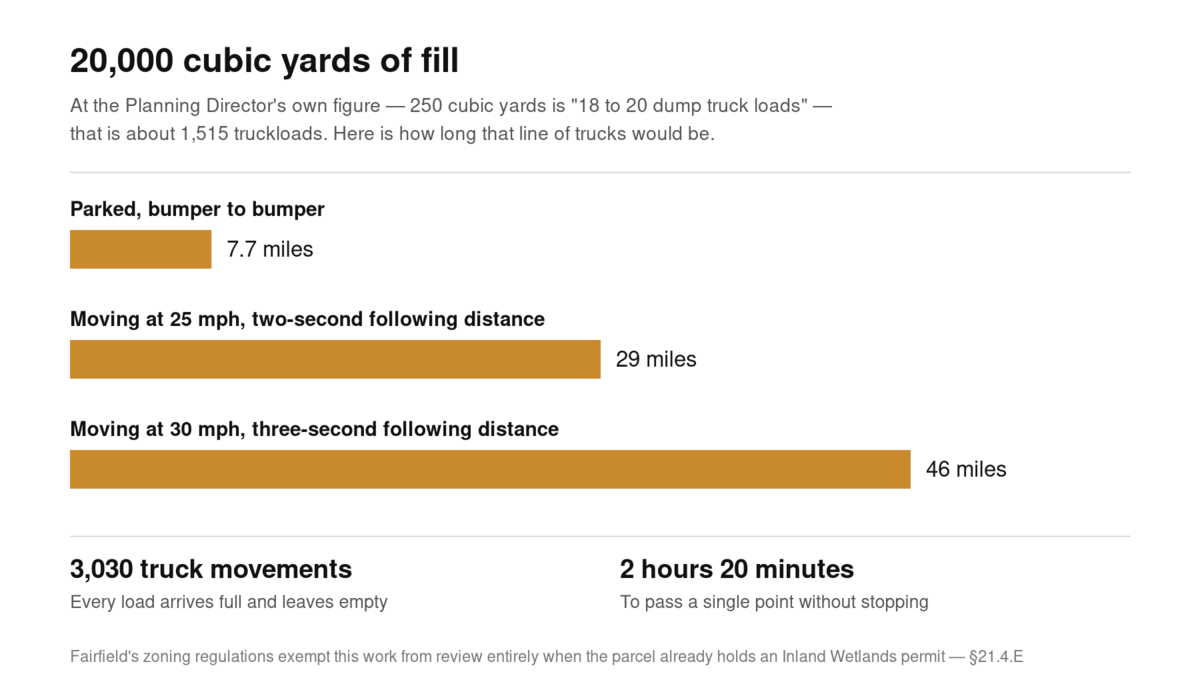
"We've had residential projects with a teeny tiny corner of wetlands in the corner of their property where they've brought in twenty thousand cubic yards of fill, and because we have this exemption in our regs, we weren't able to look at it."
By her own arithmetic that evening — 250 cubic yards being "18 to 20 dump truck loads" — twenty thousand cubic yards is roughly fifteen hundred truckloads. Fifteen hundred loads in means fifteen hundred empty trucks back out: three thousand heavy-vehicle movements through a residential neighborhood, with no traffic review at any point in the process.
It is worth walking through exactly how that happens, because it takes two separate failures.
The first is the exemption. Inland Wetlands issues a permit — and by Harrigan's own description, that agency "will only look at the portion of the property that affects those inland wetlands." A corner gets reviewed. Fill six hundred feet away does not. But under §21.4.E, that permit then exempts the entire excavation and fill operation from needing a Section 21 permit at all. A small wetland buys a large exemption.
The second is that Section 21 would not have counted the trucks even if it had applied. Randolph said so himself Tuesday: "the excavation reg does not talk about construction or logistics. It's primarily more or less an environmental reg." Section 21 governs soil. It does not govern haul routes.
Which raises the question of why the traffic regulation doesn't catch it either. The answer is that no Fairfield regulation counts construction traffic at all. A Traffic Impact Study measures the trips generated by the finished building. Randolph, again: "a TIS and a TIA never address construction means and methods. They both have the word traffic in them, but that's about the only similarity."
The July staff draft does contain a clause about construction impacts. But it sits inside the list of things a Traffic Impact Study must contain — and a Study is only required when the completed development is projected to generate a hundred peak-hour trips. A fill operation that produces three thousand truck movements and then a single-family house triggers nothing at all.
That is the gap Braun and Monahan were trying to close, and it is why the argument over where the provision belongs was not a technicality.
Harrigan's proposal was to take the trigger out of the traffic regulation now and fix Section 21 later. The Commission does not control when later arrives.
Four items ended Tuesday deferred to a future amendment. Four more went to the Town Attorney. All eight return on a schedule the Planning Department sets.
Where the two hands meet
Late in the evening, with thirteen minutes before the ten o'clock curfew, the Commission opened its second item over Braun's objection that starting it then was irresponsible. Her motion to table failed.
Braun asked what a new exception in the fourth-story setback rule — which excludes stair towers, pergolas, balconies and bay windows — was actually for. Was this about rooftop decks?
Harrigan answered that as buildings go vertical, "realistically we want to have an amenity space that's an open space for tenants, and sometimes that is going to be a rooftop area."
Braun caught it. "You said we will want this."
"No," Harrigan said, "we will see this."
"I think you just said we will want to see this," Braun said.
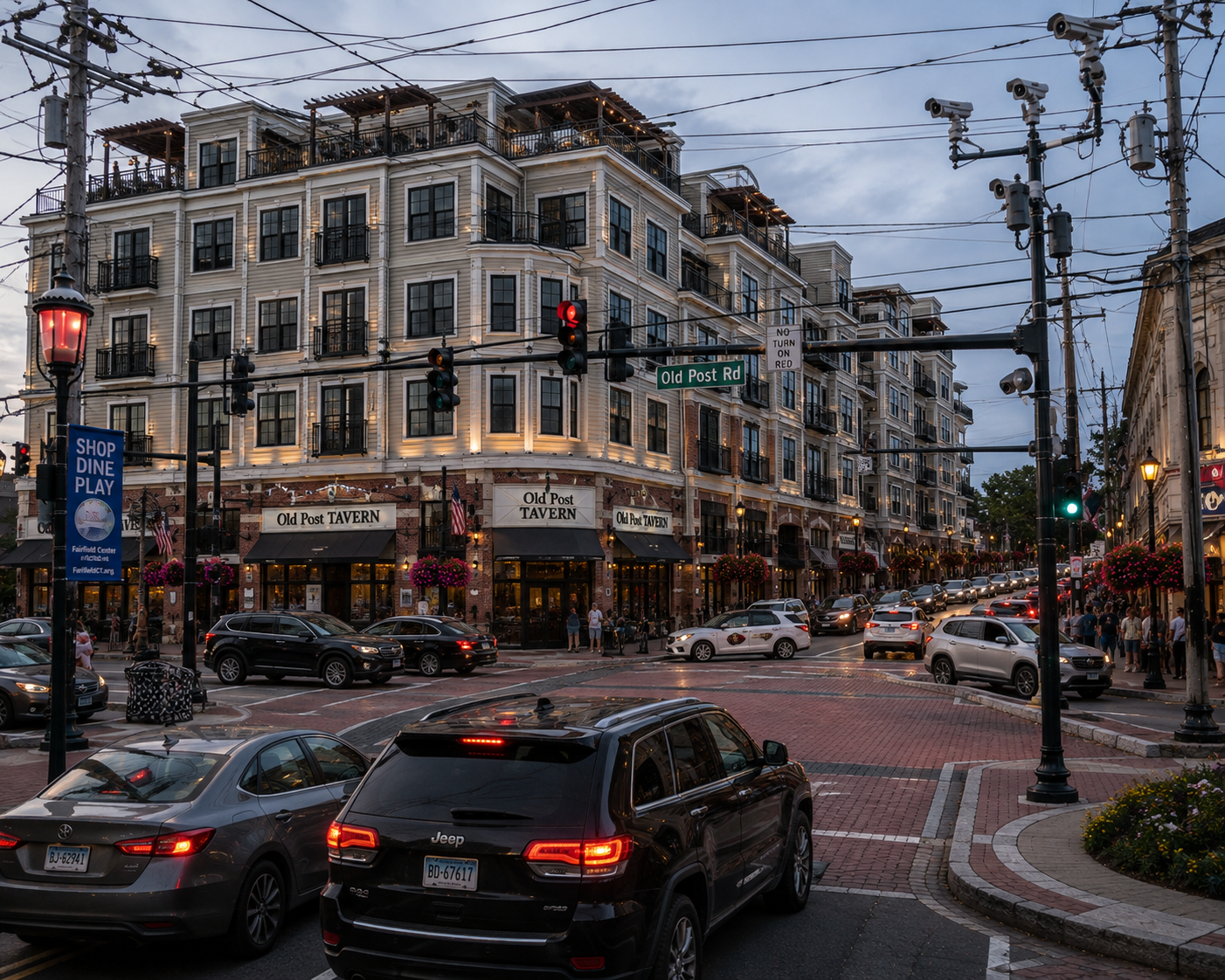
Then Commissioner Monahan read a letter into the record. It is dated March 3, 2026, from the developer Peter A. DiNardo, subject line "1619 Post Road/Mixed-Use Development." It asks the Commission to "consider allowing adequate building height to incorporate a fifth floor," to be used for "penthouses" and "a rooftop deck and recreation room for all residents to enjoy, including seating areas, plantings, overlooking the heart of downtown Fairfield."
Harrigan said she had advised him it was unlikely: "I did strongly advise him that I didn't think it would go anywhere."
Monahan asked why the district's height limit had been set at 52 feet in the first place.
Harrigan began to answer — they had wanted a taller ground floor —
"Commissioner Monahan," Randolph said, "I think we've allotted you a good amount of time."
Why any of this matters now
On July 1, Public Act 25-1 §16 took effect. A growing category of applications will no longer come to this Commission for a hearing or a vote. Staff will determine whether they conform to the objective standards in our regulations, and if they do, they are approved.
That makes the text of Section 25.14 the whole ballgame. Not staff judgment, which Frank Petise described honestly Tuesday as the thing currently doing the work. Not commissioner questions at a hearing, because there will be no hearing. The text.
Which is why what happened Tuesday is not a personality dispute.
Three commissioners spent their evenings and a weekend producing a line-by-line markup of a regulation whose gaps a neighboring town closed in 2024. They filed it. They were held to five minutes each while presenting it, under a rule nobody voted on, by the commissioner who wrote the original draft. The items they were trying to restore are, disproportionately, the ones that would have required somebody outside the Planning Department to sign off. And the questions they couldn't finish asking are now scheduled to come back on a calendar they don't control.
Two residents called in. One had watched traffic get rerouted through yield-controlled intersections near her home precisely because traffic studies don't grade them — an omission in exactly the national standards the draft relies on. She was told it wasn't relevant.
"Let me tell you unequivocally," Randolph said, "we are moving on."
Emily Hau is a Fairfield resident and a filed candidate for State Representative in the 132nd District. emilyforfairfield.com
Read her TPZ series:
Part 1: How Fairfield's TPZ chairman spends his day job advising New York housing-finance lenders — and why his public posts about that work matter for the residents whose zoning he votes on. patch.com/connecticut/fairfield/fairfields-tpz-chair-voted-against-parking-protection-nodx
Part 2: How Fairfield's TPZ chairman voted three times against engaging outside legal counsel on Connecticut's new housing law — and why his New York day job involves advising on exactly that kind of legislation. patch.com/connecticut/fairfield/why-fairfields-tpz-voted-5-2-three-times-keep-public-hearing-cts-new-housing-nodx
Part 3: The developer-initiated zoning regulation amendments now in front of the Commission, and the specific 0.92-acre Mill Hill Road parcel one of them appears to have been drafted for. patch.com/connecticut/fairfield/can-developer-buy-zone-wreak-havoc-seems-it-nodx
Part 4: How Fairfield's TPZ chairman used a bylaws subcommittee to constrain a sitting commissioner — and why the video of her resignation isn't on the Town's official YouTube. patch.com/connecticut/fairfield/six-minutes-secretary-resigned-video-gone-nodx
Part 5: How Fairfield's planning director misstated a regulation her own office had just drafted — and why her misstatement defined a 4-3 vote that left downtown unprotected. patch.com/connecticut/fairfield/she-said-protecting-downtown-would-destroy-it-regulation-said-otherwise-nod
Part 6: How Fairfield's TPZ Vice Chairman responded to parts 1-5 of the series — and why the response, which does not dispute a single fact, is the record's strongest possible endorsement. patch.com/connecticut/fairfield/tpz-vice-chairman-randolph-asked-solutions-let-me-repeat-them-nodx
Part 7: How Fairfield's TPZ Vice Chairman reassured residents that Tuesday's traffic amendment "does not replace the Commission's judgment" — without mentioning how many future applications will never reach the Commission at all. patch.com/connecticut/fairfield/what-tpz-vice-chair-randolphs-article-didnt-mention-nodx
You're reading Part 8: How one commissioner controls how long this Commission may speak and another controls what reaches it — and what happened when both operated on the same regulation in one night. patch.com/connecticut/fairfield/fairfields-traffic-rules-have-gaps-big-enough-drive-1-500-dump-trucks-through-nodx
Part 9 (coming soon): Why the architectural standards now before the Commission need more eyes on them than they are getting — and what's already been written into other regulations on the assumption they'll pass.