Neighbor News
What TPZ Vice Chair Randolph's Article Didn't Mention
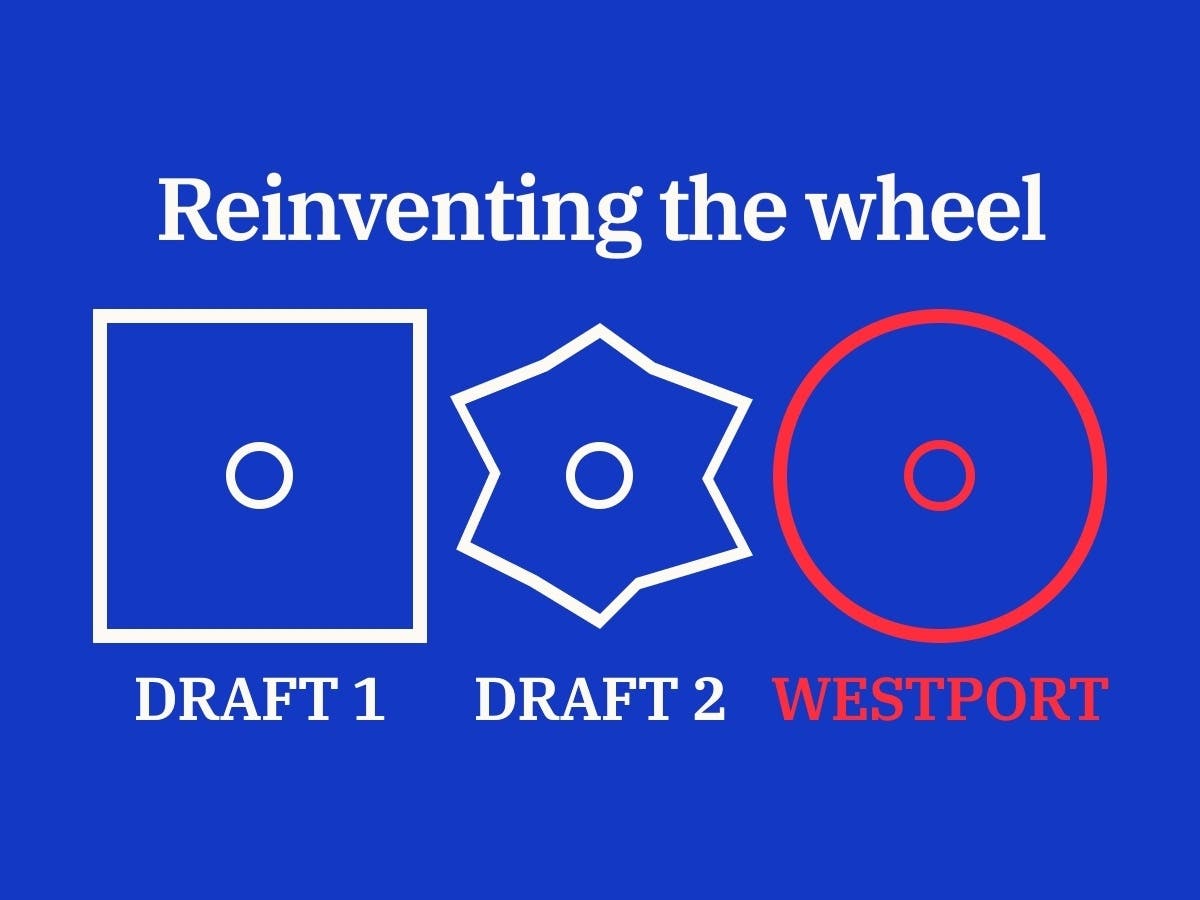
Westport, one town over, has what Fairfield's draft is missing. Why are we reinventing the wheel? (Part 7)

Fairfield Town Plan and Zoning Vice Chair Jeff Randolph published a Patch article Friday describing Tuesday's Commission agenda — and specifically the proposed amendment to Section 25.14, our Traffic Impact Study regulation. His piece describes the amendment as adopting standards "already used by transportation professionals" and reassures residents that "the amendment does not replace the Commission's judgment."
Both statements are true. They are also incomplete.
It has been suggested lately that residents who ask specific questions about town documents are implying bad motives. That is not what this is. It is possible to ask a specific question about a specific document without accusing anyone of anything. What follows is a set of questions about a document.
Find out what's happening in Fairfieldfor free with the latest updates from Patch.
What are other towns doing?
That was the question I asked myself reading the draft. So I Googled "Westport traffic impact regulations." It took about a minute.
Westport §44-2.5, Requirements for Traffic Impact Analysis, effective April 12, 2024, is publicly available online. It is written in plain English. It is one town over. And it contains specific provisions Fairfield's draft does not.
Find out what's happening in Fairfieldfor free with the latest updates from Patch.
Fairfield is one of the largest municipalities in Connecticut — roughly 63,000 residents, 11th in the state by population. If a lay resident can find our neighbor's regulation in a minute, a Commission with dedicated paid staff and legal counsel can. If a lay resident can compare the two documents in an afternoon, so can they.
That leaves two possibilities. Either the comparison was done, Westport's provisions were considered, and they were rejected — in which case residents deserve to hear on the record why. Or the comparison was not done. Both possibilities are worth naming before Tuesday's vote.
Surely we should look to our neighbors before drafting a document that will affect this many people. And it makes me wonder about the other items on Tuesday's agenda — Architectural and Site Design Standards, Accessory Structures. Are we going it alone with whatever we can think up, or are we learning from the collective experience of the municipalities around us? I hope it is the latter. I would like to hear that it is.
What Westport has that Fairfield's draft does not
Every quotation below is from Westport's Traffic Impact Analysis regulation as currently in effect.
Physical thresholds. Westport requires a traffic impact analysis for "any project containing either fifteen (15) or more new residential dwelling units, forty (40) or more parking spaces in a new or expanded parking lot or any project over ten thousand (10,000) square feet of gross floor area." Fairfield's draft uses only a peak-hour trip-count trigger, calculated by the applicant. A fifteen-unit apartment building generates about eight to ten peak-hour trips under standard rates — it does not trigger Fairfield's rule at all. Under Westport's, it does.
A five-year aggregation clause. Westport: "The requirements listed above shall be applicable to any site or adjacent and interrelated sites that exceed these thresholds over a five (5) year period." If a developer proposes eight units this year, eight next year, and eight the year after on adjacent parcels, Westport looks at the combined twenty-four. Fairfield's draft has no equivalent rule. As drafted, a developer can build eight units on one parcel this year, another eight next door next year, and another eight the year after — never crossing a threshold, never triggering a study.
A numerical mitigation trigger. Westport: "Where it is projected that the additional traffic resulting from the project will exceed a volume/capacity ratio of 0.8 at the intersection, reduce the Level of Service to 'D' or below for the intersection as a whole, or further reduce the Level of Service when it is already at 'D' or below for any movement at the intersection, the Commission may at its discretion require that: Provision be made by the applicant for the improvement of said inadequate condition; or The proposed project be otherwise reduced or modified to mitigate the adverse impacts."
Fairfield's draft uses the phrase "acceptable traffic operations," which is nowhere defined.
The undefined phrase matters because of something I watched during the Circle Hotel traffic testimony. When you are already in a high-traffic area where the delay rating is already an F on the A-through-F Level of Service scale, additional traffic from a new development is treated as having no measurable regulatory impact — because there is no G, H, or I on the scale to record incremental worsening. An F is an F. But it is not an F to the resident who has to sit in it. The delay lengthens. The frustration compounds. Drivers make worse decisions. Pedestrians are less safe.
Notice what Westport does about exactly this problem. Its regulation requires the analysis to include "length of time and the direction of intersection delay during each day which reduces the Level of Service to D or below" and "existing roadway capacity, including Level of Service (LOS), vehicle delay (seconds) and volume to capacity ratios." Seconds of delay, measured. That captures what the letter grade hides.
A baseline traffic model. Westport: "Data for this analysis shall include data derived from the most recent baseline traffic study prepared for the town of Westport, as amended from time to time, as an additional basis for background traffic assumptions. The applicant shall provide any data gathered or projections made in electronic format so that such new data can be incorporated into and used to update the town's baseline traffic model."
Every application improves the accuracy of the next. It also captures cumulative impact — the exact question every resident asks when a new project goes in. Any one project can be said to have negligible impact standing alone; the twelfth project on the same corridor cannot. A baseline model is how a town keeps track. Fairfield has no equivalent provision.
Unqualified Commission authority. Westport: "The Commission may at its discretion require additional data and analysis, which the Commission deems necessary to supplement, improve and enhance the accuracy of the traffic data related to the application." No conditions, no qualifiers. Commissioner Braun asked for a narrower, findings-based version of exactly this authority at the July 21 hearing. It is one of the items that did not survive the redraft.
Sight distance and speed studies. Westport requires the applicant to conduct "a speed study on an adjacent street to the project site to determine an 85th percentile speed for intersection site distance requirement calculations," or to submit CTDOT speed data from within the past eighteen months. It requires that "Driveways shall be designed to achieve clear sight lines based on the design procedures set forth in the Connecticut Department of Transportation, Highway Design Manual." Given the pattern of sight-distance disputes at recent Fairfield applications, including the 15 Unquowa Road court decision, this matters here.
Interconnected parking. Westport: "The project design shall consider interconnecting parking areas, shared common access drives and future access connections to adjacent property." Fairfield's draft does not require an applicant to demonstrate that shared solutions were considered.
This one surprised me most. Planning Director Emmeline Harrigan has raised shared parking repeatedly this year in public meetings — at Town Plan and Zoning, at the Board of Finance, at the Affordable Housing Committee. If shared parking is a Fairfield priority, and Westport already has the language on its books requiring applicants to consider it, adopting that language would have been the easiest item on the list.
Twenty-eight items the TPZ Commission itself identified
Following the July 21 public hearing on Section 25.14, Commissioner Judy Szablek submitted a written list of twenty-eight substantive improvements the Commission identified at that hearing. Her list — public, in the Commission's own August 4 packet — walks through the staff draft page by page and identifies specific fixes to language, thresholds, definitions, enforcement mechanisms, and cross-references. It includes items proposed by Chairman Corsillo, Commissioners Braun, Monahan, Randolph, and Szablek herself, as well as staff members Frank Petise and Emmeline Harrigan.
I have read the list. I couldn't have done it better myself.
The revised staff draft that will be discussed Tuesday adopts ten of Commissioner Szablek's twenty-eight items in full. Eight more appear in weakened form — the item's conceptual intent is captured, but the enforcement mechanism that makes it work in practice is removed. Three are deferred to the Town Attorney. Five are dropped entirely. One was attempted and introduced a new error in the process.
Notably, the Chairman's own items did not all survive. Chairman Corsillo raised the question of preserving the Town's authority to collect traffic data on state roads and having any OSTA-required design change return to the Commission for a modified approval. The first half made the redraft. The return-to-Commission trigger did not. He also joined Commissioner Randolph in asking for a construction-vehicle logistics plan requirement for large-excavation projects; that item was deferred to a future amendment of a different section. If items raised by the Chairman of the Commission do not survive a staff redraft, residents should understand what that indicates about how the redraft was prepared.
The pattern of drops raises a question. Every one of Commissioner Szablek's twenty-eight items was raised by a commissioner or a staff member on the record at a public hearing. The revised draft was prepared by Planning Director Emmeline Harrigan and/or her staff. Several of the items dropped or watered down in the redraft are the items that would have moved specific decisions from Planning Department staff to Commission review, or that would have required Engineering, Police, or Fire input on the record before staff could act. In each case, the item's practical effect was to reduce the Planning Director's own department's discretion — and in each case, the item did not survive the redraft. This is not the sort of thing that happens by accident. Residents deserve to know whether the amendment they are being asked to adopt Tuesday reflects the Commission's collective work at the July 21 hearing, or reflects a redraft in which the items reducing staff discretion happened to be the ones that fell out.
About "the amendment does not replace the Commission's judgment"
Vice Chair Randolph reassures readers that the amendment does not replace the Commission's judgment. That is true — if items come to the Commission to decide. As the redlined draft currently stands, many will not.
On July 1, 2026, Public Act 25-1 §16 took effect. It requires Fairfield to permit transit community middle housing and mixed-use development in commercial and mixed-use districts by summary review. Under Connecticut law, summary review means an application is approved under the terms of the zoning regulations without a public hearing and without any discretionary zoning action — no variance, no special permit, no special exception. What remains is a determination that the site plan conforms to the regulations and that public health and safety will not be substantially impacted. That determination is not discretionary. If the plan meets the objective standards in our regulations, it is approved.
Which means the objective standards in Section 25.14 are, for a growing share of applications, the entire review. There is no hearing at which a resident can raise a traffic concern. There is no discretionary finding a commissioner can make. There is only whether the plan meets the standard — and whether the standard was written well enough to matter.
If those standards are drafted concretely, they do the work automatically. If they are drafted as aspirational guidance, they don't. The Commission's remaining judgment applies to the applications that come before it — not to the applications that Zoning Enforcement will now approve on paper.
Fairfield's elected and appointed commissioners are accountable to residents in a way that staff review is not. Every one of them sits in a public meeting and takes a recorded vote. That is the accountability structure Section 25.14 should preserve wherever the state law still permits it — and where the state law does not permit it, the objective standards should be specific enough to substitute for it.
What to watch on Tuesday
You can attend in person at Fairfield Regional Fire School, 205 Richard White Way, at 6:30 pm. You can join on Zoom at https://zoom.us/j/7250682403 (passcode: 123). You can listen on YouTube at https://www.youtube.com/watch?v=n0ImxUUQInE. Or you can email tpzcommission@fairfieldct.org.
However you participate, three questions will help you distinguish substantive debate from stylistic debate.
First: does the adopted text include a physical threshold trigger, or does it rely solely on the applicant-calculated peak-hour-trip count?
Second: does it include a numerical mitigation trigger with defined values, or does it rely on the undefined phrase "acceptable traffic operations"?
Third: does it include a sight-distance certification requirement for every site plan application, or only within a Traffic Impact Study?
Each has been raised on the record. Each has a documented peer-town precedent. Each will produce a materially different regulatory outcome depending on how it is answered.
And, for anyone still with me
In the single subsection listing the technical references applicants must consult, the revised draft contains five citation and typographical errors.
Three of them were flagged on the record at the July 21 hearing. Commissioner Monahan identified stray spaces in "Highway Capacity Manual Volumes 1-4, 6 th" and "AASHTO, Policy of Geometric Design of Highways and Streets, 7 th," and a misspelling of "latest" as "lat4st." Commissioner Szablek captured all three in her written list, along with the correction that AASHTO's publication is properly cited as "A Policy on Geometric Design of Highways and Streets."
The revised draft fixes "lat4st." The stray spaces in "6 th" and "7 th" are still there. "AASHTO, Policy of" is still there.
Commissioner Monahan also asked that the ITE Trip Generation Manual reference be updated from the 11th Edition to the current 12th (2024). The revised draft cites it as the "112th Edition (2025)." That is a new error, introduced while making the correction a commissioner requested.
The fifth is one nobody flagged: ITE Parking Generation is cited with a lowercase "edition" where every other entry in the list is capitalized.
Five errors in one subsection, three of them previously identified on the record and left uncorrected. That is a lot for a public-facing regulatory document that applicants and their engineers will be required to follow. This is what happens when a fine-print document is not proofread by anyone who reads the fine print.
I hope the Commission will not accept the document as it currently stands without further public comment. The July 21 hearing — the first true planning meeting of the year — did not have public comment on Section 25.14. Residents have not yet had a chance to raise these questions on the record. Tuesday is that chance.
Emily Hau is a Fairfield resident and a filed candidate for State Representative in the 132nd District.
Read the series:
Part 1: How Fairfield's TPZ chairman spends his day job advising New York housing-finance lenders — and why his public posts about that work matter for the residents whose zoning he votes on. patch.com/connecticut/fairfield/fairfields-tpz-chair-voted-against-parking-protection-nodx
Part 2: How Fairfield's TPZ chairman voted three times against engaging outside legal counsel on Connecticut's new housing law — and why his New York day job involves advising on exactly that kind of legislation. patch.com/connecticut/fairfield/why-fairfields-tpz-voted-5-2-three-times-keep-public-hearing-cts-new-housing-nodx
Part 3: The developer-initiated zoning regulation amendments now in front of the Commission, and the specific 0.92-acre Mill Hill Road parcel one of them appears to have been drafted for. patch.com/connecticut/fairfield/can-developer-buy-zone-wreak-havoc-seems-it-nodx
Part 4: How Fairfield's TPZ chairman used a bylaws subcommittee to constrain a sitting commissioner — and why the video of her resignation isn't on the Town's official YouTube. patch.com/connecticut/fairfield/six-minutes-secretary-resigned-video-gone-nodx
Part 5: How Fairfield's planning director misstated a regulation her own office had just drafted — and why her misstatement defined a 4-3 vote that left downtown unprotected. https://patch.com/connecticut/fairfield/she-said-protecting-downtown-would-destroy-it-regulation-said-otherwise-nod
Part 6: How Fairfield's TPZ Vice Chairman responded to parts 1-5 of the series — and why the response, which does not dispute a single fact, is the record's strongest possible endorsement. patch.com/connecticut/fairfield/tpz-vice-chairman-randolph-asked-solutions-let-me-repeat-them-nodx
You're reading Part 7: How Fairfield's TPZ Vice Chairman reassured residents that Tuesday's traffic amendment "does not replace the Commission's judgment" — without mentioning how many future applications will never reach the Commission at all.
Part 8 (a follow-up to part 7): How one commissioner controls how long this Commission may speak and another controls what reaches it — and what happened when both operated on the same regulation in one night. patch.com/connecticut/fairfield/fairfields-traffic-rules-have-gaps-big-enough-drive-1-500-dump-trucks-through-nodx
Part 9 (coming soon): Why the architectural standards now before the Commission need more eyes on them than they are getting — and what's already been written into other regulations on the assumption they'll pass. Pssst. They're honestly the worst. You gotta go look.