Schools
Quinnipiac University's Medical School Welcomes Class of 2030 at White Coat Ceremony
The 96 first-year medical students bring extensive clinical, research and service experience to the Frank H. Netter MD School of Medicine.
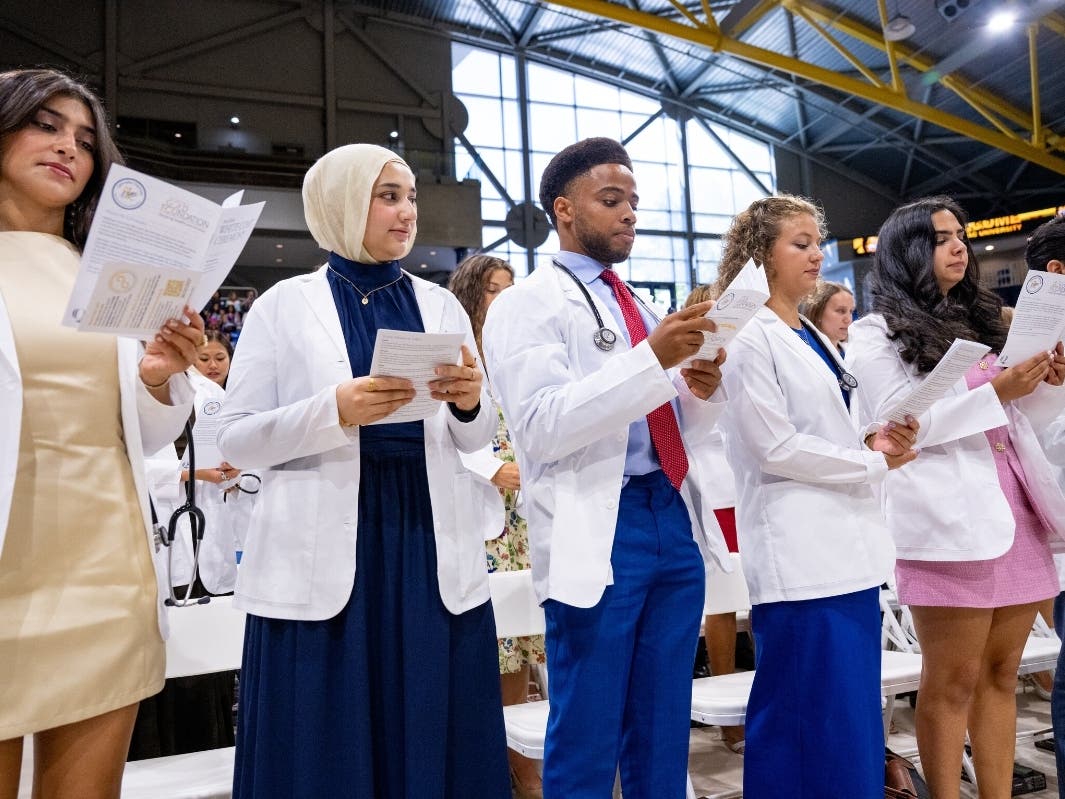
HAMDEN, Conn. – Quinnipiac University’s Frank H. Netter MD School of Medicine officially welcomed its newest class of future physicians during its annual White Coat Ceremony on Aug. 7, at the M&T Bank Arena.
The ceremony marked an important milestone for the Class of 2030 as students received their first white coats and stethoscopes and recited the Physician’s Pledge, also known as the Modern Hippocratic Oath, before family members, friends, faculty and mentors.
Addressing the class, President Marie Hardin emphasized that becoming a physician carries a unique responsibility to both master the science of medicine and earn the trust of patients.
Find out what's happening in Hamdenfor free with the latest updates from Patch.
“As you know, many professions rely on a university education to prepare students with the expertise and skills to make a difference,” Hardin said. “But only a handful of professions ask society to place extraordinary trust in young people almost from the moment they begin. Medicine is one of them. That is why today matters.”
Keynote speaker Dr. John Huston, a member of Quinnipiac Netter’s inaugural class, reflected on the evolution of medicine throughout his career, including the emergence of technologies such as artificial intelligence, while emphasizing that the fundamental role of a physician remains unchanged.
Find out what's happening in Hamdenfor free with the latest updates from Patch.
Huston, a pulmonary and critical care physician with Hartford HealthCare and a clinical assistant professor at the Netter School of Medicine, shared personal stories from his medical training, family life and experiences caring for patients. He encouraged the Class of 2030 to recognize that the relationships they build with patients will ultimately define their careers.
“Today we will hand you a white coat. Your origin story begins,” Huston said. “You’ll fill it with stethoscopes, pagers, reflex hammers, maybe even snacks. But the pocket that matters most is the one here that no one can see. Because one day, when a frightened patient looks up at you, everything you’ve placed inside that pocket will guide you. And it is who they’ll remember.”
Dean Dr. Lisa Coplit, participating in her first White Coat Ceremony as dean, challenged the students to wear their white coats with “curiosity, humility and kindness.”
“Remember that every patient who places their trust in you has given you one of life’s greatest privileges,” Coplit said.
Alayna Santarosa delivered remarks on behalf of the student body, encouraging the Class of 2030 to recognize that some of the most meaningful moments in medicine happen quietly — through compassion, listening and teamwork.
“In just a few moments, you’ll put on your white coat,” Santarosa said. “Wear it proudly. Let it inspire you. And remember, its greatest meaning won’t come from the moment it’s placed on your shoulders. It will come from the person you become while wearing it.”
The ceremony culminated with the traditional presentation of white coats and stethoscopes, followed by the Physician’s Pledge. After each student stood at the lectern, introduced themselves and shared their hometown, Dr. Siobhan Hollander, interim assistant dean for student affairs, led the class in the pledge.
The Class of 2030 brings a broad range of academic, professional and life experiences to Quinnipiac Netter. The students represent 15 states and 56 undergraduate institutions, including five students who already hold master’s degrees.
Before beginning medical school, the class collectively accumulated more than 300,000 hours of paid clinical experience, an average of 3,345 hours per student. They also bring more than 139,000 hours of research experience and 116,542 hours of community service.
The class includes four Peace Corps and AmeriCorps alumni, three military veterans and 15 former varsity athletes. Twelve students have a parent who attended medical school, while 13 are the first in their families to earn a bachelor’s degree.
The incoming class also reflects the increasingly global communities that physicians serve:
- 40 students have at least one parent who was born outside the United States.
- 16 students were born abroad, representing nine countries.
- 51 students speak a combined 26 languages with advanced or fluent proficiency.
In her closing remarks, Dr. Ellen Pearlman, senior associate dean for education, praised the students for the diverse experiences and perspectives they bring to their medical education.
She encouraged the Class of 2030 to embrace the unexpected paths that brought them to medicine and carry those experiences with them as they begin their journey as physicians.
The White Coat Ceremony is a longstanding medical school tradition that marks the transition into the profession and reinforces the importance of compassionate, ethical and patient-centered care.