Politics & Government
DeSantis Vetoes $1.7B From His Eighth — And Final — State Budget As Governor
'What he was really signaling is that he didn't get his way, therefore he was taking his marbles and going home, and that's not fair.'

June 30, 2026
Gov. Ron DeSantis, who will leave office in January due to term limits, signed his eighth and final state budget into law Monday but not before he struck $1.7 billion in spending.
Find out what's happening in Across Floridafor free with the latest updates from Patch.
The actual line-item vetoes were actually smaller — $810 million — but they fell along a familiar pattern of DeSantis using his power to axe money set aside from everything from programs that help the elderly to wiping out pay raises for Florida’s correctional officers because they were tied to another bill to build a new prison hospital.
The overall $117.6 billion spending plan is less than the current year budget, which is set to expire June 30. The governor added that it was the fourth consecutive year the budget has been smaller than the previous year.
Find out what's happening in Across Floridafor free with the latest updates from Patch.
“Who else is doing that? “ he asked rhetorically during a press conference at Hillsborough State College in Tampa, which is the beneficiary of $50 million in funds for capital improvements that could help the Tampa Bay Rays build a stadium there.
He added: “You know, we’ve had a few people move to Florida, there, so the population’s grown, and yet we’ve been able to do it.”
The biggest cut was $750 million that is supposed to go to the Budget Stabilization Fund, a “rainy day” account mandated by the Florida Constitution, which requires that 10% of revenue collections be directed there.
The fund is already about maxed out, but legislators set aside additional money to increase its bottom line if voters approve a constitutional amendment in November that would require 25% of state revenue to be deposited into the rainy day fund.
DeSantis has previously criticized the idea and has maintained voters will reject it.
Meanwhile, during his press conference, DeSantis dwelled primarily on his budget priorities, ranging from $665 million for Everglades restoration projects to more than $1.5 billion that will go to teacher pay hikes and $30 million for a cancer treatment “incubator program.”
“If you go back to 2019 until now, no question that we are leaving it better than we found it,” DeSantis said.
DeSantis vetoed a budget conforming bill, HB 5403 E, that would have required spending $50 million in each of the next 40 years for the construction of new prisons and improvements to existing facilities. The legislation also authorized the state to build a new 600-bed correctional hospital.
The veto has gone largely unnoticed; Republican legislative leaders haven’t issued press statements or commented on the veto on social media.
This isn’t the first time the Legislature included funding for prison improvements that the governor vetoed. DeSantis killed $2 million from the FY 2020-21 budget legislators included to contract for an independently prepared master plan for repair, maintenance, or replacement of state prisons.
DeSantis, the following year, vetoed $850 million from the FY 2022-2023 General Appropriations Act for the construction of a new 4,500-bed correctional facility and 250-bed hospital unit.
But in an attempt to prevent a veto this year, the Legislature tied the prison construction and improvements to $91.5 million in to raise correctional officer pay to $24 an hour.
The strategy, however, didn’t work.
During a House Democrat media availability Monday, state Rep. Kelly Skidmore of Boca Raton said the Legislature “should really be thinking about ways in which we can override these vetoes, in my opinion.” But she later acknowledged it was “wishful thinking,” given the tensions between House and Senate leaders over the past two years.
“The corrections budget was a massive veto on behalf of the governor,” saId Skidmore, who added that it left “many of our prison workers in dangerous, dangerous situations, not even able to get up to $24 an hour. Talk about affordability. Who can live in Florida when they are not making enough money to feed their families, let alone have any quality of life?”
DeSantis suggested he vetoed the budget conforming bill because of the extensive commitment to bonding that would have been required over the years to fulfill the mandate.
“It was a casualty of saying, ‘Okay, we’re going to rob Peter to pay Paul,’” DeSantis said. “That accounts for a decent chunk of the vetoes.”
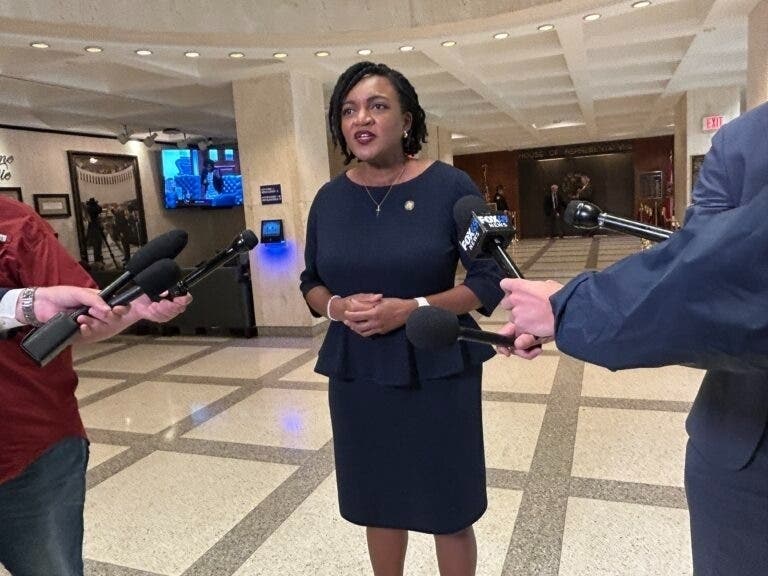
But House Democratic Leader Rep. Fentrice Driskell of Tampa attributed it to the governor’s need to come out on top.
“This is the type of stuff that people hate about politics. We should be able to be there for our law enforcement, you know, including our corrections officers, who work in some of the most dangerous conditions day in and day out, and so it’s a real disappointment to see the governor try to count it in those terms,” Driskell said.
“But I really feel like that was just a scapegoat, and what he was really signaling is that he didn’t get his way, therefore he was taking his marbles and going home, and that’s not fair, because who loses out? Well, it’s our corrections officers, it’s our entire corrections system, frankly, that needs those resources to modernize, to improve, and to keep both the officers and the folks who are housed in those facilities safe.“
In a nearly hour-long press conference, DeSantis said he spoke to legislators before the vetoes and told them, “Listen, you know, I respect what you guys put in the budget, I don’t always agree, but I know it’s meaningful to a lot of people, and we want to accommodate.”
The list
The governor didn’t release his actual veto list to the public until hours after his budget press conference.
During the afternoon press conference, Driskell said she was still reviewing the vetoes but that some of the victims of DeSantis’ pen included programs that support veterans, children with autism, opioid and drug prevention programs, seniors, and pregnant mothers.
“Funding equals priorities, and helping Floridians remain our Number One priority. We don’t take it lightly that people are struggling to provide for themselves and their families. This is not a game for us, and we are fighting with every tool we have in our toolbox to address the issues surrounding affordability. This is not about politics or whose side you’re on. We’re talking about real people with real needs. And I grew up knowing that where your treasure is, there your heart is also.”
Driskell said Democrats had about twice as many projects vetoed by the governor as their Republican counterparts.
“And what’s so unfortunate about that is that regardless of whether or not your district is represented by a Democrat or a Republican, there are people of all political stripes in those districts, so it’s unfair to see the governor punish Democrats.”
She said the governor also likely aimed at Republicans who had disagreed with his policies.
“So it’s just, it’s really icky, and it’s the partisan underbelly of politics that people hate,” she said.
DeSantis did not veto additional funding for a drug assistance program for people with HIV called ADAP, an acronym for the AIDS Drug Assistance Program. Advocates had challenged the DeSantis administration’s attempt to drastically reduce the program by alleging a $120 million deficit. The battle resulted in two separate appropriations: a near $31 million in the spring during the regular session and another $75 million in the actual FY 26-27 budget passed during a special session.
“This victory belongs to our whole coalition, the clinicians, providers, and people living with HIV who told their stories at real personal cost,” said Esteban Wood, director of advocacy and legislative affairs at the AIDS Healthcare Foundation. “We led this fight together. For months, it was a promise. Today it is the law, and people can finally breathe.”
The Florida Phoenix, a nonprofit news site that’s free of advertising and free to readers, covers state government and politics through a mix of in-depth stories, briefs, and social media updates on the latest events, editorial cartoons, and progressive commentary. The Phoenix is part of States Newsroom, a national 501(c)(3) nonprofit supported by grants and a coalition of donors and readers.