Schools
Sticker Stickler: Ex-York Teacher Recalls Gloomy Student Who Got No Reward
The teacher had a strategy for deploying stickers to motivate students in his classes.


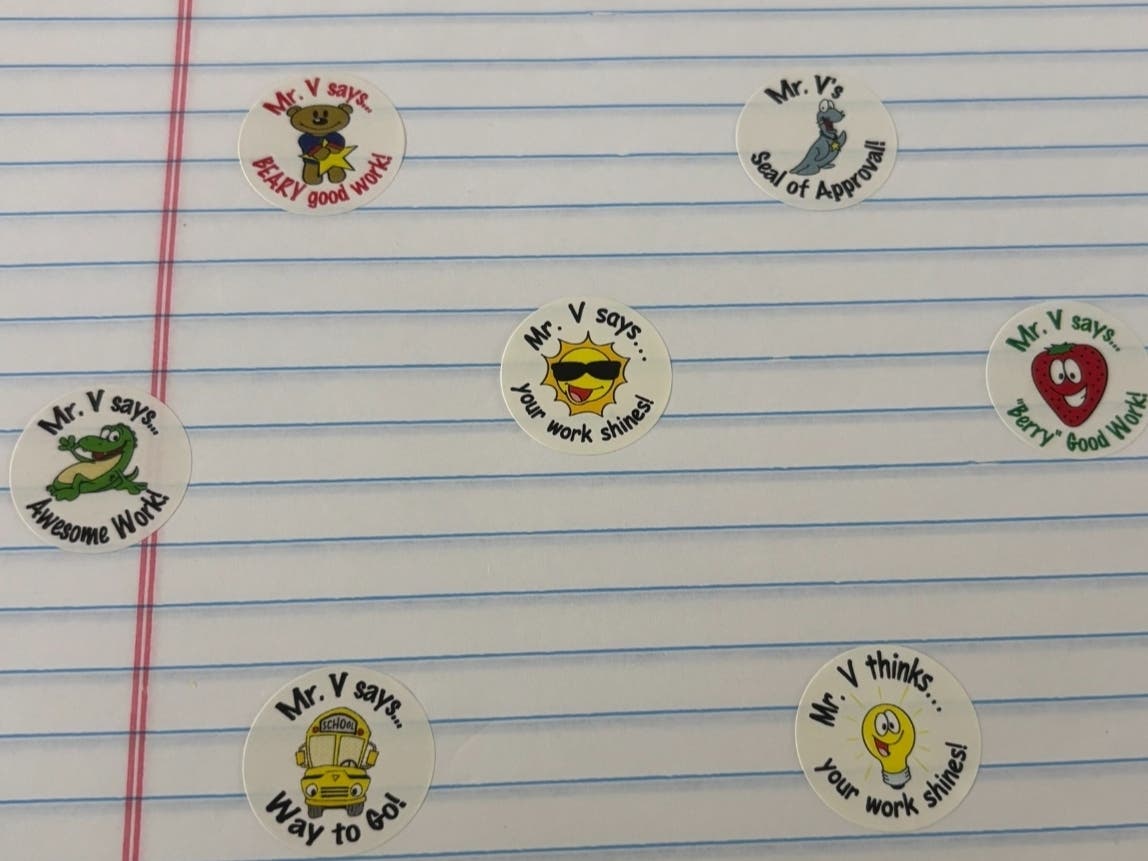
David Venetucci, a retired teacher from Elmhurst School District 205, is writing a memoir. Here is the part about the use of stickers as rewards and a student's gloom about not getting one:
Everyone is motivated differently. Some folks are intrinsically motivated via self-determination. Others are extrinsically motivated and rely on external factors, such as rewards and praise, to accomplish things.
In practice, however, most individuals utilize a combination of motivators depending on the situation — sometimes summoning internal motivation to complete a task, while leaning into external rewards at other times.
Find out what's happening in Elmhurstfor free with the latest updates from Patch.
Skilled educators are motivation masters. When talking with students about motivation, I'd often use personal examples to make the point that learning to motivate oneself is a life skill, especially for essential tasks one finds distasteful. The typically unplanned, impromptu classroom motivation mini-lesson usually went something like this…
[STUDENTS BEGIN MOANING AND COMPLAINING ABOUT COMPLETING AN ASSIGNED ACADEMIC TASK]
Find out what's happening in Elmhurstfor free with the latest updates from Patch.
ME: "OK, what's with all the grumbling and belly-aching?"
VOCAL STUDENT SPOKESPERSON: "C'mon, Mr. V. We're so sick of these assignments."
ME: "I hear you. But guess what? There's a good reason for these assignments."
VOCAL STUDENT SPOKESPERSON: "Yah, it's because you like to torture us kids."
[STUDENTS CHUCKLE, NOD THEIR HEADS IN AGREEMENT]
ME: "That was a good one, but hear me out. Would you guys agree that I seem to like my job as a teacher?"
[MOST STUDENTS NOD OR MUMBLE IN AGREEMENT; OTHERS CONTINUE STARING AHEAD WITH BLANK EXPRESSIONS]
ME: "Right. I enjoy teaching. There are parts of my job I enjoy so much that I might do them for free. That's called intrinsic motivation. It’s the willingness to perform a task without any sort of reward. Folks who work without getting paid — volunteers, for example — donate their time and effort because they genuinely love the job or want to help others. But — even though I really like my job as a teacher — do you think I'd show up for work every day if District 205 didn't pay me every two weeks?"
STUDENT SPOKESPERSON: "No chance, Mr. V."
[MOST STUDENTS LAUGH, NOD IN AGREEMENT]
ME: "Correct. No way would I put up with wacky teens without a paycheck. That’s called extrinsic motivation—motivation based on some sort of reward or compensation. The best example is getting paid for a job. You and I know that most students go to school and complete academic assignments mainly because of grades, not for an intrinsic love of learning. Grades are an extrinsic motivator."
[MOST STUDENTS LISTEN ATTENTIVELY]
ME: "Do you think I like grading your assignments every night at the kitchen table when I could be spending time with my family?"
STUDENT SPOKESPERSON: "So why don't you just stop giving us assignments? C'mon, Mr. V, make your life easier."
ME: "Good point. I could stop assigning academic work…but, if I did, I'd likely lose my job. I'll be honest. I hate grading papers. I'd be delighted to never grade another student assignment. The problem is that grading papers is an important part of my job. If I didn't take grading seriously, I'd probably lose the ability to do all the things I intrinsically love about teaching. A lot of days, I use self-discipline and force myself to grade your papers. I don't like it, but I do it because I not only want to keep my job, but I want to do my job well.”
[STUDENTS LISTEN, MOSTLY ATTENTIVE]
ME: "Most of you are 100 percent extrinsically motivated right now — it's all about grades. I get that. I was like that when I was your age, too. My point is that doing academic work is part of your job as a student right now, whether you like it or not. You'll probably never find a job after high school or college that you'll love 100 percent. If you're fortunate, like me, you'll land a job you mostly like. But, to be successful at that job, you'll have to perform as well on the parts of the job you dislike as well as with the stuff you like to do. That means learning to be self-motivated. It can come naturally or from external factors such as getting a paycheck — it really doesn't matter. I'm talking about a life skill here, folks. Those of you who don't believe me will figure this out later. I guarantee it. So, let's get back to that new assignment we were talking about a few minutes ago."
[STUDENTS BOO, HISS, GRUMBLE IN UNISON]
— — — — —
New teachers discover immediately that most students aren't nearly as excited about their subject matter as they are. The next disappointing revelation is that some students aren't even motivated by grades. As such, successful educators learn to take full advantage of extrinsic motivators to engage students. That's where stickers come in. Why? Everyone likes stickers.
I learned early in my career that even high school students enjoy receiving stickers. My first foray into stickers was when I started placing simple smiley-face stickers on assignments as a reward. Students loved it. I soon upped my game by ordering custom stickers with expressions such as "MR V SAYS…WELL DONE!" or "MR V SAYS…GOOD EFFORT." Students noticed when I started using customized stickers. I'd sometimes spy the interior pockets on student folders — usually girls, but not always — littered with a collection of stickers from my classes. It was fun for students and for me.
Despite the success of using stickers as an academic reward, I learned to be judicious with how I handed them out. If I affixed a sticker on every assignment, the sticker's power as an extrinsic motivator would diminish. So, I did my best to use what social scientists call "intermittent reinforcement" and placed stickers on students' papers only occasionally, even when the students' work was of superior quality. This approach was effective by creating excitement and appreciation each time a student received this academic reward.
All of this talk about stickers brings me to a story — the school day decades ago when I thought I might lose life or limb because of a forgotten sticker. I still recall the events vividly. Here’s how it went down.
— — — — —
I don't recall the precise year, but I know this incident occurred in one of my York SPEECH classes after the school's renovation from 2000 to 2004. The last lesson plan agenda item for that class period was to distribute grade summaries for a group project. My practice was to assign project grades based on individual contributions to the group's final product, typically a class presentation. Individual grades could vary within the group based on peer and self evaluations, along with my assessment of each student’s unique contributions.
I learned early on to always distribute graded assignments at the end of a class period. Not doing so usually led to classroom chaos, with students questioning grades and occasional belligerent adolescent outbursts. On this particular day, I dutifully returned grade summaries near the class period's conclusion with the commensurate adolescent rejoicing and/or grousing. I could count on the grade-fueled ruckus to spill into the hallway once the class ended, oftentimes mercifully.
On this day, however, one student remained after the others had vacated the classroom. Wearing a hoodie pulled up over his head, a male teen sat quietly at his desk, staring down at the grade summary sheet I had handed him a few minutes earlier. He was awkwardly hulking, mostly keeping to himself during class. The young man was probably a sophomore, as were most students in York's then graduation-required SPEECH course.
Seeing this student — whose name I've long forgotten — sitting at his desk sullenly after his peers had left the classroom activated what students might refer to as "spidey senses." The brain's limbic system, the reptilian section responsible for self-preservation, kicked in immediately as I experienced an escalating feeling of impending doom. This kid was pretty big and seemed upset. Something wasn't right, but I had no idea what it was, at least not yet. My brain racing, I took a deep breath before approaching the student's desk.
ME: "Hey, (insert student’s name). What's goin' on?"
STUDENT (not looking up): "I didn't get a sticker."
Oh my goodness. This kid didn't seem angry with me or about his project grades. He didn't want to kill me. He was disappointed because I failed to affix a sticker on his project grade sheet.
I made a point of putting a sticker on every student's grade summary. But in my haste to finish grading, I apparently forgot a sticker for this student. This quiet but sensitive teen had likely noticed stickers on other students' grade sheets. He had perhaps gone down an adolescent rabbit hole and assumed that I had skipped him on purpose.
Relieved to discover that I would see my family again and, at the same time, marveling at the power of extrinsic rewards, I composed myself before responding.
ME: "(insert student's name), I am so sorry. You absolutely should have received a sticker on your project grade summary. I apologize. Here’s how I'm going to make it up to you."
I noticed the student lift his head and watch me closely as I scurried to the front of the classroom, grabbed a folder from my desk, and headed back to the teen. I sat next to him at an adjacent desk and opened up the folder containing my extensive stash of personalized stickers.
ME: "Take any sticker you want. My apologies again."
The student's face brightened noticeably as he scanned the top page of stickers. Like a kid in a candy store, the young man flipped through the various pages of stickers with a sense of purpose until he found the one he liked best. Without a word, he pulled that sticker off the sheet and put it on his grade summary sheet. He looked at me, smiled slightly, and said, "Thanks, Mr. V," before getting up from the desk and quickly exiting the classroom. It was a teaching moment I'll never forget.
— — — — —
I recently discovered an old folder containing a collection of my customized stickers. A representative sampling accompanies this memoir chapter. The company I purchased these personalized stickers from back in 2008 is called Three Dog Graphx, and, interestingly, it's still in business, according to a Google search. If you’re ever in need of extrinsic motivation ammo, check out this company's offerings at threedoggraphx.com.
Yes, everyone loves stickers, but a word of caution. Be careful not to leave anyone out when you affix stickers to whomever or whatever as an extrinsic reward. Forget a sticker, and your limbic system may never let you live it down.
Get more local news delivered straight to your inbox. Sign up for free Patch newsletters and alerts.