Neighbor News
Revolutionary War Patriot John Cook Honored at Joliet’s Oakwood Cemetery
SAR, DAR, local leaders, and Joliet Central JROTC join America 250 ceremony, preserving the Patriot's story for future generations
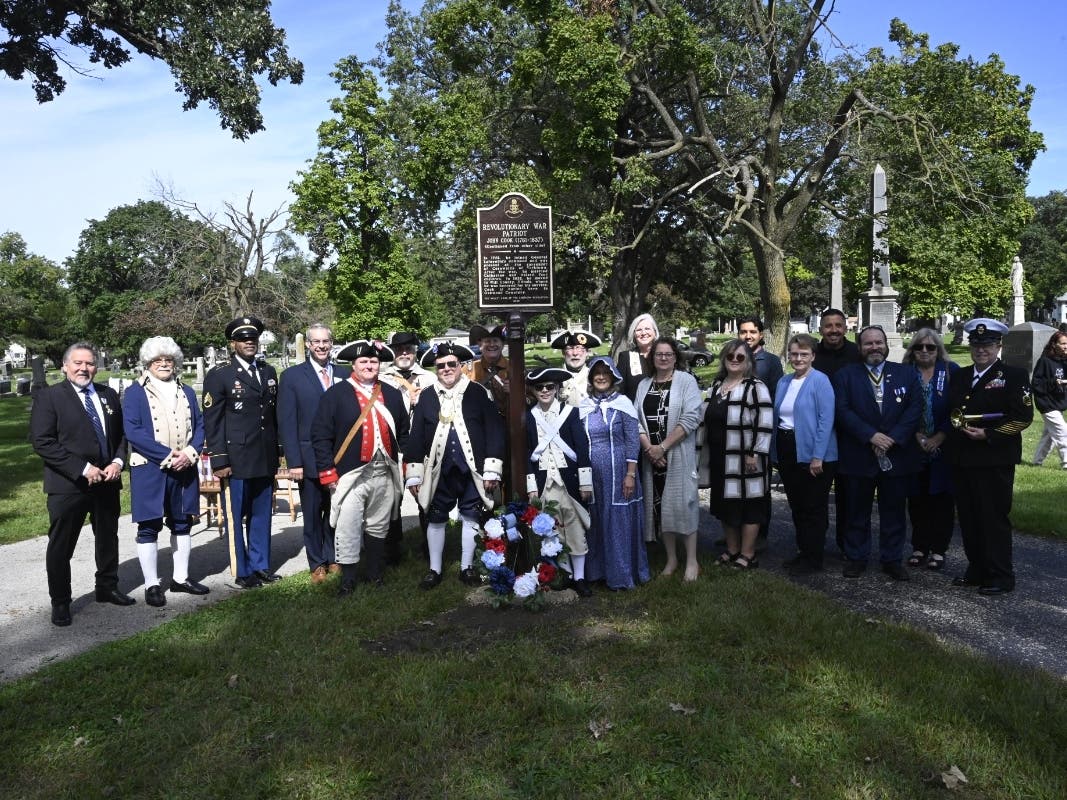
JOLIET, Ill. — Nearly 250 years after Revolutionary War Patriot John Cook served the cause of American independence, the Joliet community gathered at his final resting place to ensure future generations remember his service.
The Fox Valley Chapter of the Sons of the American Revolution and the Louis Joliet Chapter of the Daughters of the American Revolution held a Patriot Grave Marking and Dedication Ceremony Sept. 26 at Oakwood Cemetery in Joliet.
The America 250 commemoration brought together SAR and DAR members, state and local leaders, veterans, students, historical organizations and community members for the unveiling and dedication of a new interpretive monument honoring Cook.
Find out what's happening in Jolietfor free with the latest updates from Patch.
“This monument gives John Cook a voice again,” said Matt Clark, State Secretary of the Illinois Society Sons of the American Revolution and project chairman. “People will come through Oakwood Cemetery years from now, see his name and learn that someone buried right here in Joliet helped secure American independence. We are preserving his story for our children, grandchildren, and generations we will never meet.”
Cook was born Dec. 25, 1761, in Hanover, Morris County, New Jersey. Following the Revolution, he married Catherine and raised a family before eventually moving west to Will County, Illinois. His final resting place is at Oakwood Cemetery.
Find out what's happening in Jolietfor free with the latest updates from Patch.
The project was a collaboration between the SAR and DAR, with support from Oakwood Cemetery, Joliet Township, the City of Joliet and community partners.
“We are so grateful that John Cook’s story will now be permanently preserved here at Oakwood Cemetery,” said Pat Decker, Regent of the Louis Joliet Chapter NSDAR. “This has been a wonderful collaboration between the DAR, SAR and our local community. We hope people will stop at this monument, learn who John Cook was and understand that the history of the American Revolution is connected directly to the community where we live today.”
The ceremony included remarks from Jeff Case, President of the Illinois Society Sons of the American Revolution, and Marty Callahan, President of the Fox Valley Chapter SAR.
Bobbie Today, Corresponding Secretary, represented the Illinois State Organization NSDAR on behalf of Illinois State Regent Marria Blinn.
Local leaders Joliet City Councilman Cesar Cardenas, District 4, and Joliet Township Supervisor Cesar Guerrero also participated and offered remarks recognizing Cook and the importance of preserving local history.
Organizers said the cooperation of local officials and cemetery leadership was instrumental in bringing the project to completion.
“When we talk about the Revolution, we often talk about Washington, Jefferson, and the other famous names of the founding generation,” Callahan said. “But independence was won because thousands of individual Patriots like John Cook were willing to serve and sacrifice. Marking his grave is our way of saying his service mattered, his story matters, and we have a responsibility to make sure he is not forgotten.”
Cook’s story came to life during “A Conversation with John Cook,” with Callahan portraying the Revolutionary War Patriot, Decker portraying Catherine Cook, and Polly Herpy of the Louis Joliet Chapter NSDAR serving as the historical interviewer.
A special part of the ceremony was the participation of Joliet Central High School JROTC cadets, who joined the Color Guard in honoring Cook. Their involvement connected the Revolutionary generation with the young Americans who will carry its history forward.
Virginia Ireland performed “The Star-Spangled Banner” on trumpet, and Mary Arvidson, District IV Director of the Illinois State Organization NSDAR and a retired U.S. Navy Master Chief Petty Officer, sounded Taps in Cook’s honor.
For organizers, the ceremony's lasting importance is the monument that remains behind.
“This is what America 250 can be about—rediscovering the individual people behind our history,” Clark said. “Long after everyone who attended this ceremony is gone, this monument can still tell John Cook’s story. A child may stop and read it. A descendant may discover it. A student may research him. His name and service will continue to be remembered.”
The ceremony concluded with a simple message for those gathered at Cook’s grave:
Remember his name. Remember his service.