Neighbor News
The Billionaire Blueprint: How America's Wealthiest Families Still Control Our Elections
Buying elections
The Price Tag of Democracy
If you listen into any civics classroom in America, and you’ll hear teachers explain how one person equals one vote. It’s a beautiful principle. But step into the real world of campaign finance, and you’ll discover a different equation: one billion dollars equals substantially more influence than a million votes.
Side note, at the presidential level, the Electoral College dispels the one vote equals one vote principle, but I digress.
The 2024 election cycle has clearly illustrated what many Americans suspected, but few wanted to accept: a handful of ultra-wealthy families are effectively purchasing electoral outcomes at every level of government. And, they’re doing it legally, at rates of expenditure never seen before.
Find out what's happening in La Grangefor free with the latest updates from Patch.
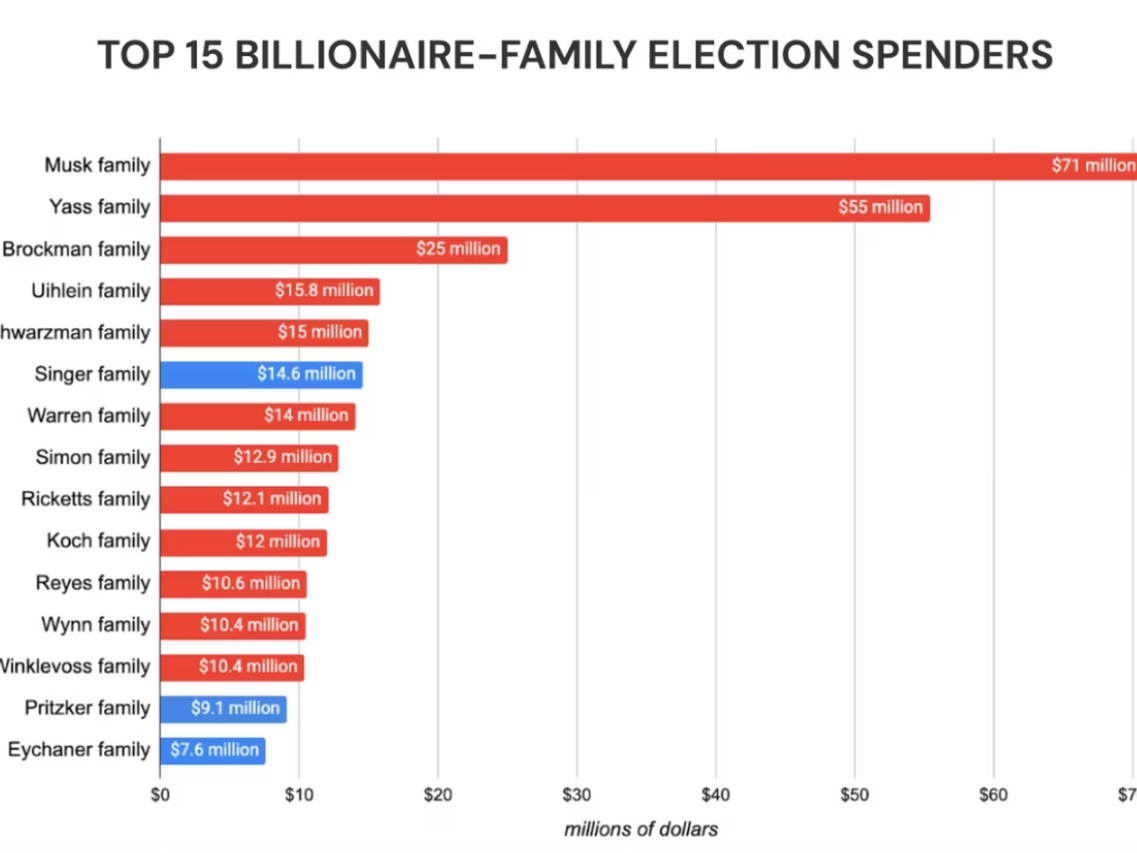
Top Billionaire Families Have Already Pumped Over $430 Million Into Midterms
“Billionaires are on track to break their $1 billion midterm spending record,” said Americans for Tax Fairness.
According to CommonDreams.org reporting:
Find out what's happening in La Grangefor free with the latest updates from Patch.
“ATF (Americans For Tax Fairness) found that nearly 80% of top billionaire families’ 2026 midterm spending—$344.3 million of the $433 million total—has gone to Republicans and GOP organizations, with the pro-Trump MAGA Inc. super PAC receiving $89 million, far more than any other group.”
“Four of the top five recipients of midterm cash from the nation’s richest billionaire are pro-Republican PACs.”
“Republicans and conservatives receive the lion’s share of billionaire financial support because it is the nation’s right-wing that works to ensure the wealthiest families get to keep and expand their fortunes, such as through the GOP tax-and-spending lawenacted last year,” ATF noted.”
However, a good deal is spent on Democratic primaries and in the general election as well. We will be tackling that again later in primary season!
The New Aristocracy
According to OpenSecrets, the top 100 donors in the 2022 midterm elections contributed over $1.2 billion—more than double what the same number of donors gave in 2018. To put this in perspective, that’s roughly equivalent to the combined contributions of approximately 12 million average Americans donating $100 each.
The Koch network (a long-held Republican bastion of billionaires) has spent over $500 million in recent election cycles promoting candidates who oppose climate legislation—a position that conveniently protects their fossil fuel investments. The Adelson family poured $218 million into the 2020 elections alone, according to the Center for Responsive Politics. George Soros contributed $179 million to Democratic causes that same cycle. Meanwhile, Jeff Yass, a lesser-known trading mogul, has emerged as a conservative mega-donor, spending $46 million in the 2022 cycle primarily through super PACs.
These aren’t just political enthusiasts exercising their rights. They’re investors expecting returns.
How the System Actually Works… The machinery of billionaire influence operates on multiple levels simultaneously, making it nearly impossible for ordinary citizens to compete in the marketplace of ideas.Super PACs serve as the primary vehicle. Following the Supreme Court’s 2010 Citizens Uniteddecision, these organizations can accept unlimited contributions from individuals and corporations. The nominal restriction—that they cannot coordinate directly with campaigns—has become a running joke among political operatives. As former Federal Election Commission chair Ann Ravel told ProPublica, “The likelihood of the laws being enforced is slim to none.”
In other words, campaigns play the “tell a friend to tell another that X will help them and ABC should know that information” game to coordinate with dark money.
Dark money groups add another layer. These 501(c)(4) organizations don’t have to disclose their donors at all. The Brennan Center for Justice reports that dark money spending has grown from $5.2 million in 2006 to over $1 billion in 2020. You might see an ad claiming “Americans for Prosperity” or “Patriot Majority USA” or “Susie Sunshine Loves Bubbles PAC” opposes your local congressional candidate, but you’ll never know which billionaire funded the attack.
State and local races offer the highest ROI. While presidential races grab headlines, savvy billionaires know that state legislators and attorneys general often provide better value. Illinois Governor J.B. Pritzker, himself a billionaire, spent $171 million of his own fortune on his 2018 campaign—a state record. Texas pipeline magnate Kelcy Warren contributed $1 million to Attorney General Ken Paxton’s legal defense fund, according to the Texas Tribune, while Paxton’s office was simultaneously reviewing permits for Warren’s energy projects.
Similarly, Governor Pritzker spent $10 million, according to local reporting on the US senate race in Illinois to elect Lt. Governor Julianna Stratton to be the Democratic nominee for senator.
The Corruption Isn’t Hidden—It’s Normalized
Perhaps most troubling is how this system has become so normalized that it barely registers as scandalous anymore.
Consider the pharmaceutical industry. Between 2020 and 2022, pharmaceutical executives and companies contributed over $100 million to federal candidates, according to Kaiser Health News. During that same period, Congress repeatedly failed to pass meaningful prescription drug pricing reforms that polling showed 80% of Americans supported across party lines.
Or examine the financial sector. After the 2008 financial crisis that devastated millions of American families, banks and investment firms spent $2.5 billion on lobbying and campaign contributions over the following decade, according to Americans for Financial Reform. The result? Most of the Dodd-Frank reforms have been systematically weakened or eliminated.
The Sackler family, whose company Purdue Pharma fueled the opioid epidemic, contributed millions to politicians who opposed stricter prescription drug monitoring while their company aggressively marketed OxyContin. The bodies piled up—over 500,000 opioid deaths between 1999 and 2019—while their political investments helped delay meaningful intervention.
The Democracy Deficit
This isn’t about partisan politics. Billionaires corrupt elections on both sides of the aisle, buying influence regardless of party affiliation.
A 2014 Princeton University study by Martin Gilens and Benjamin Page analyzed 1,779 policy outcomes over 20 years. Their conclusion? “Economic elites and organized groups representing business interests have substantial independent impacts on U.S. government policy, while average citizens and mass-based interest groups have little or no independent influence.”
Translation: What ordinary Americans want doesn’t statistically matter.
The Path Forward
Some Americans still believe the answer is finding “better billionaires” to back their preferred causes. But the problem isn’t which billionaires hold the purse strings—it’s that democracy has purse strings at all.
We should not have the ability to buy elections. We need to get rid of the mechanisms
Until we confront the reality that billionaire families are essentially conducting a hostile takeover of our electoral system, we’ll continue having the best democracy money can buy. And increasingly, ordinary Americans can’t afford the cover charge.
Keep speaking up folks.