Neighbor News
A Norma Rae, Rocky and Rita O'Grady Moment?Labor Is About To Make A Big Move.
Here's why
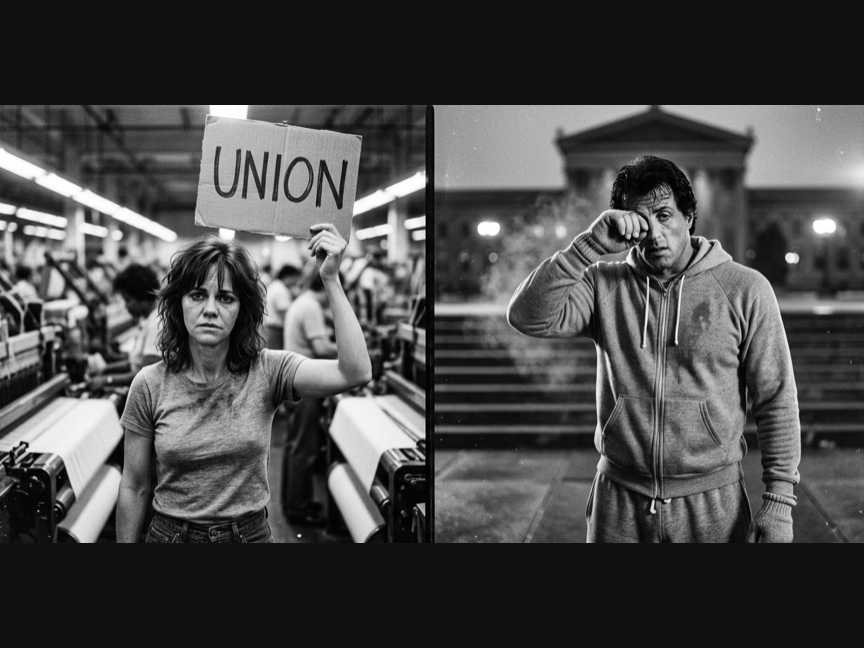
There is a great little movie called Made in Dagenham, circa 2010-ish that is giving me “the underdogs are alive and crushing it” vibe right now. In fact, it brought back great memories of two other movies I love: Norma Rae and Rocky.
Made in Dagenham is based on the true story of female factory workers at the Ford plant in Dagenham, England in 1968. The women, who sewed car seat covers, discovered they were being paid far less than male workers despite doing skilled work. An ordinary working-class woman named Rita O’Grady unexpectedly becomes the leader and spokesperson for the group.
The women decide to go on strike, which begins gaining national attention and seriously disrupts Ford’s production. Rita faces resistance from Ford management, unsupportive male union officials, and even pressure from her own family. She eventually travels to London and secures a meeting with Barbara Castle, the Secretary of State for Employment, to plead their case.
Find out what's happening in La Grangefor free with the latest updates from Patch.
Ultimately the women win a pay increase and their courageous strike directly contributed to the passing of the Equal Pay Act of 1970 in the United Kingdom.
Not unlike the Norma Rae movie of 1979, leaders come in all shapes, sizes and backgrounds.
Find out what's happening in La Grangefor free with the latest updates from Patch.
It also reminded me that over the last 18 months, the labor movement has taken some astronomical blows and we need more leaders like Rita and Norma Rae to rise up.
Sometimes, even when a movement is down and beaten, they rise up stronger.
Remember that scene in Rocky when everyone had written off the battered fighter, when the crowd had turned away, when the establishment had already crowned Apollo Creed the inevitable champion? And then — slowly, painfully, gloriously — Rocky Balboa climbed back off the canvas and made the whole arena reconsider everything they thought they knew about power?
That’s where the American labor movement finds itself right now. And this time, the bell hasn’t even rung for the final round.
So much so, I feel we may be going into quite a union-led renaissance in the next few years. Further, there may be a Labor Party someday in America.
Stranger things have happened!
Let’s Look Across the Pond First
Let’s take a quick trip across the Atlantic, because the British in the last decade have given us a masterclass in political resurrection that Americans would be foolish to ignore.
For years, pundits buried the UK Labour Party. After Brexit, after Jeremy Corbyn’s divisive leadership, after three consecutive crushing electoral defeats, the British commentariat declared the party politically deceased. The obituaries were written. The flowers were sent.
Then came Keir Starmer and the architects in the Labour Party who brought it back to life.
In July 2024, Labour didn’t just win a general election — it obliterated the Conservative Party, securing one of the largest parliamentary majorities in modern British history. The party flipped seats in places that hadn’t voted Labour in generations. Why? Because working people voters - squeezed by inflation, hollowed out by wage stagnation, and exhausted by a political establishment that seemed allergic to their struggles - decided they were done waiting for someone to represent them.
To be clear, Keir Starmer has resigned as the party leader and true, the Labour Party may lose some power. However, the Labour Party did indeed come back from a very low point and will continue to be a part of the UK power circle in the next administration, regardless of their leadership position. Ultimate and full power is not always the only way to solve problems.
The Labour Party will continue to have influence. Sustainability is the greatest challenge.
Creating power for Labor has happened elsewhere, whether a party is built around the labor movement or we force working people’s needs be addressed by another party.
The time is coming.
The American Pressure Cooker Is Ready to Blow
Here’s what the numbers tell us that the Sunday morning talk shows won’t say plainly: the conditions for a labor-aligned political movement in America have never been more ripe.
- Union membership, while still historically low, has seen its approval ratings hit a 60-year high, with Gallup reporting 67% of Americans now support unions.
- The Trump administration has decimated the NLRB, crushed federal funding, killed labor programs and has been abusive to unions in every way. Unions have a very long memory and they will not forget how they have been treated.
- The UAW strikes of 2023 captured the national imagination in a way labor actions haven’t in decades.
- Nearly 60% of Americans now say they’d consider voting for a candidate outside the two major parties, according to Gallup’s 2024 polling.
- Younger voters — Gen Z and Millennials — are drowning in student debt, locked out of housing markets, and working multiple gig jobs with zero benefits. They are angry, organized, and looking for an alternative.
The two-party system has responded to this pressure with the political equivalent of a shrug. Democrats talk about workers at fundraisers hosted by hedge fund managers. Republicans wave the blue-collar flag while voting against union protections. The cognitive dissonance has become deafening.
Hypocrisy of both parties has exhausted American voters.
The Man From Nebraska Who’s Changing the Conversation
Which brings us to Dan Osborn.If you haven’t heard his name yet, write it down. A former union mechanic and strike leader, Osborn ran as an independent candidate for U.S. Senate in Nebraska in 2024 — one of the reddest states in the country — and came startlingly close to defeating incumbent Republican Deb Fischer. He raised millions of dollars largely from small donors, drew massive crowds, and built a coalition that crossed party lines by speaking one simple language: the language of working people.
Osborn didn’t run as a Democrat. He didn’t run as a Republican. He ran as someone who had actually stood on a picket line, who had actually lost sleep over a health insurance bill, who had actually felt the boot of corporate indifference on his neck. And Nebraska, yes Nebraska, nearly sent him to Washington.
He is not alone. Across the country, independent and labor-aligned candidates are threading the needle in places the establishment dismissed as impossible. They are proving that the hunger for authentic working people representation transcends geography and party affiliation.
There are lots of others running on working people platforms that are enormously popular. In fact, the following Democrats lead with labor positions and do not always emphasize they are Democrats.
- Former U.S. Senator Sherrod Brown is running to win back his seat based on working families and workers’ needs.
-Chris Raab is favored in Pennsylvania- 03 and a huge pro-labor advocate
-Milat Kiros, a union advocate in Colorado is likely to beat old school Diana Degette in CO-01
-Dr. Abdul El-Syed is likely to beat out two old guard establishment players in Michigan for US Senate.
- And then, there is Mayor Zohran Mamdani, who was elected on the promise of affordability, everyday, practical solutions and supporting unions.
All of these above candidates had one thing in common with Norma Rae, Rita O’Grady and Rocky. They all were written off and rose up. Leaders like these succeed despite the opposition. And that opposition usually comes from all sides.
The Moment Is Now
Political parties are not born in boardrooms. They are born in moments of collective exhaustion, when enough people simultaneously realize that the existing options have stopped working for them. The best example was The New Deal coalition was born from the economic devastation of the Depression.
We are living inside another one of those inflection points — whether we recognize it or not.
The UK’s Labour Party didn’t succeed because it had better consultants or slicker advertising. It succeeded because it returned to its roots and spoke directly to people who felt economically abandoned.
America has tens of millions of those people right now.
The crowd is stirring. And somewhere out there, in a union hall in Nebraska or a warehouse break room in Georgia, the next chapter of American political history is being written — one shift at a time.
Will the labor movement and an exhausted electorate force the Democrats to actually work with them and for them? Or will they start their own party?
Stay tuned.