Lakeview, MI|Local Classified|Other|

When a Leaning Tree in Greenville Becomes a Root Failure, Not a Waiting Game?
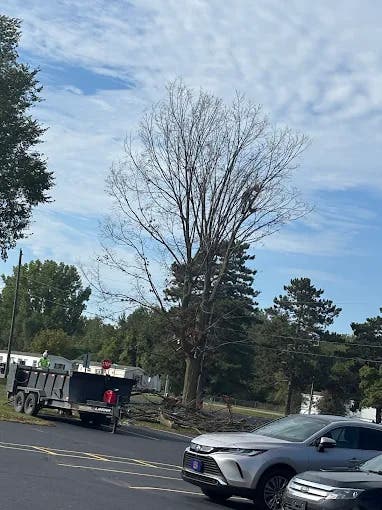
Every wet spring in Montcalm County, the same pattern repeats. A homeowner notices their large red maple or white oak leaning slightly more than it did the previous fall. They watch it through winter and into the thaw, figuring the ground is just soft. By the time they call, the root plate has already begun to heave, and what looked like a manageable lean has become a removal job that now requires careful rigging around a fence line or garage.
That delay is not unusual. It reflects a genuine misread of what wet soil is doing to the root system below.
What Most Homeowners Assume?
The common assumption is that a tree leans because of wind loading during a storm, and that once the wind stops, the tree either snapped or it held. If it held, it seems stable. That logic works for some events, but it misses what happens over the weeks after heavy rain or snowmelt in Zone 5b.
When saturated soil loses its grip on a root plate, the process is gradual and invisible from the yard. The canopy can look full and healthy while the anchoring roots are already working against compromised ground. A visual inspection from the driveway tells you almost nothing about what is happening two feet underground.
How a Field Evaluation Actually Works in Montcalm County?
Root Flare and Soil Movement
The first thing I check on a suspected root plate problem is the flare itself. Soil pushing up on one side of the base, or a gap forming on the opposite side, tells me the tree has already begun to rotate. This is not a future risk at that point; it is an active failure in progress.
Canopy Weight and Lean Direction
I look at where the canopy mass is distributed relative to the lean. A tree with a heavy lateral branch load on the downhill side of a lean carries far more torque on that root system than a symmetrical canopy would. That changes the urgency and the rigging plan completely.
Clearance Zones Near Structures
In tighter residential lots near areas like Reynolds Road or the neighborhoods east of M-91, the drop zone calculation becomes the controlling factor. When a structure or utility line sits inside the natural fall path, standard felling is off the table. That is when crane operations or sectional rigging systems become the only responsible option.
My Background in This Work
I have been doing hazard assessments and removals across Montcalm County for over two decades, and saturated spring soil is one of the most consistently underestimated variables I see. Homeowners looking to understand what this type of evaluation involves can find out more before scheduling a visit.
What the Field Keeps Teaching Me?
A few observations that come up repeatedly on these jobs:
- Raised soil on one side of the trunk base is a root plate warning sign, not normal settling
- Trees near low-lying areas or seasonal drainage paths are higher risk after prolonged rain
- Internal decay pockets can exist in a structurally intact-looking trunk and only reveal themselves once sectional cutting begins
- Hiring based on price alone after storm damage often means the clearance zone around utility lines does not get properly calculated
Homeowners who want to know more about our work in the area can view details here before reaching out.
A Practical Takeaway
The trees that cause the most property damage in Greenville are rarely the ones that looked dangerous. They are the ones that looked fine until the soil beneath them gave way. Checking the base of a tree after a wet season takes five minutes and can change the decision you make about it entirely. That is not a complicated idea, but it is one that gets skipped more often than it should.
Justin Crabb
Owner, Highline Tree Service
11923 N Vining Rd, Lakeview, MI 48850
989-339-7070
https://highlinecraneandtreeservices.com/