Community Corner
An Easter Story About Community Members Doing Good Things When Nobody Is Looking
This is about gratitude. Gratitude for people in our community who quietly help others...



I’ve always believed that the best stories don’t arrive with trumpets.
They show up quietly. In grocery aisles. In the backs of trucks. In the kind of conversations where no one is trying to impress anyone else.
This is one of those stories.
Find out what's happening in Plymouth-Cantonfor free with the latest updates from Patch.
It’s an Easter story, yes—but it could just as easily belong to any day of the year. Because the people in it don’t check the calendar before they decide to care. They just do.
Now, most folks will tell you they care about their community. And they mean it. Life just gets busy. Bills show up. Time slips away. Good intentions get folded into tomorrow.
Find out what's happening in Plymouth-Cantonfor free with the latest updates from Patch.
But every so often, you meet people who don’t just feel it—they live it. Every single day.
This story begins, as many good ones do, with something small.
A $200 grant.
It came from a local Meijer store in Westland. Not a life-changing amount on its own. Not the kind of number that makes headlines. But then again, the most meaningful things rarely do.
Because someone looked at that $200 and didn’t see dollars.
They saw possibility.
The local Vietnam Veterans of America Chapter 528 stepped in next. They didn’t hesitate. They matched it. Just like that. No meeting needed. No long discussion. Just a simple, quiet decision: We’re in.
And then there was Julius Kassab.
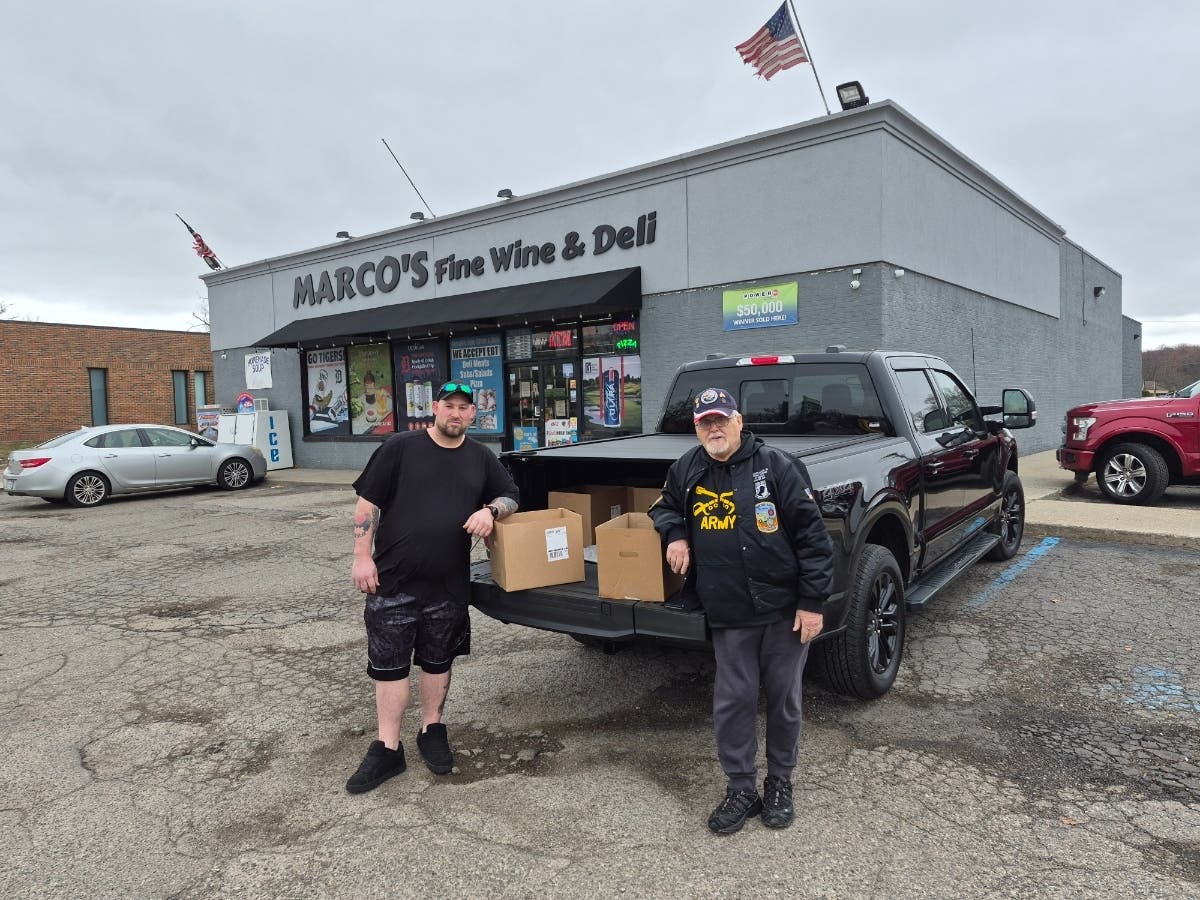
If you’ve ever met a person who seems to carry other people’s burdens as naturally as their own, you’d understand Julius. He owns a small shop—Marco’s Fine Wine Liquor & Deli in Westland—but that’s not really what defines him.
What defines him is what he does when no one is watching.
He said yes, too.
Not loudly. Not for recognition. Just… yes.
Soon enough, the pieces began to come together. The money turned into hams—spiral-sliced ones, the kind that make a house smell like a holiday. VVA member Darryl Bazeman delivered these hams to Marco's. But a ham alone doesn’t make an Easter dinner.
So Julius filled in the rest.
He cleared space in his store cooler. He gathered the sides. The fixings. The small touches that turn food into something more than food. Something that says, someone thought about you.
On the day of delivery, there was no ceremony. No ribbon cutting. Just people showing up.
Boxes lined up.
Hands moving.
A rhythm forming.
Anthony—“AJ” to those who know him—stood there helping pack each box, one after another. Not rushing. Not dragging. Just doing the work the way it’s meant to be done.
And then, just as quietly as they had arrived, the veterans returned.
Bob Dew. Al Sneath.
Names that won’t make the evening news. Men who have already served their country once—and somehow found the strength to keep serving in a different way.
They loaded the truck.
They drove.
From Westland to Livonia. Garden City to Canton. Out to Belleville.
No speeches. Just miles.
And at the end of those miles, 33 families had something waiting at their doors.
Thirty-three.
It’s not a number that stops you in your tracks. Not at first glance. But numbers can be deceiving.
Because if you asked those 33 families what that meal meant to them, you wouldn’t get a number back.
You’d get something closer to relief.
To dignity.
To being remembered.
And just when the work could have been called finished, it wasn’t.
There were still hams left.
So Julius did what people like him tend to do—he kept going. The remaining food was given to the Elmwood Blessing Box, a place that understands something simple but powerful: sometimes a “hand up” is all a person needs to keep moving forward.
No spotlight followed that donation either. Just gratitude, passed quietly between people who understood.
And maybe that’s the thread that ties this whole story together.
No one involved wanted credit.
In fact, most of them would probably prefer you didn’t know their names at all. They’d shrug it off. Change the subject. Tell you it wasn’t a big deal.
But it was.
Because in a world that often measures value by how loudly something is announced, these folks chose to measure it by how deeply it is felt.
I was thinking about all of this on Easter Sunday.
Standing in a checkout line, holding a few forgotten items like we all do, caught somewhere between rushing and reflecting.
The man behind me caught my eye. We smiled. The kind of smile strangers exchange when, for a second, the world feels a little smaller.
“Hello, how ya doing?” I asked.
He looked at me—not past me, not through me—and gave a wide, honest grin.
“I’m grateful,” he said.
Just that.
No explanation. No story attached.
I nodded.
“Me too, brother. Me too.”
And I didn’t tell him why.
But if you’ve made it this far, you already know...