Business & Tech
From Kitchen Table To Store Shelves: Can New England Still Create The Next Big Brand?
The good news for New England startups is that their customer base is one of the wealthiest in the nation.

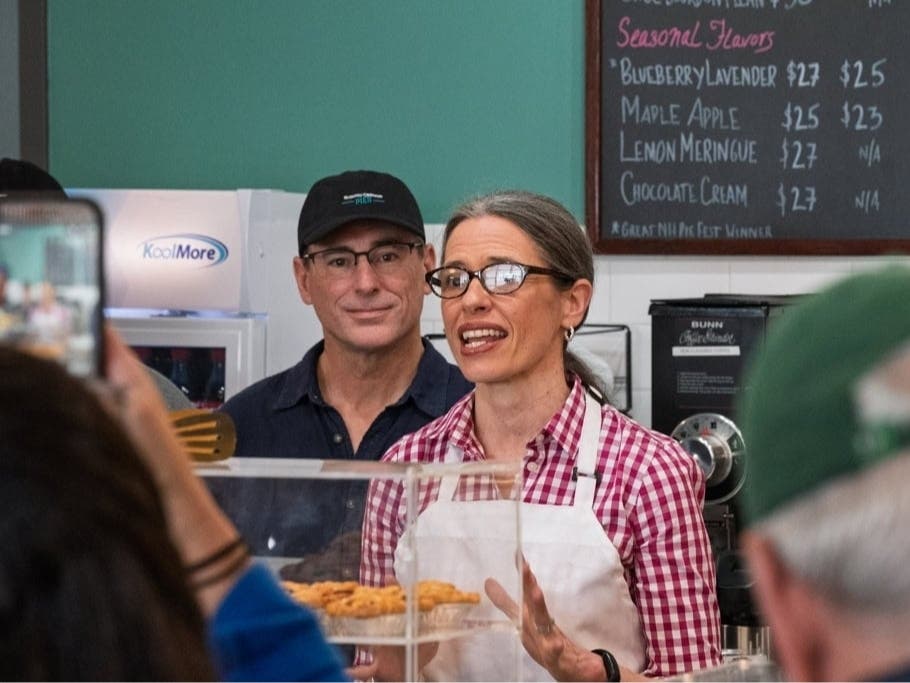
Lauren Cline started with just a dough roller and a dream.
Cline was a full-time PR professional who loved making pies and sharing them with friends. When friends started asking for pies and passing her name to their neighbors, she started thinking about starting a business.
Find out what's happening in Bedfordfor free with the latest updates from Patch.
In classic American entrepreneurial fashion, she soon had a hot and flaky side hustle that included selling pies at the nearby farm stand at the Joppa Hill Educational Farm in Bedford, N.H.
In March, Cline took a big step, opening Slightly Crooked Pies in Manchester, where Queen City residents can stop by for pies, cookies, and a cup of coffee.
Find out what's happening in Bedfordfor free with the latest updates from Patch.
But the big prize remains: seeing her pies on grocery store shelves. That leap is both the biggest mark of success and the greatest challenge for small businesses like Cline’s.
“That’s the goal,” Cline said. “The wholesale side is the bread and butter of businesses like mine.”
Cline is at the beginning of a journey that many New England business owners have taken. Some have made it. Many have not. On average in the U.S., about half of all business start-ups fail within five years.
The question for policymakers in Boston, Concord, and Augusta is what government can do to make that journey easier and to get more entrepreneurs from the kitchen table and the garage to store shelves and grocery aisles.
The good news for New England startups is that their customer base is one of the wealthiest in the nation. The bad news is that, according to the Kauffman Foundation’s 2025 entrepreneurship report, all six states are below the national rate of new entrepreneurship. Across the U.S., 0.29% of adults start a business each month. Every New England state is below that rate, including New Hampshire (0.28%, the highest rate in the region), while Maine is dead last (0.15%).
One New England company that bucked the trend is RYZE, a mushroom coffee company that started in a Harvard dorm room and made its way to Target shelves nationwide.
RYZE co-founders Rashad Hossain and Andrée Werner met as undergrads at Harvard University, where they say a shared dependence on coffee eventually inspired them to find an alternative.
“RYZE was born from a very personal problem,” Werner told NHJournal. “Rashad and I were exhausted, running on too much coffee, and we knew it wasn’t sustainable. That search for something better led us to functional mushrooms, and when we started experimenting with Cordyceps in our coffee, we genuinely felt a difference. We wanted to share that discovery with the world because we believed then, as we do now, that people deserve to feel better every single day.”
The two invested their own savings, supplemented by support from family and friends, then built the business largely online. Rather than compete immediately for grocery-store shelf space, RYZE focused on direct-to-consumer sales, digital advertising, and social media marketing, helping the brand gain national recognition while remaining headquartered in Boston.
That strategy paid off.
Forbes estimated earlier this year that RYZE generated more than $300 million in annual revenue in 2025 and has become the nation’s top-selling mushroom coffee brand. After years of selling almost exclusively online, the company has begun expanding into traditional retail, including a launch in Target stores.
While Hossain and Werner offered a new twist on a traditional American beverage, Dave Currier of Henniker, N.H., stuck with the classics: beer. And keep it coming.
Currier had already founded and sold an emergency medical supply company before he got into the beer business. In 2011, he had a large building that would be sitting empty. So he decided he wanted to get back in the business of making things.
“I love the manufacturing thing,” he told NHJournal. “When I saw the machines that filled the bottles … that really intrigued the hell out of me.”
The result: Henniker Brewing. Currier was an experienced entrepreneur, but not a brewer. He joked that a winemaking kit his wife gave him years earlier was still sitting unopened in the box.
 What interested him was the process: taking raw materials, creating a product, and building a system to deliver it to customers.
“The distribution,” he said. “Turning stuff out, boom boom, putting it into cases.”
His timing was impeccable.
When Currier began exploring the beer business, New Hampshire’s craft brewing industry was still in its early stages.
The state had about 19 breweries in 2012. In 2025, New Hampshire had 103 craft breweries, ranking seventh nationally in breweries per capita, according to the New Hampshire Brewers Association. The industry produced more than 88,000 barrels of craft beer annually and generated an estimated $468 million in economic impact.
New England states have benefited from the work of these entrepreneurs, but have state and local governments been partners or obstacles?
“The biggest friction point for brands like ours is the regulatory environment around functional ingredients,” said Werner. “There is a meaningful gap between what the science supports and what brands are permitted to say. States that invest in creating more supportive environments for functional food and beverage innovation can become real hubs for this category.”
Currier’s perspective on government and entrepreneurship is unusual because he has occupied both sides of the equation. In addition to starting businesses, he also served in the New Hampshire legislature.
Asked what government could do to encourage more entrepreneurs to move from kitchen tables and garages into larger businesses, Currier pointed to New Hampshire’s treatment of the brewing industry.
Initially, he said, the state created smaller licensing categories, including a nano-brewery license, to make it easier for new businesses to enter the market. But over time, he said, additional changes created complications.
“Somebody said, ‘Let’s fix it this way, let’s add this to it, and let’s add that to it,’” Currier said. “So it became a Band-Aid approach.”
The problem was not government involvement itself, he argued. It was a lack of a comprehensive system.
Eventually, the brewing industry and state officials worked together to create a more structured licensing system, with fees and requirements tied more closely to production levels.
For Cline, with her pie business just getting started, she’s had relatively few interactions with government, most of them at the local level and very positive.
“I’ve been involved in Manchester for many years, and I wanted to be a part of it when I was looking at spaces. I had people say to me, ‘Oh, good luck, they’re really tough to work with.’ But nothing could be further from the truth,” Cline said.
“They have open office hours every week with the folks from Planning and Zoning. So, if you have a project, you bring a project over there, you say, ‘Hey, what do I need to know? What am I missing here?’ And at every turn when I thought I would make a mistake that would be very costly or would get me shot down, they had a solution.”
Drew Cline, President of the Josiah Bartlett Center for Public Policy — and Lauren Cline’s husband — agrees.
“Manchester’s economic development office has done great work streamlining the business startup process in the city. Jodie Nazaka and her team deserve credit for reducing a lot of the friction that comes with seeking city approvals and permits.
So what is the secret to entrepreneurial success in New England?
“Build something people genuinely love before you pursue retail,” Werner said. “Be honest with yourself about timing, because going in before you’re ready can set you back further than waiting. And think of retail as a complement to everything else you’re building, not a finish line.
“The brands that win are the ones that stay deeply connected to their customer no matter where that customer is shopping.”
This article is part of a New Hampshire Journal series on the New England economy and challenges facing start up businesses and entrepreneurs.
This story was originally published by the NH Journal, an online news publication dedicated to providing fair, unbiased reporting on, and analysis of, political news of interest to New Hampshire. For more stories from the NH Journal, visit NHJournal.com.