Politics & Government
New Hampshire Teachers Union Faces Election Law Complaint Over Anti-Tax Cap Campaign
The complaint says advertisements omitted donor-disclosure language and the union failed to file political committee registration info.

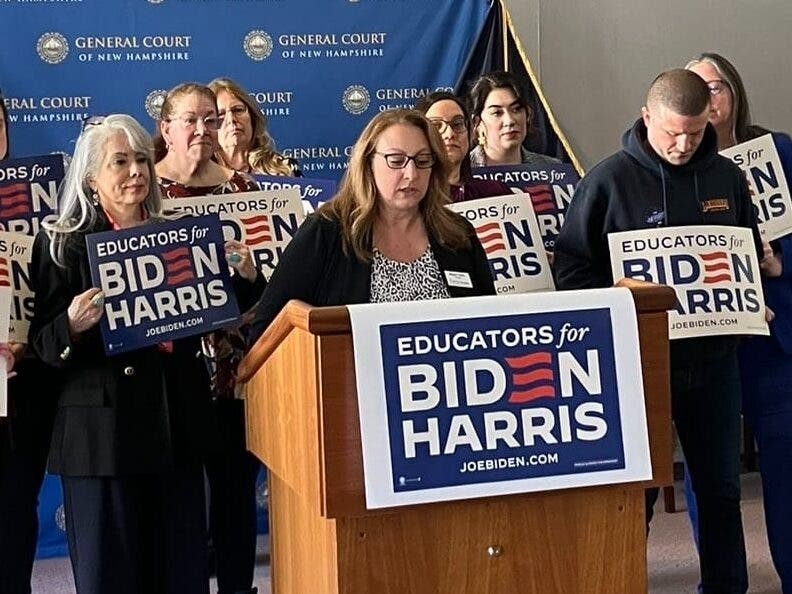
The day Gov. Kelly Ayotte signed the new law allowing voters to cap local property taxes, the head of the state’s largest teachers union pledged to oppose the tax cap.
“NEA-New Hampshire will work to ensure every Granite Stater knows how these ballot measures will harm their local public school before they vote in November,” said union president Megan Tuttle.
Find out what's happening in Concordfor free with the latest updates from Patch.
But Tuttle’s union may have gone too far, violating state election laws in its determined effort to block tax caps.
An election law complaint filed Wednesday alleges NEA-New Hampshire and the NEA-NH Fund for Strong Public Schools failed to comply with disclosure and campaign finance requirements while promoting a “VOTE NO ON QUESTION 2” campaign.
Find out what's happening in Concordfor free with the latest updates from Patch.

“Question 2” is shorthand for the property tax cap question that will be on every voter’s ballot, asking whether they want to limit tax increases to inflation plus qualifying new taxable property growth. Adoption requires a 60% majority.
One of the mailers targeted in the complaint claims that “Question 2 will force school districts across New Hampshire to cut funding for our public schools.” In public statements, the NEA-NH described it as an effort to “arbitrarily cap school budgets.”
These statements are factually incorrect. The property tax cap puts no limits on overall school spending, only on how much school property taxes can be increased.
Communities are free to raise and spend as much money via other sources as they choose. Districts will still receive their state funding, which hit an all-time per-pupil high in the latest budget.
But the NEA-NH’s marketing efforts aren’t in legal jeopardy over false claims. Instead, the complaint says the union failed to meet the state’s disclosure requirements for political marketing.
House Majority Leader Jason Osborne says it goes beyond that.
“The union broke election law to keep taking more and more money from Granite Staters with no accountability,” Osborne said. “They hid who’s paying, they ignored the rules every other group follows, and they did all of it to keep your property taxes going up. If the union is willing to break the law to protect its blank check, imagine what it does with your money once it has it.”
Tuttle and the NEA-NH press representative did not respond to a request for comment.
The complaint raises two principal allegations about the union’s campaign.
First, it contends that a mailer and digital advertisements omitted donor-disclosure language required under state law. The complaint identifies $48,734 in in-kind contributions from NEA-NH to the Fund for Strong Public Schools.
Second, it alleges NEA-NH itself spent money opposing the ballot question without completing required political committee registration and reporting.
According to the complaint, Meta’s advertising records identified NEA-NH as the payer for 20 Facebook and Instagram advertisements opposing Question 2. The filing places spending on those advertisements between $9,500 and $11,480, with approximately 1.58 million to 1.87 million impressions.
Those figures describe the advertising identified in the complaint, rather than a complete accounting of the union’s anti-cap campaign.
The American Federation of Teachers-New Hampshire has also fought the proposal. AFT-NH President Deb Howes argued after its signing that costs rising faster than the cap could result in larger classes, fewer teachers, and reduced student services.
School boards have also joined the opposition.
In Plainfield, the district’s website carries an official statement opposing Question 2, which the school board adopted Oct. 13. The statement argues that rising health insurance costs and fluctuations in tuition could force cuts elsewhere in the budget.
It also repeatedly describes the proposal as a spending cap, warning of “draconian cuts” and arguing that the administrative limit could undermine Plainfield’s arrangement to share central office services with neighboring Cornish.
Osborne says these school districts are fighting against a reasonable proposal to address one of New Hampshire voters’ top priorities: high property taxes.
“Question 2 is a common-sense approach to put a limit on how fast your property taxes can grow. The union will continue to use scare tactics to preserve their blank check.”
This story was originally published by the NH Journal, an online news publication dedicated to providing fair, unbiased reporting on, and analysis of, political news of interest to New Hampshire. For more stories from the NH Journal, visit NHJournal.com.